This week, I finished reading All the Way to the River, Liz Gilbert’s new memoir about love, grief, and addiction.
Back in the spring, when I’d seen that she was coming to the Arsht Center for a “conversation,” I booked three tickets for Ana, Kim, and I to see her speak. Our tickets included a brief meet and greet as well as a signed copy of the book. I made a calendar event for the evening, November 3rd, and then promptly forgot about it until October or so.
I wasn’t planning on reading the memoir ahead of the event, since we were going to receive a copy anyway, but Ana forgot that she’d pre-ordered it and read it, and then I figured I could at least listen to some of the audiobook with my Spotify premium membership. So I started it on my daily dog walks, but got a bit turned off by the music, and distracted by Phoebe, and ultimately decided to just wait until the event. I let some critics get in my head too, so headed into the night a bit skeptical, which, combined with work stress, didn’t make me the most receptive audience member.
The conversation was supposed to begin at 7:30pm, but for the meet and greet, we were required to get there by 5:45pm at the latest, the email said. So we did, and lined up, and I ranted to two of my closest friends as we waited in line to meet Liz.
When it was our turn, I hoped she would sign my copy of Big Magic (my favorite book of hers), but it wasn’t a signing kind of thing.
“Have we met?” she asked me when we hugged.
I told her we hadn’t.
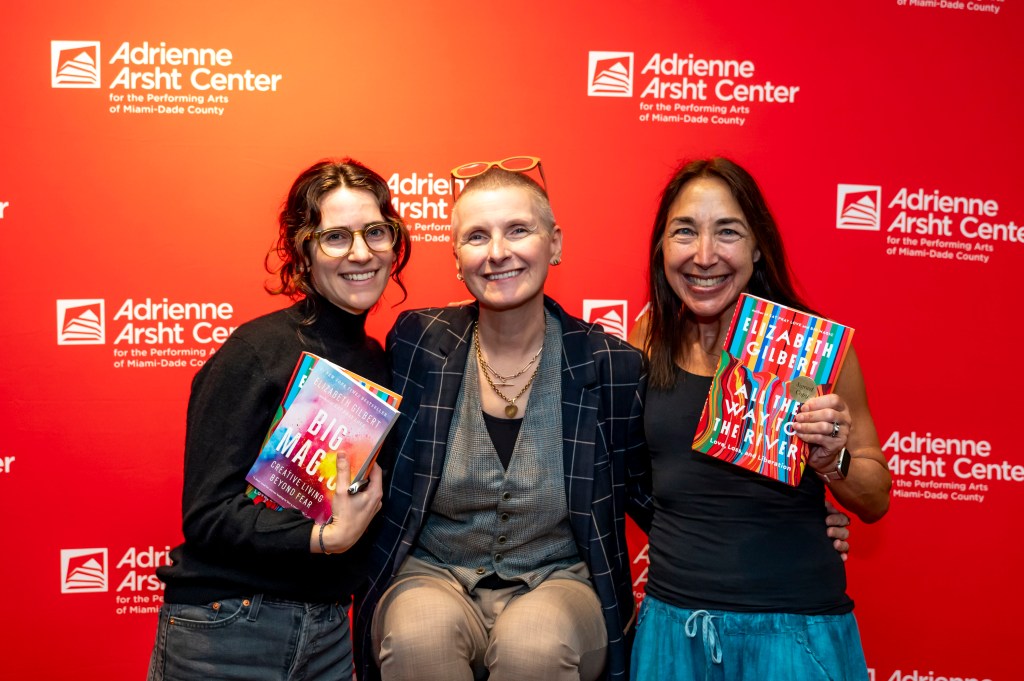
They snapped our photo, and then we went to wait in the lobby for another hour or so before the event began.
And once it began? Whoa.
Liz is a public speaker like few I’ve ever seen. She absolutely knows how to tell a story and engage her audience, all while remaining one hundred percent authentic.
It truly was like a conversation with her. The meet and greet was just a photo op, but this? This was an intimate conversation. There weren’t that many of us.
Liz spoke about creativity and love and the process of writing this memoir. She spoke about getting to a point in your life where your past lives and loves are just a distant memory. She made us laugh, she made us tear up, and she made me nudge Ana for a stack of post-its I knew she’d have and Kim for a pen so I could take some notes.
Some small nuggets of gold I was able to jot down (some from Liz, and some that Liz quoted from others — these are not necessarily exact words, but include some exact words!):
- We have one planet, but 8 billion worlds. Art is: take me into your world.
- In all art, you’re revealing yourself — you’re exposing yourself, but you’re on a nude beach! What a critic is is someone who goes to the nude beach, fully clothed a with a telephoto lens, and scrutinizes you, then decides what it is. They say, I’ll tell you what she looks like naked, without taking off a stitch of their own clothing! “Get off the beach!”
- You only need to know what you think of your art. Criticism and flattery go down the same drain — both are destabilizing. (Credited to Georgia O’Keefe)
- The universe hates secrets.
- Rayya would always say, since the truth is where we’re gonna end up anyway, why don’t we just start there?
- Grief is a bill that you have to pay eventually. You can pay it all at once or in installments, but you have to pay it.
- Be vulnerable enough to do your learning in public.
We left the evening absolutely inspired, and also exhausted from Daylight Savings Time.
As soon as I finished my next book, I launched back into Liz’s new memoir, this time with the hard, signed copy. I started from the beginning. I finished it this past Sunday, a gorgeous day, sitting on my balcony with Phoebe at my feet.
Something that has really been sitting with me is her notion that “Earth is nothing but a school for souls” (48). Liz writes:
In my life, I have certainly found that the Earth School model is a useful thought exercise during times of darkness, pain, and betrayal—for it takes me out of a victim mentality and offers up a worldview that feels far more empowering and fascinating than the limiting, anguishing cry of “Why me?!”
A more fruitful question than “Why me?” could be “How might this terrible situation be perfectly designed to help me to evolve?”
Because what if that’s really what it’s all about?
And what if we are all here to help each other evolve? (49)
I’ve found this incredibly useful lately. So I leave it here with you.
What is a terrible situation that was perfectly designed to help you evolve? And maybe, if you’re going through one now, you can reframe your “why me?” thoughts à la Liz.


 Writing With Abandon
Leave a reply to Joanne Toft Cancel reply