There’s something about teaching Writer’s Workshop that I feel oddly possessive about. It was something I grasped tightly to after meeting Ana, moving to Miami, and starting to work at KLA. It helped me through a tough couple of years in my personal life. It was something that I had control over, and which brought me and my students joy. It got me writing again, got me to see myself as a writer, just like I hope my students will see in themselves.
So, letting go of it as a subject that I teach, that I plan, feels… scary, and uncomfortable, followed by guilt that I feel that way. It’s like a blanket being pulled off the bed that I’m still clutching to a corner of because I am desperate to stay snuggled up in it, even though I know the blanket is big enough for me and another.
But that fear and discomfort gets replaced by awe and pride each time I watch Kim lean in and open up to the students, whose eyes light up with her stories. Every time I watch her implement all that she’s learned in just one year. There’s no doubt in my mind she will teach them so wonderfully. And I’ll be right beside her to support, to model conferencing, to be her mentor.
“Writers, today I want to teach you,” she says, using that predictable language. And teach them she does.
I can’t wait to watch her fly.
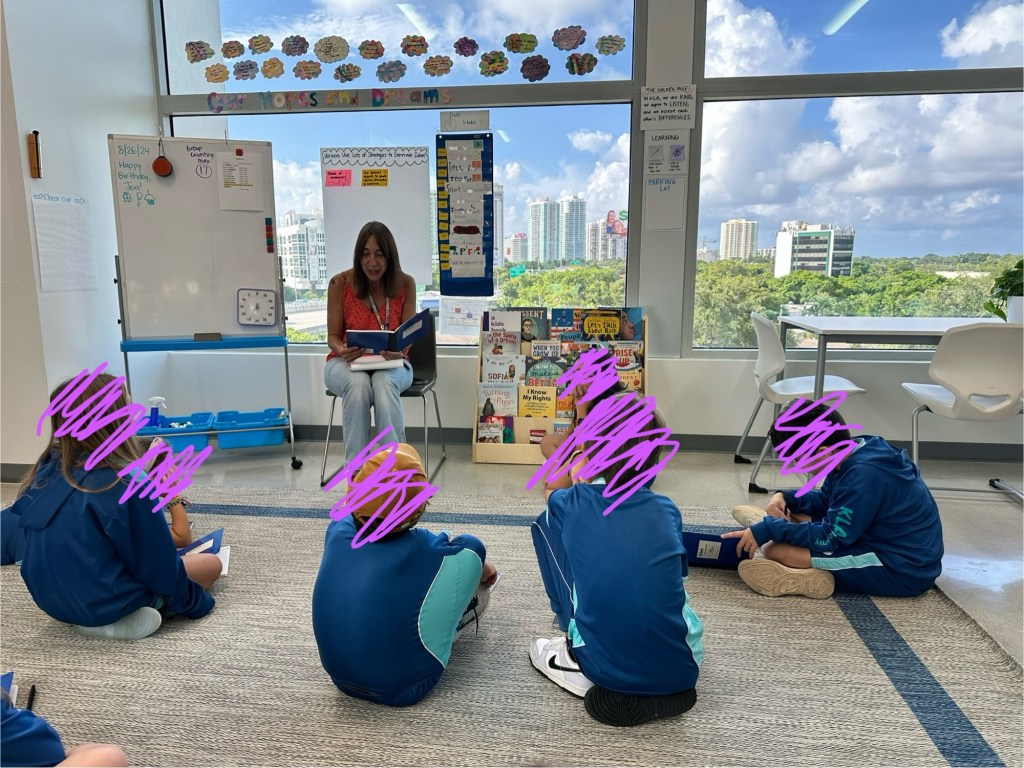
Kim reading one of our student’s stories out loud, just like Georgia Heard did for us at the Quoddy writing retreat.
At the launch of every new writing unit, I feel a wave of anticipation that teeters dangerously between excitement and overwhelm.
Excitement because it’s a new genre, and there are so many great tools and resources, and I have some new systems I want to put in place, and this time I swear I’ll be more intentional with picking the mentor texts and modeling in my own writer’s notebook.
Overwhelm because there are TOOMANY great tools and resources! And how will I teach all the new systems and still give writers time to write? And how will I get these on-demands graded in time? And, oh god, there are so many things to teach them, where do I even begin?
So I’m taking a break from the grading to write this post and remind myself to BREATHE.
To just take it “bird by bird,” as Anne Lamott says. The unit will pick up speed as the writers step into it, and I will know how to sift through the tools and use what I need once I see what they’re producing.
I am leaning towards excitement as I gear up for tomorrow, for two main reasons.
First, Consuelo and I have decided to split the class in half for reader’s and writer’s workshop, aligned with their book clubs and their writing partners. This way we can take advantage of both instructors and get a 12:1 student:teacher ratio. We’ll also have more time and freedom to conference with students, which I’m really excited about. After attending the TCRWP’s Virtual Saturday Reunion, as well as Ana’s last WW meeting on the teacher work day, I’ve got so many ideas about how to make small groups work better for both me and the kids. That’s a big goal for me as a teacher this unit.
Additionally, as I was preparing a “This Unit’s Mini-Lessons” anchor chart, an idea Ana and I had for student accountability, Consuelo gave me the idea to make small cards to give to the students for each teaching point. That way, it could live on the anchor chart AND in the students’ notebook for reference.
Here are how the first three lessons’ cards turned out. I’m looking forward to seeing how this helps cement the teaching point for each writer!
It’s important for the card to include a visual, and I also added in which stage of the writing process it applies to. I’m hoping this helps empower students when we confer!
My weekly reflection got postponed a bit from our days off for Hurricane Ian. It didn’t end up hitting Miami too badly (thankfully), so it mostly gave us teachers and the students a mini vacation to rest and recuperate. Which was much needed, especially as I was nursing a cold at the time.
So sessions 7 and 8 were pushed to last week, which was completed with two mini-lessons on leads and setting. I had one successful and one not-so-successful small group, and a bunch of successful conferences.
My plan this week is to finish conferencing on Monday and Tuesday with the students I didn’t get to last week, and then offer a couple small group sessions on Wednesday and Thursday where students can “sign-up” to get support with revision strategies.
Next week, students will be editing and publishing, and I’ve offered typing as an option for their final drafts. I think for small groups/conferencing, I’ll do another “sign-up” but this time with editing conventions (like, punctuating dialogue correctly, or reading your piece out loud to catch run-on sentences).
The week after that, we’ll finish up with our intimate class celebration, a more public celebration, and our narrative on-demand to see the growth from the beginning of the year.
This is a short blog post, but it’s been a busy weekend. I hope to have a more thorough post by the end of the unit!
It’s Saturday and I’ve just finished planning the lessons for the second week of our realistic fiction unit and creating some tools to help my writers.
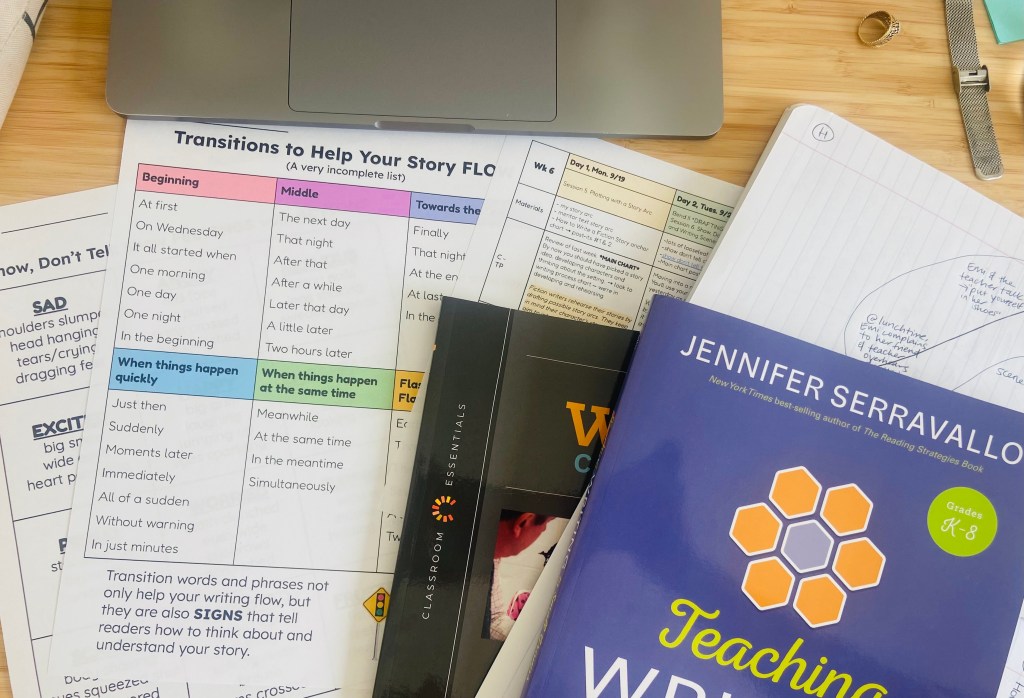
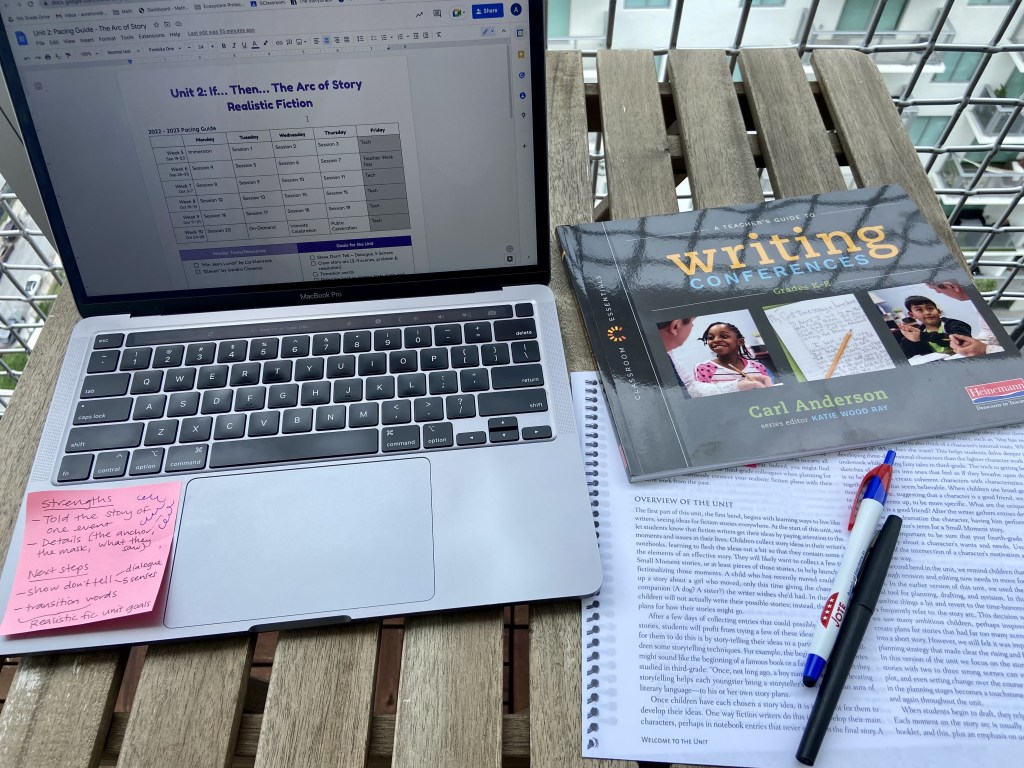
Tools, plans, a story arc in my writer’s notebook, and my two handy professional texts.
Mini-Lesson Breakdown
This is the week where I’m going to attempt to really tackle each of my goals in mini-lessons:
Session 5 – Plotting with a Story Arc (I’ll be emphasizing the importance of just a few scenes, and how the problem can still intensify in such a short time period)
Session 6 – Show, Don’t Tell – Planning and Writing Scenes (I’ll introduce a show, don’t tell chart that includes examples of telling vs showing as well as dialogue; I’ll also provide students with a tool that Ana made to show feelings by using actions)
Session 7 – Feeling and Drafting the Heart of Your Story (This lesson is all about losing yourself in your story while you draft. Last year we did some envisioning, enacting, and drafting, but this year I’ll try having them ask themselves what the heart of the story is before/while they envision and embody their characters)
Session 8 – Using Transitions to Give Your Writing a Flow (While the first 3 sessions of this week are adapted from the TC unit, this lesson I created based on the needs of my students. We’ll take a look at the narrative checklist and then I’ll give writers a transitions tool to keep in their folders. They’ll re-read one part of their draft during the active engagement and look for where they might need transitions)
“How’s it going?”
One thing I’m proud of myself for this last week is that I checked the writers notebooks every day, keeping track of where students are in terms of trying out the mini-lessons, doing writing at home, etc. This helped me to schedule some small group sessions, which was super necessary, because I realized that with 23 students, and realistically only 25 minutes of independent writing each day (I know, it’s short — our day is tight), there’s no way I can conference with every writer every week.
I also purchased Jennifer Serravallo’s Teaching Writing in Small Groups to complement my professional reading with the Carl Anderson book. I’m really excited about the Skill Progressions that Jennifer has outlined, because they’re a really easy tool to know what to teach next based on a particular student or group’s goal.
I still have lots of room to grow in small group instruction, but at least for right now I can say:
I know what my students are writing and where they’re at in the writing process.
I met with all students last week (except one who was absent for two days), either in a conference or a small group. Hooray!
Now I just need to assign goals to each student and make a plan for this week’s small groups! But first, I’m going to take a break.
It’s September and we’re about to head into the 5th week of school. Routines are falling into place, the students are beginning to feel more comfortable with one another and with us teachers, and the amount of work we have to do goes back and forth between feeling manageable and never-ending, all at the same time.
I feel lucky to be teaching 5th grade for the fourth year in a row, with a new crop of students in front of me, a whole extra year of teaching 5th graders like them behind me, and an amazing co-teacher by my side. Each year with the same grade, I get to reflect, revise, and take another stab at teaching that subject/topic/unit that I didn’t get right the first time.
Take, for example, our next writing unit. It’s a unit that I taught last year — The Arc of Story, Realistic Fiction — one which… didn’t go as intended. It was my first time planning and teaching a published Writer’s Workshop unit, and there were MANY things that I ended up wishing I’d done differently. I had some wins (learning how to craft teaching points & active engagement for the mini-lessons), but I mostly focused, as I tend to do, on the shortcomings (I barely conferred, and most students wrote 15+ page stories that weren’t focused and that they didn’t have time to revise).
I’m energized by the chance to reteach this unit. For one thing, Ana’s going to be teaching it to 4th grade as well, which means we’ll get to put our heads together to brainstorm and rework lessons as we go. For another, I am coming at the unit with more confidence as a writing teacher and a clearer idea of how I can make the unit successful for my students and for me.
Goals for the Unit
The pitfalls from the last unit were clear, and the data from this group’s on-demand narratives supports them. So, I’ll be aiming to teach towards the following goals:
Focused short story arcs — 2-4 scenes, clear problem, clear resolution
Transition words
Show, Don’t Tell — specifically through (properly punctuated) dialogue and vivid description of setting and character
Game Plan
My game plan for tackling these goals includes:
Choosing mentor texts that clearly show off a command of the aforementioned skills, and referring to them consistently throughout the unit (both in mini-lessons and conferences). Last year, I used two picture books, but they were a little too long. I want the fifth graders to be able to see structure and scenes easily, and so some simple short stories are what’s needed. The two I’m going with are “Min Jee’s Lunch” by Elizabeth Kleinrock and “Eleven” by Sandra Cisneros.
Writing my teacher mentor piece ahead of time and ensuring that it also demonstrates and reflects the type of writing I want my students to be able to produce. Last year I tried making my piece follow the same structure as the example in the teacher’s guide. This year, I’m going off of my own seed ideas and thinking about the students I have in our classroom. Who are they? What will they relate to? How can I make sure that my piece is short and focused, just like I want theirs to be?
Creating a schedule for conferring with students one-on-one and in small groups so that I can keep track of what they’re writing and give them feedback before it’s too late. I didn’t start conferring with students until the third unit of writing last year, because I was still getting the hang of planning the mini-lessons. My students would have benefitted greatly from me reading their writing and meeting with them about it more regularly. (This is partly why some students wrote such long pieces — I didn’t catch them until it was too late.) I bought the new A Teacher’s Guide to Writing Conferences by the one and only Carl Anderson and am already digging into it. It’s a fantastic resource with tons of digital resources and videos of Carl in action.
Staying Accountable
I’ll try to hold myself accountable by checking in on the blog each week. Let’s see how it goes!
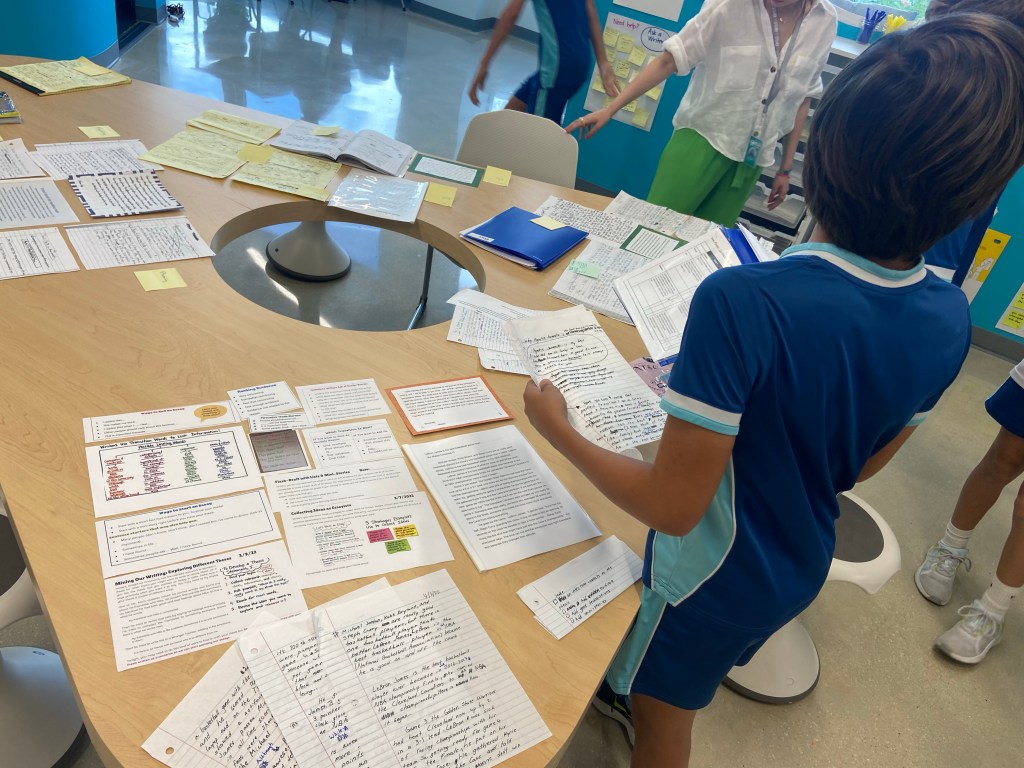
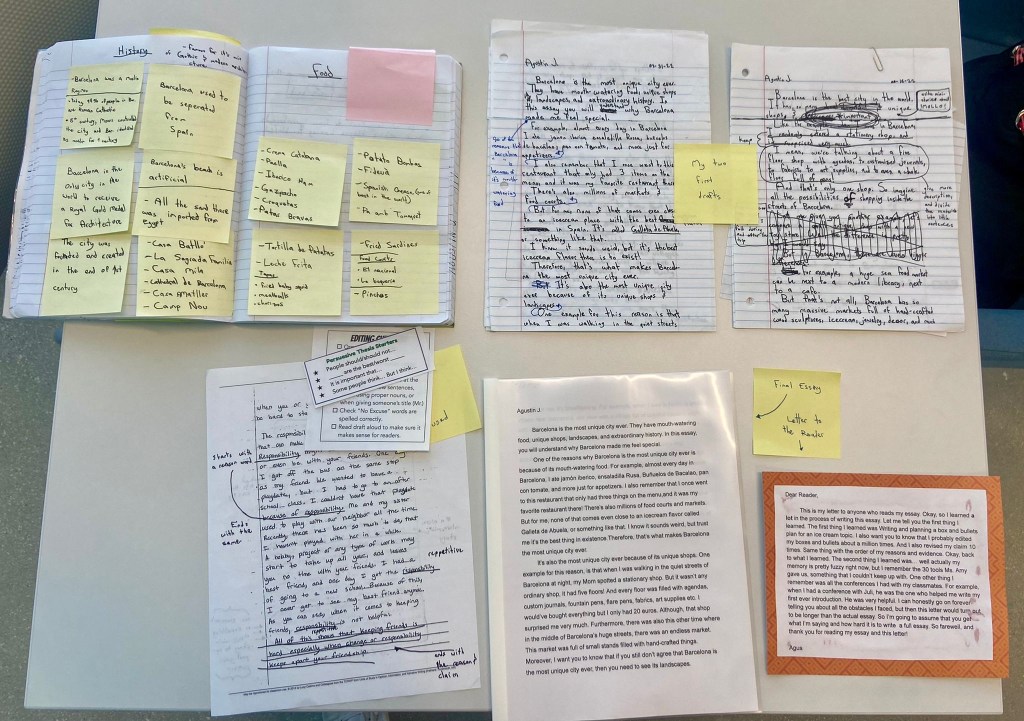
This morning we held our essay writing celebration. I gifted students their typed final drafts in plastic report covers, their letters to the reader pasted on patterned cardstock. They set up their writing displays, encircling their essays with all the work that went into them: the ideas in their notebooks, their plans, their revised (and revised again!) drafts, the tools and strategies they used to help them. Some students grabbed post-its to label each page. Some flocked excitedly to their classmates’ areas, peeking at what they had put out.
At 10:30 on the dot, Isa squealed, “They’re here!” and opened the door to a group of parents streaming out of the elevator.
Each student greeted their parent warmly and guided them towards their writing display. And then the work of celebrating truly began.
What I’ve loved so much about Writer’s Workshop this year is the emphasis on the writing process — on all of the work that goes into a published piece, rather than just focusing on the product. Publishing takes one day, whereas all the work before that — generating ideas, choosing one to plan and develop, drafting fast and furious, revising, and editing — takes up to 4 weeks. In one unit, writers generally cycle through two pieces, deciding in the final days which they will commit to publishing.
The heart of writing lies in the mess, the struggle to find an idea, the conferences with a mentor or partner, the beautiful sessions where time flies without you realizing it, so focused you are on getting down the words in your head. The heart of writing lies in revision, in realizing your first draft isn’t your best. The heart of writing lies in looking at your writing as a reader, examining it from different angles and through different lenses.
There is much this year that I have learned and that I still struggle with as a writer. I went to college for creative writing, and sort of fell out of it for a variety of reasons, only now starting to pick it back up again. I let the magic lie dormant for a long while, but these 5th grade writers have sparked that big magic in me again.
Today I celebrate the writers in my classroom and their phenomenal growth. I celebrate myself, knowing that their growth is a reflection of my teaching. And I celebrate the possibilities ahead, for my classroom, for my own writing life, and for the future writing lives of these students.
“Oh! You would be so proud of me,” I started saying to Ana at dismissal. She herded a child out the front door, wishing them well, and then turned back to me. I took a breath. “I—”
“Stop.” She grabbed my shoulder, cutting me off. “Why do you keep saying I ‘would’ be so proud of you? I am proud of you!”
I struggle sometimes to turn inward and tell myself, Look at you! You rocked it. I’m proud of you. But I’m trying to get better at it, so here we go: I made leaps and bounds in my conferring skills this past unit.
My big goal during this unit on journalism was to know what my students were writing so I could best support them through conferring and small groups. I had dabbled in conferring during the first two units, but felt ill-equipped to actually support my students apart from giving a compliment and moving on, which often felt like I was going, “You’re doing great! Keep it up, byeeee!”
Ana told me that in order to truly plan for conferring and small groups, I needed to know what the heck my students were able to do and what they were still working towards. And I could only do this if I actually read their writing.
So, the day after Thanksgiving break, I requested all students turn in their writer’s notebooks so I could see what was up. Skimming through the stack of notebooks was eye-opening, to say the least. I noticed which students weren’t generating ideas, which students had already written multiple news reports, and which students were still stuck writing what appeared to be narratives (which can happen during a genre switch like this). I did it again a week later, once students had started drafting.
In order to keep track of where students were at, I used a conferring notes document created by Amy Ellerman and outlined in depth in her blog post on Two Writing Teachers. I revised the teaching points at the top to work for my unit, and downsized it so it would fit on one page. Here’s what I ended up with:
Second set of conferring notes, taken after students started drafting out of the notebook.
This document is GOLD. Ellerman’s pattern-seeking strategy helped me so much, not just to figure out which teaching points I could revisit with which students in a small group, but also with my one-on-one conferring sessions.
With a quick visual of data, aligned to the major teaching points of my unit, I could come to a conference ready to go with both a compliment and a teaching point. This was a game-changer for me, and for my students as well. I believe many of them wrote better articles because I knew where they were at, knew where they still needed to go, and was prepared with supports for them when we met.
However, I did struggle with a couple of students (as we always do!). One of them is Enrique, who basically listened to my suggestions for revisions without implementing any. We had one small group session the day after I took stock of students’ notebooks that ultimately got hijacked by us butting heads (him: “Why do I have to _____” and me: “Because I said so!” Ohhh, shame).
Ana even had a short one-on-one conference with him where she suggested he keep his reader in mind as he drafted and revised, which he replied to with a, “Hm, yeah I’ll think about it.” She looked at me and shrugged.
But then something glorious happened. I had a small group conference with Enrique and his writing partner, Marcelo, who also happens to be his best friend.
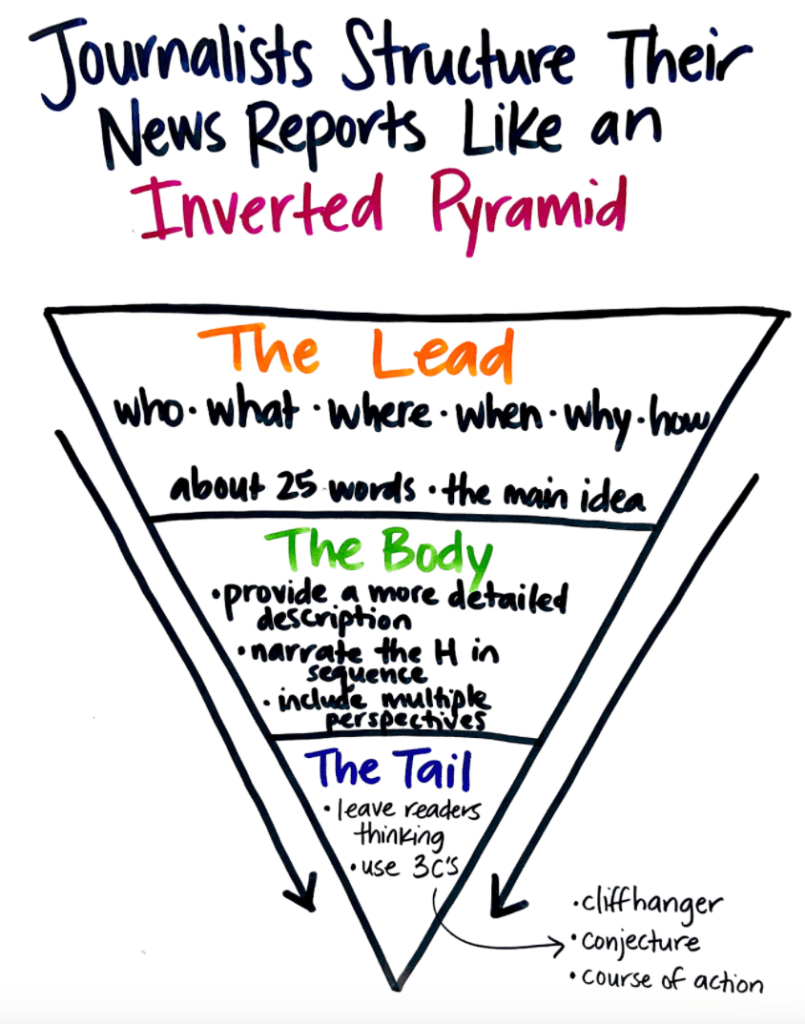
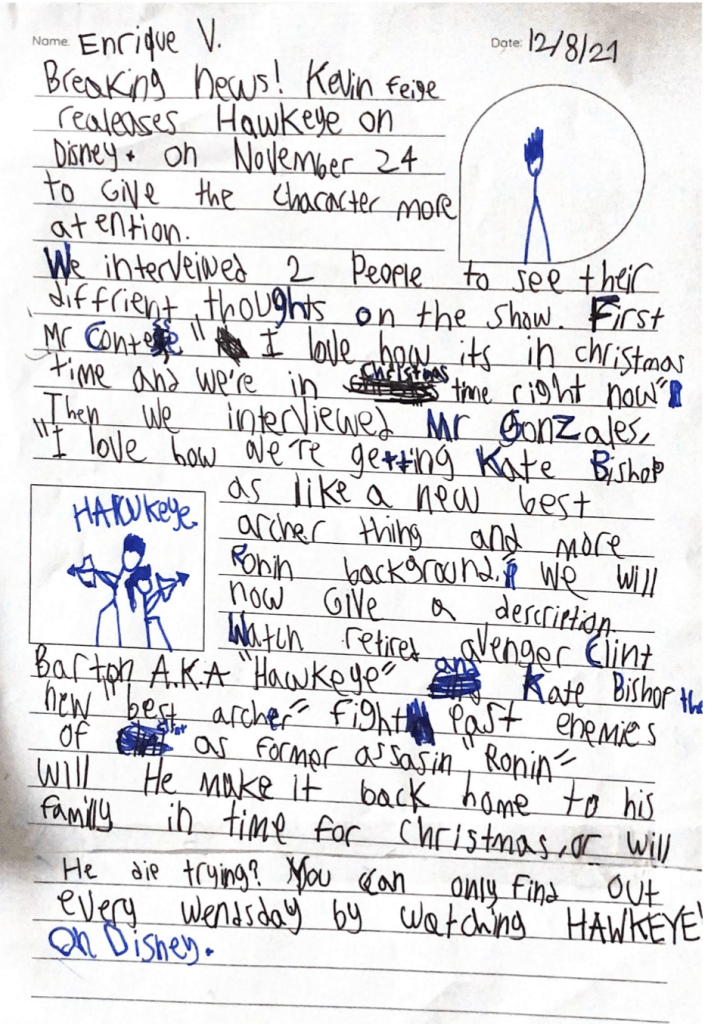
As I could see from my conferring notes, neither of them had a lead that included the 5 W’s and H. Enrique was writing about new Disney Plus shows and had really just listed a bunch of items and saved his most important information for last, which was almost the opposite of the structure the students were supposed to be aiming for. Marcelo had written a catchy lead, but it was lacking some details that the reader really needed in order to understand what his article was about.
I started the small group conference with a compliment. I said: “You both generated a great newsworthy idea and are using an officious tone, just like a journalist! I think you are ready to look at the structure of your news reports to see if they follow the inverted pyramid. Let’s start at the top with the lead.”
They both flipped to the mini-anchor charts pasted in their notebooks and reminded themselves of what should go in a strong lead.
At Ana’s suggestion, I started including mini print-outs of anchor charts the class and I had co-created in my conferring toolkit. Both Enrique and Marcelo already had one of these already in their notebooks from a previous conference.
I had them take a highlighter to their drafts and highlight where they saw the 5 W’s and H. I did the same to my mentor article. Both boys realized quickly that their leads were falling short.
So we went back to our strategy from a mini-lesson a couple weeks prior: jot down each of the 5W’s and H and fill them out, then make a sentence or two with all that information. (Note: This strategy is inspired by Judith Hochman’s strategies to help students write complex sentences.) They started filling it out, and that’s when the lightbulb moment happened.
“How do I choose the ‘what’ in my article? There are so many shows!” Enrique asked.
“Maybe it’s the one you’re recommending at the end,” I ventured.
“So, Loki?” Enrique confirmed. He started jotting it down.
“I don’t think the most newsworthy one is Loki,” Marcelo interjected. “I think it’s Hawkeye, since that just came out.”
Enrique paused, thought about it, and then nodded. He erased what he’d written down and wrote: “Hawkeye.”
He filled out the rest of his page with ease.
The two of them then moved on to the body, figuring out they could interview each other to provide alternate perspectives in their articles, and finally onto the tail, both deciding to conclude with a follow-up course of action.
When Enrique showed me his revised article at the end of the independent writing period, it looked nothing like his first few drafts. It was a complete overhaul—a “major surgery” as we often say in our workshop. I gave him a huge hug.
Later that week, when he’d finished his published piece, I sent Ana a scan of his writing, from generating ideas to final product.
“I am SO PROUD OF HIMMMM!” I texted Ana.
I smiled at her reply: “I am SOOO PROUD OF YOUUUUUUUU!”
I guess I am proud of me, too.
Generating seed ideasFirst draft in the notebookThird draft out of the notebookNotes during small groupFinal draft with editsFinal published news report before adding pictures Click through the images above to see Enrique’s writing process







 Writing With Abandon