Writing With Abandon

Reflections and ramblings about life as an educator, writer, reader, knitter, and over-thinker. Trying to do the writing only I can do.

Tag: writer's workshop

  • Friday Haikus

    HOW-TO HAIKU

    Taught kids to haiku

    They tried traditional ones

    And silly ones too

    *

    FUNNY KID

    Reluctant writer

    Manages to write the best,

    Funniest haikus

    *

    SPRING BREAK

    It’s finally break

    School is out — Quick! Run away!

    Ready to relax

    *

    SOCIAL MEDIA

    Deleted TikTok

    It is a total time suck

    Now screen time is low.

    *

    HYDRATE

    Remember to drink

    It’s important to hydrate

    Gotta love water

    Day 17 of 31
  • An Excerpt

    For today’s slice (day 9! wow!), an excerpt from my writer’s notebook entry yesterday.

    ***

    The sun dapples differently in the morning, the humidity still thick. The brown vines hang and sway from the branches of the trees, almost like they’re dancing in the wind. I can hear birds chirping and roosters clucking. Car engines as they drop children off at school.

    What if you could mute the sounds one at a time?

    Take away the white noise of the whooshing air on the highway. Take away the rumbling car engines. Take away the whistles from the rooftop.

    Leave the air rustling the leaves on their branches. Leave the birds tweeting in the trees. Leave the rustle of pen and paper, children’s voices.

    Blankets of pollen coat the benches, allergy culprits. Like fairy dust, causing sneezing and watery eyes.

    M found a worm, inching along his leg. We gave him a post-it pack home.

    “He has good abs,” M said. “I’m gonna call him squiggly.”

  • Taking Workshop Outside

    This morning, I told the students to gather quickly with their writer’s notebooks and a pen or pencil, because we were taking our workshop outside to the park.

    “No way!” They shouted. “Yessss!”

    We headed downstairs and out to the park that faces our school, congregating around one of the picnic tables so I could tell them the teaching point.

    “Writers, today I want to teach you another strategy for generating ideas for poems,” I said. “Poets see the world with eyes that are alert to the smallest details.”

    I pointed to the vines hanging from the tree branch above us.

    “Look at how the sun is glinting off of the vines, making them look golden. Notice how they’re waving in the wind, swaying.”

    “Almost like they’re dancing!” T chimed in.

    “Exactly!” I smiled back. “I think I’ll write that down. I might be able to use it in a poem later.”

    I pulled out a mini-anchor chart with steps for the teaching point.

    “Poets, today you’ll look at the park with new eyes. You’ll write long in your notebooks about what you observe, what you notice, and what you think about what you see. All of this can be used as inspiration for later poems! Now, spread out and find a spot where you can really fine tune your poet’s eyes. Off you go!”

    And they all dispersed.

    For the next thirty minutes, pens scribbled in notebooks, eyes gazed around in wonder, and when we gathered again, almost everyone shared an excerpt from their writing.

    On our way back to the school building, we brought back plenty of new ideas, as well as a moth and a tiny inchworm.

    As the door closed behind us, one student asked, “Can we have writer’s workshop outside every day?”

    If only!

  • Poets

    Today one of my students brought his writer’s notebook with him to our social studies lesson, sneaking poetic lines in between notes taken on his classmates’ presentations. Yesterday, he asked if he could bring it down to music, because he thought he might get distracted, and knew having the notebook there to write in would help him. Later, he asked if he could take it home.

    “Of course,” I replied.

    Because isn’t this what we as writing teachers hope for?

    That a child will want to bring that notebook with them everywhere, to catch thoughts before they disappear from their minds? To capture vivid images and fierce wonderings?

    Today he left his notebook at school, and he won’t be back tomorrow. As I got home, I saw an email from him saying that he left the notebook at school, asking if his sister could get it for him tomorrow morning, because he really wants to share the poems he wrote today with his mother.

    “Of course,” I replied.

    Of course.

    This unexpected enthusiasm for our new poetry unit is magic.

    Students reading their poems out loud at the end of workshop today, smiling as they read, sharing their inner worlds with their peers, receiving snaps at the end.

    Oh! Let me be like my student who can’t wait to bring his notebook home, who can’t wait to put pencil to page, to put mind to words.

    “Can this be a poem?”

    “Can I write this in my poem?”

    Of course.

  • In My Feels: Anticipation

    All. The. Things.

    At the launch of every new writing unit, I feel a wave of anticipation that teeters dangerously between excitement and overwhelm.

    Excitement because it’s a new genre, and there are so many great tools and resources, and I have some new systems I want to put in place, and this time I swear I’ll be more intentional with picking the mentor texts and modeling in my own writer’s notebook.

    Overwhelm because there are TOO MANY great tools and resources! And how will I teach all the new systems and still give writers time to write? And how will I get these on-demands graded in time? And, oh god, there are so many things to teach them, where do I even begin?

    So I’m taking a break from the grading to write this post and remind myself to BREATHE.

    To just take it “bird by bird,” as Anne Lamott says. The unit will pick up speed as the writers step into it, and I will know how to sift through the tools and use what I need once I see what they’re producing.

    I am leaning towards excitement as I gear up for tomorrow, for two main reasons.

    First, Consuelo and I have decided to split the class in half for reader’s and writer’s workshop, aligned with their book clubs and their writing partners. This way we can take advantage of both instructors and get a 12:1 student:teacher ratio. We’ll also have more time and freedom to conference with students, which I’m really excited about. After attending the TCRWP’s Virtual Saturday Reunion, as well as Ana’s last WW meeting on the teacher work day, I’ve got so many ideas about how to make small groups work better for both me and the kids. That’s a big goal for me as a teacher this unit.

    Additionally, as I was preparing a “This Unit’s Mini-Lessons” anchor chart, an idea Ana and I had for student accountability, Consuelo gave me the idea to make small cards to give to the students for each teaching point. That way, it could live on the anchor chart AND in the students’ notebook for reference.

    Here are how the first three lessons’ cards turned out. I’m looking forward to seeing how this helps cement the teaching point for each writer!

    It’s important for the card to include a visual, and I also added in which stage of the writing process it applies to. I’m hoping this helps empower students when we confer!
  • Arc of Story: Week 2/3 Reflection

    My weekly reflection got postponed a bit from our days off for Hurricane Ian. It didn’t end up hitting Miami too badly (thankfully), so it mostly gave us teachers and the students a mini vacation to rest and recuperate. Which was much needed, especially as I was nursing a cold at the time.

    So sessions 7 and 8 were pushed to last week, which was completed with two mini-lessons on leads and setting. I had one successful and one not-so-successful small group, and a bunch of successful conferences.

    My plan this week is to finish conferencing on Monday and Tuesday with the students I didn’t get to last week, and then offer a couple small group sessions on Wednesday and Thursday where students can “sign-up” to get support with revision strategies.

    Next week, students will be editing and publishing, and I’ve offered typing as an option for their final drafts. I think for small groups/conferencing, I’ll do another “sign-up” but this time with editing conventions (like, punctuating dialogue correctly, or reading your piece out loud to catch run-on sentences).

    The week after that, we’ll finish up with our intimate class celebration, a more public celebration, and our narrative on-demand to see the growth from the beginning of the year.

    This is a short blog post, but it’s been a busy weekend. I hope to have a more thorough post by the end of the unit!

  • Arc of Story: Week 1 Reflection

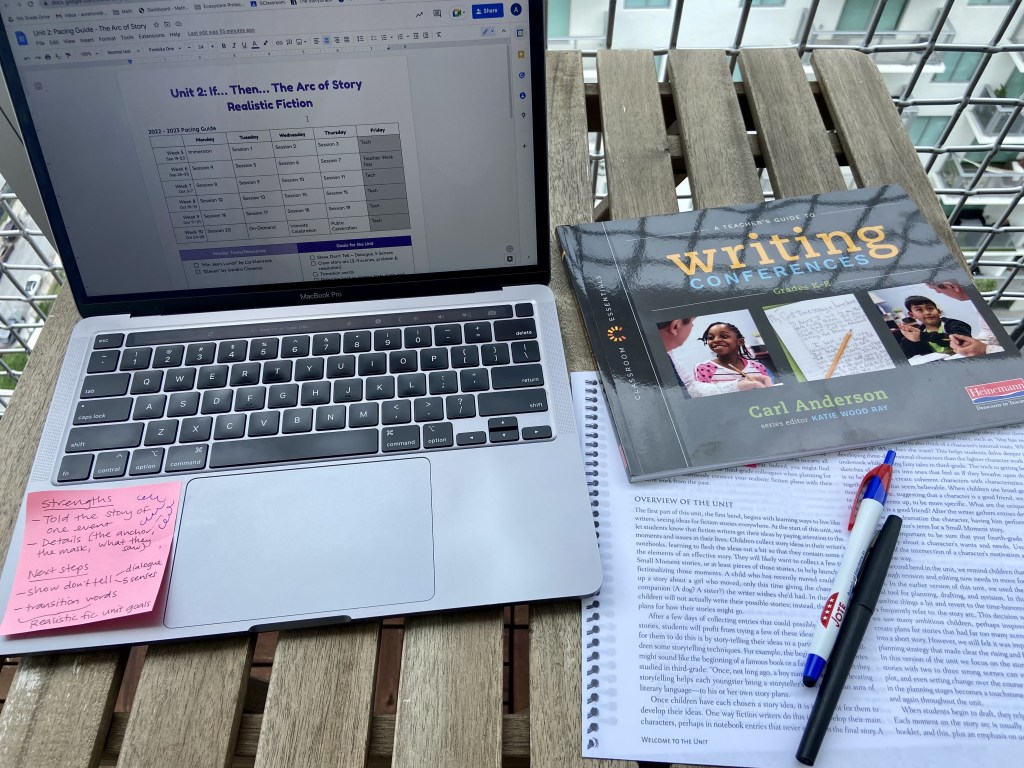
    It’s Saturday and I’ve just finished planning the lessons for the second week of our realistic fiction unit and creating some tools to help my writers.

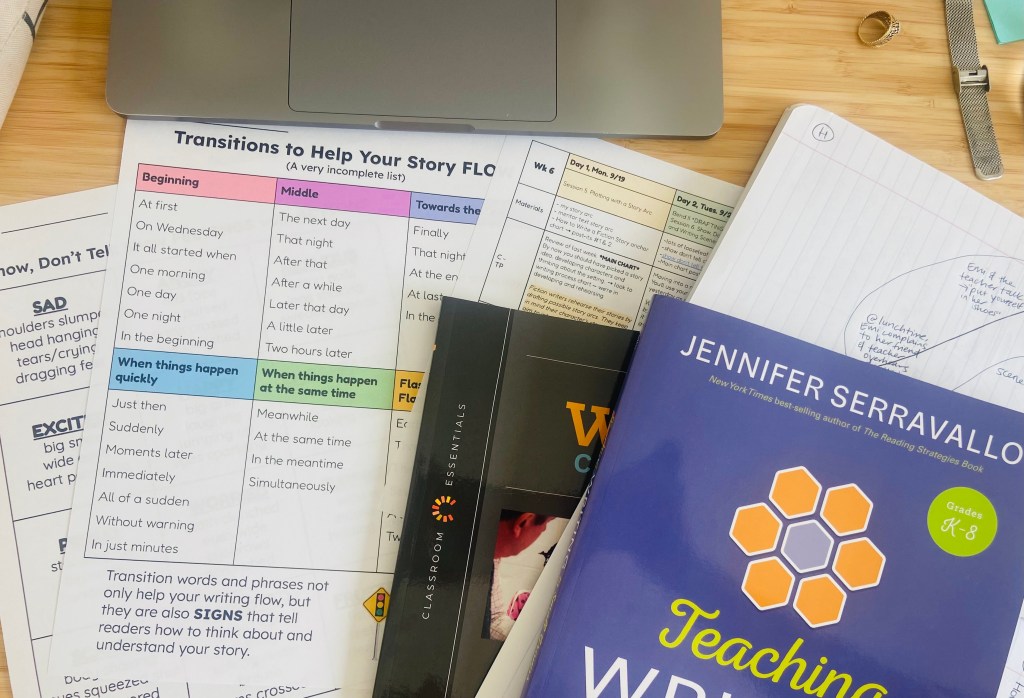
    Tools, plans, a story arc in my writer’s notebook, and my two handy professional texts.

    Mini-Lesson Breakdown

    This is the week where I’m going to attempt to really tackle each of my goals in mini-lessons:

    • Session 5 – Plotting with a Story Arc (I’ll be emphasizing the importance of just a few scenes, and how the problem can still intensify in such a short time period)
    • Session 6 – Show, Don’t Tell – Planning and Writing Scenes (I’ll introduce a show, don’t tell chart that includes examples of telling vs showing as well as dialogue; I’ll also provide students with a tool that Ana made to show feelings by using actions)
    • Session 7 – Feeling and Drafting the Heart of Your Story (This lesson is all about losing yourself in your story while you draft. Last year we did some envisioning, enacting, and drafting, but this year I’ll try having them ask themselves what the heart of the story is before/while they envision and embody their characters)
    • Session 8 – Using Transitions to Give Your Writing a Flow (While the first 3 sessions of this week are adapted from the TC unit, this lesson I created based on the needs of my students. We’ll take a look at the narrative checklist and then I’ll give writers a transitions tool to keep in their folders. They’ll re-read one part of their draft during the active engagement and look for where they might need transitions)

    “How’s it going?”

    One thing I’m proud of myself for this last week is that I checked the writers notebooks every day, keeping track of where students are in terms of trying out the mini-lessons, doing writing at home, etc. This helped me to schedule some small group sessions, which was super necessary, because I realized that with 23 students, and realistically only 25 minutes of independent writing each day (I know, it’s short — our day is tight), there’s no way I can conference with every writer every week.

    I also purchased Jennifer Serravallo’s Teaching Writing in Small Groups to complement my professional reading with the Carl Anderson book. I’m really excited about the Skill Progressions that Jennifer has outlined, because they’re a really easy tool to know what to teach next based on a particular student or group’s goal.

    I still have lots of room to grow in small group instruction, but at least for right now I can say:

    1. I know what my students are writing and where they’re at in the writing process.
    2. I met with all students last week (except one who was absent for two days), either in a conference or a small group. Hooray!

    Now I just need to assign goals to each student and make a plan for this week’s small groups! But first, I’m going to take a break.

  • Second Chances: Planning for “The Arc of Story” (Again)

    It’s September and we’re about to head into the 5th week of school. Routines are falling into place, the students are beginning to feel more comfortable with one another and with us teachers, and the amount of work we have to do goes back and forth between feeling manageable and never-ending, all at the same time.

    I feel lucky to be teaching 5th grade for the fourth year in a row, with a new crop of students in front of me, a whole extra year of teaching 5th graders like them behind me, and an amazing co-teacher by my side. Each year with the same grade, I get to reflect, revise, and take another stab at teaching that subject/topic/unit that I didn’t get right the first time.

    Take, for example, our next writing unit. It’s a unit that I taught last year — The Arc of Story, Realistic Fiction — one which… didn’t go as intended. It was my first time planning and teaching a published Writer’s Workshop unit, and there were MANY things that I ended up wishing I’d done differently. I had some wins (learning how to craft teaching points & active engagement for the mini-lessons), but I mostly focused, as I tend to do, on the shortcomings (I barely conferred, and most students wrote 15+ page stories that weren’t focused and that they didn’t have time to revise).

    I’m energized by the chance to reteach this unit. For one thing, Ana’s going to be teaching it to 4th grade as well, which means we’ll get to put our heads together to brainstorm and rework lessons as we go. For another, I am coming at the unit with more confidence as a writing teacher and a clearer idea of how I can make the unit successful for my students and for me.

    Goals for the Unit

    The pitfalls from the last unit were clear, and the data from this group’s on-demand narratives supports them. So, I’ll be aiming to teach towards the following goals:

    • Focused short story arcs — 2-4 scenes, clear problem, clear resolution
    • Transition words
    • Show, Don’t Tell — specifically through (properly punctuated) dialogue and vivid description of setting and character

    Game Plan

    My game plan for tackling these goals includes:

    • Choosing mentor texts that clearly show off a command of the aforementioned skills, and referring to them consistently throughout the unit (both in mini-lessons and conferences). Last year, I used two picture books, but they were a little too long. I want the fifth graders to be able to see structure and scenes easily, and so some simple short stories are what’s needed. The two I’m going with are “Min Jee’s Lunch” by Elizabeth Kleinrock and “Eleven” by Sandra Cisneros.
    • Writing my teacher mentor piece ahead of time and ensuring that it also demonstrates and reflects the type of writing I want my students to be able to produce. Last year I tried making my piece follow the same structure as the example in the teacher’s guide. This year, I’m going off of my own seed ideas and thinking about the students I have in our classroom. Who are they? What will they relate to? How can I make sure that my piece is short and focused, just like I want theirs to be?
    • Creating a schedule for conferring with students one-on-one and in small groups so that I can keep track of what they’re writing and give them feedback before it’s too late. I didn’t start conferring with students until the third unit of writing last year, because I was still getting the hang of planning the mini-lessons. My students would have benefitted greatly from me reading their writing and meeting with them about it more regularly. (This is partly why some students wrote such long pieces — I didn’t catch them until it was too late.) I bought the new A Teacher’s Guide to Writing Conferences by the one and only Carl Anderson and am already digging into it. It’s a fantastic resource with tons of digital resources and videos of Carl in action.

    Staying Accountable

    I’ll try to hold myself accountable by checking in on the blog each week. Let’s see how it goes!

    Now, back to planning.

  • When Writers Grow

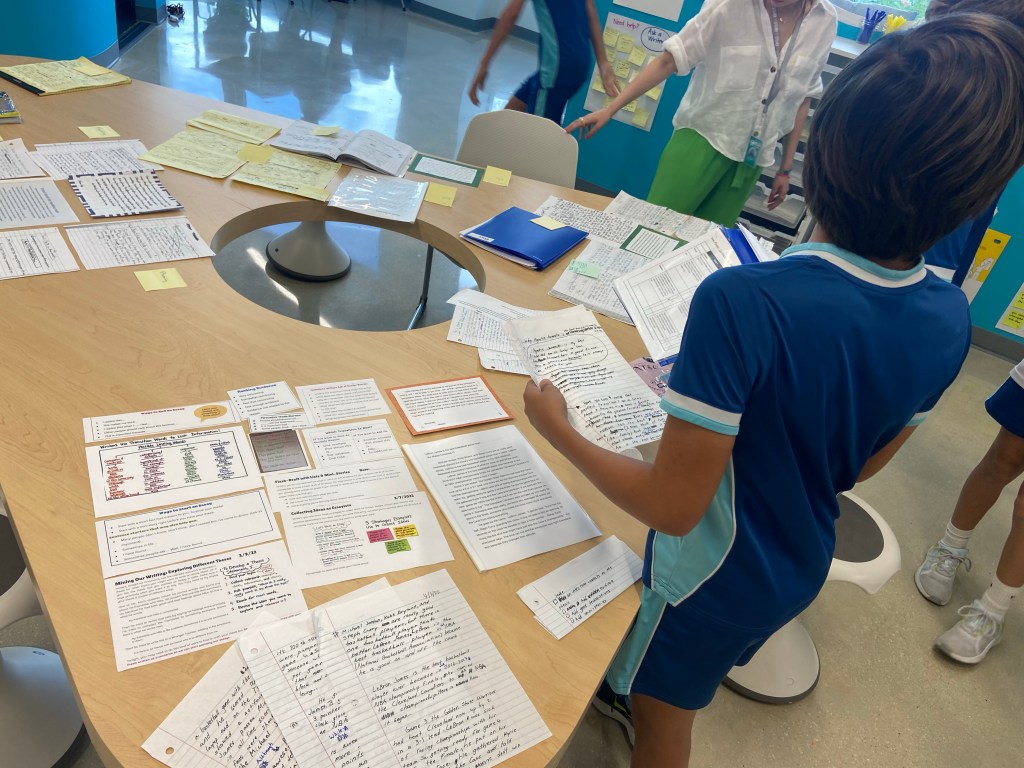
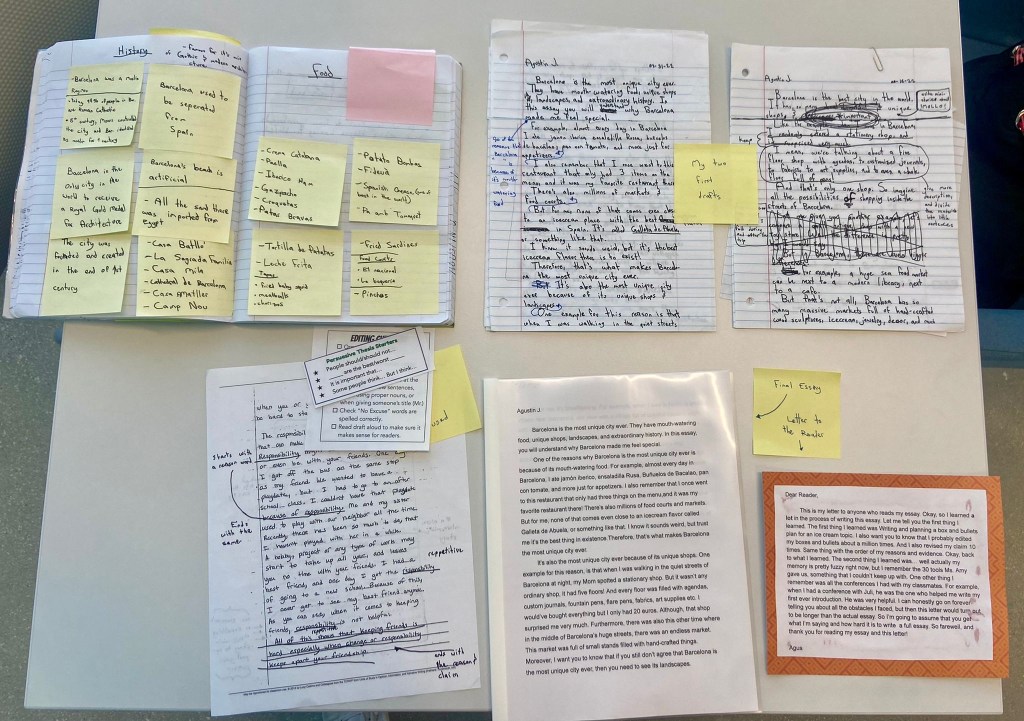
    This morning we held our essay writing celebration. I gifted students their typed final drafts in plastic report covers, their letters to the reader pasted on patterned cardstock. They set up their writing displays, encircling their essays with all the work that went into them: the ideas in their notebooks, their plans, their revised (and revised again!) drafts, the tools and strategies they used to help them. Some students grabbed post-its to label each page. Some flocked excitedly to their classmates’ areas, peeking at what they had put out.

    At 10:30 on the dot, Isa squealed, “They’re here!” and opened the door to a group of parents streaming out of the elevator.

    Each student greeted their parent warmly and guided them towards their writing display. And then the work of celebrating truly began.

    What I’ve loved so much about Writer’s Workshop this year is the emphasis on the writing process — on all of the work that goes into a published piece, rather than just focusing on the product. Publishing takes one day, whereas all the work before that — generating ideas, choosing one to plan and develop, drafting fast and furious, revising, and editing — takes up to 4 weeks. In one unit, writers generally cycle through two pieces, deciding in the final days which they will commit to publishing.

    The heart of writing lies in the mess, the struggle to find an idea, the conferences with a mentor or partner, the beautiful sessions where time flies without you realizing it, so focused you are on getting down the words in your head. The heart of writing lies in revision, in realizing your first draft isn’t your best. The heart of writing lies in looking at your writing as a reader, examining it from different angles and through different lenses.

    There is much this year that I have learned and that I still struggle with as a writer. I went to college for creative writing, and sort of fell out of it for a variety of reasons, only now starting to pick it back up again. I let the magic lie dormant for a long while, but these 5th grade writers have sparked that big magic in me again.

    Today I celebrate the writers in my classroom and their phenomenal growth. I celebrate myself, knowing that their growth is a reflection of my teaching. And I celebrate the possibilities ahead, for my classroom, for my own writing life, and for the future writing lives of these students.

    Brava.

  • Gratitude

    I’ve been trying to write this post about the importance of thought partners for the past week and a half, but I keep coming up against a wall. “Blog!” kept staring at me on my to-do list, and I kept pushing it to the next day, and the next. It was the first week back from break and I’ll just say I barely made it to Friday.

    Today, though, as I was speaking to two of my favorite coworkers and now good friends, A&A, I was filled with a sense of gratitude. I’m so lucky that I get to work alongside these smart, capable, caring, and reliable women, I thought. Reflecting on my practice with them these past eight months has made me a better teacher, whether those reflective chats happen at lunch or after school, at 7:30 in the morning as we make copies, through voice notes sent over WhatsApp, or in an official coaching cycle meeting.

    I remember the first time I met Ana, it was during one of her first Writer’s Workshop PDs with the staff. It was a Tuesday in May, and I was visiting Miami for my husband’s birthday and to help him move some furniture in. After a day of Zoom with my students back in the Bronx, I caught an Uber to KLA and was greeted warmly by Angie and Male. I poked my head into the 4th grade classroom to see my soon-to-be students and was pulled to a seat to watch their end-of-year show rehearsal. Then, while the last students dismissed, I made my way into the gym and sat down in one of just a few seats, placed in a U-shape in front of the projector. As Ana shared, I took fast and furious notes in my journal, filling up 3 or 4 pages. Estelle and Lizzie asked questions, showing genuine interest and enthusiasm, even though we know that most teachers in May are exhausted and would rather go home than sit in a Tuesday PD.

    I went up to Ana after the meeting and introduced myself. She seemed excited that someone else knew about workshop. I laughed and tried to explain that I didn’t follow it exactly, had never been trained in it. Later that night I texted my friend Danielle, who was finishing up her Master’s at Teacher’s College, how Writer’s Workshop finally made sense to me — and that was just after one hour of hearing Ana explain it.

    I met Allison in that same gym, though it was arranged quite differently. It was the first teacher work day in August — the first first day of school for me — and tables were everywhere, with 6-8 seats at each. I, in true Crehore fashion, arrived early, sweating from the Miami humidity that I wasn’t quite used to yet. I took a seat at Estelle’s table, where Ana soon joined, along with a couple of preschool teachers who I made small talk with.

    Then there was Allison, pulling up a chair and introducing herself. We discovered that we shared a similar background, having both taught as auxiliares in Madrid for a couple of years. Her smile and contagious laugh settled my nerves, which had been buzzing under the surface since the morning. I finally felt at ease.

    For the next two weeks, I lived in Ana and Allison’s classroom as much as I could. We shared ideas and thoughts, signed onto Zoom meetings together, and dothed ourselves Triple-AAA.

    So yes, pandemic teaching is hard, and we’re still in the thick of it, unfortunately. The end of the year is only going to make it harder, as everyone starts to get a little loopy in the build up to summer break and graduation.

    But today I am grateful for having this support system to get through it alongside.