There’s something about teaching Writer’s Workshop that I feel oddly possessive about. It was something I grasped tightly to after meeting Ana, moving to Miami, and starting to work at KLA. It helped me through a tough couple of years in my personal life. It was something that I had control over, and which brought me and my students joy. It got me writing again, got me to see myself as a writer, just like I hope my students will see in themselves.
So, letting go of it as a subject that I teach, that I plan, feels… scary, and uncomfortable, followed by guilt that I feel that way. It’s like a blanket being pulled off the bed that I’m still clutching to a corner of because I am desperate to stay snuggled up in it, even though I know the blanket is big enough for me and another.
But that fear and discomfort gets replaced by awe and pride each time I watch Kim lean in and open up to the students, whose eyes light up with her stories. Every time I watch her implement all that she’s learned in just one year. There’s no doubt in my mind she will teach them so wonderfully. And I’ll be right beside her to support, to model conferencing, to be her mentor.
“Writers, today I want to teach you,” she says, using that predictable language. And teach them she does.
I can’t wait to watch her fly.
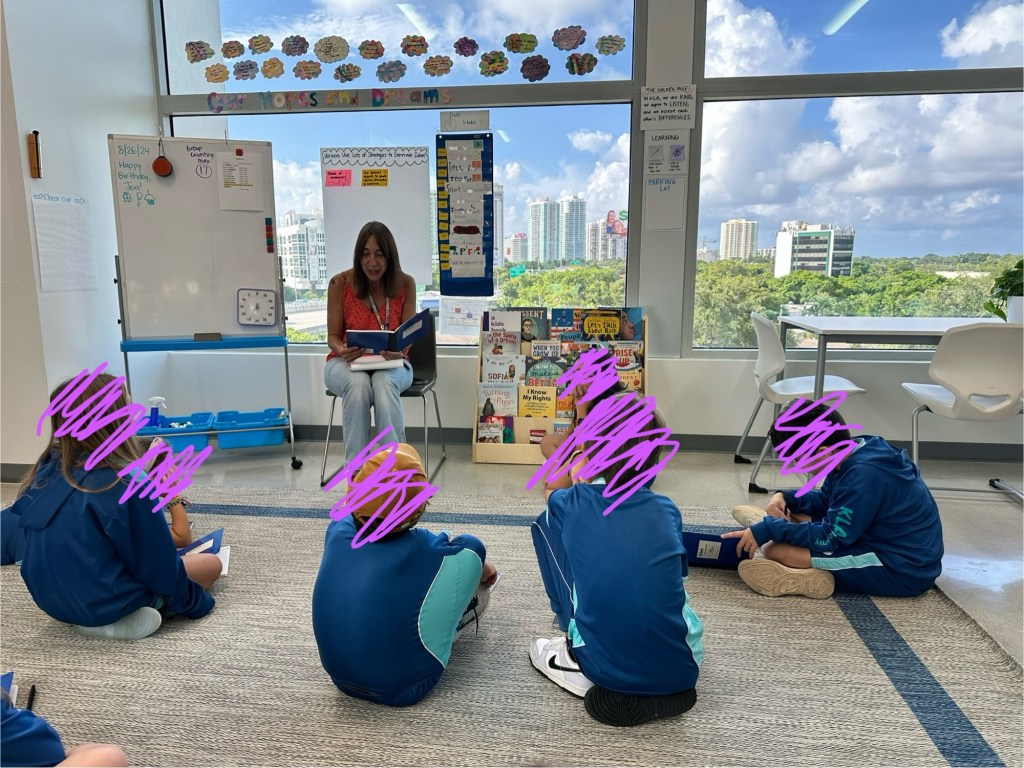
Kim reading one of our student’s stories out loud, just like Georgia Heard did for us at the Quoddy writing retreat.
It’s 5:30am and I’ve already been up for an hour. I’ve been struggling with morning insomnia for a few months now — waking up around 4 or 5 to pee, and unable to quiet my brain enough to fall back asleep. I have a notebook beside my bed to help me dump these thoughts, the goal being to train my brain to deal with them later, but tomorrow is moving day and so I’m too excited to settle back down.
Besides, it’s the perfect time to get my slice of life out of the way. And I do have a goal for my Tuesday slices, now that the school year has started — I’d like to document a year in the life of a 5th grade teacher and her class and the learning we all do. So I thought I’d begin with the first Writer’s Workshop.
***
This year is a little different. It’s the first year at KLA that I don’t have Ana in the classroom across from mine or down the long hallway, and it’s not because she’s on maternity leave or has moved away. Ana has gotten the job we’ve all been hoping for (and more!): instructional coordinator. This means she is more available to do coaching work with teachers, coordinate curriculum for the school, help streamline and align all-school practices, and so much more. This spring and summer, she also wrote a whole new WW launching unit for us: The First 20 Days of Writer’s Workshop, a beautiful unit that emphasizes talk, encourages teachers to join in the writing, and keeps writers in their notebooks to help them develop a strong repertoire of strategies for generating ideas of what to write about.
To be honest, my head hasn’t been in the right place since starting school, what with everything that’s been going on (see my last post), but I knew I needed to start this year off right with a first Writer’s Workshop lesson that would hook my writers. That need became even more apparent when, during our morning meeting share, students expressed their feelings (good or bad) about writing — some saw it as something to enjoy, when they got to write made up stories or jot down their feelings to destress, while others cited it as being boring, hard, or tedious, unless they were passionate about the topic.
I knew this first lesson would be important in convincing my reluctant writers that maybe, just maybe, there could be something to enjoy about writing this year. (And I have verbal — and written — proof from previous years that I’ve been able to do this. Many students who previously didn’t like writing either fell in love with it or found the utility in it.)
So, as they gathered on the rug in rows for the first mini-lesson, I took a breath, told them I needed a moment to put on my writing teacher’s hat, and then leaned in close, as if letting them in on a secret: “Good morning, writers.”
Envisioning language, a suspenseful story, big eyes and smiles, audible surprise — I wish I could have filmed the lesson from my perspective. It was a beautiful example of engagement, when every single kid is there with you, one of the utmost highs of teaching.
And then, the planned conversations for oral rehearsal — one partner talking, the other asking follow-up questions. By the time I sent them off to write, there was no question that the notebooks would be filled. When the timer beeped, you could feel that they would have kept going.
But it’s the first six weeks of school. The first 20 days of writing. And so we go slow to go fast.
What a week! Back to school, finding an apartment, applying for said apartment, booking movers, booking the elevator for move-out, awaiting final approval from the association, finishing my sweater, filing for divorce, organizing the classroom, thinking about first day and first six weeks plans, meetings meetings meetings, interviewing new teachers with no time to spare, interviews with families of incoming students over Zoom, rescheduling interviews, gathering boxes from school supplies to bring home to fill with things that I need to move, new math workbooks and textbooks, a fire drill not for a fire but for a burst pipe from a plant truck whose driver f-ed up, rescuing the paper!, and that oppressive heat on the walk home every day. It’s a whirlwind.
I am grateful, as ever, for my people.
I am also sorry, to said people, for the brain farts that I continue to have.
“Kim, we should, um… wait… I just had it! ARGH! It’s gone.”
I think I have started more sentences than I have completed today.
But now, just after 9pm, I am finally on the couch after packing up most of the kitchen, and I feel accomplished.
My classroom is ready for parents and students to see it tomorrow.
The first day plans are set.
I’ll sign off with my past few days in pictures.
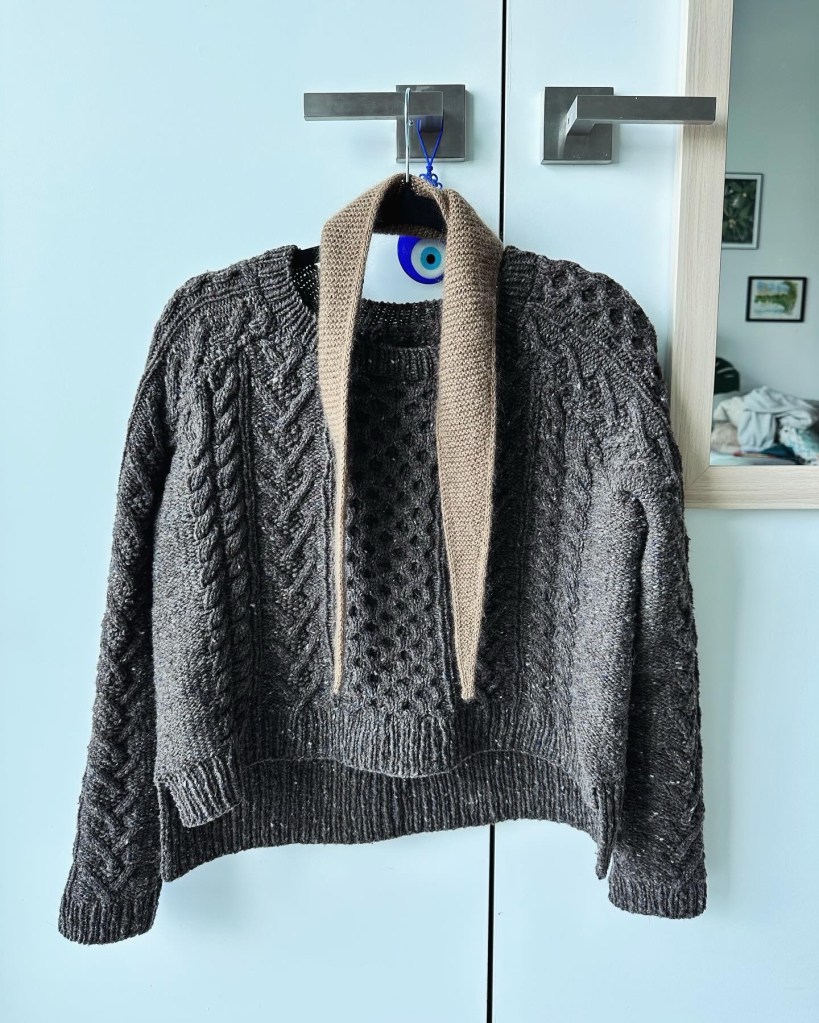
Completed Bronwyn sweater with a Sophie scarfThe happy face of a girl who just filed for divorceThese ladies and their loveOur amazing classroomBooks and viewsThe writing center!Phoebe is unfazedAccomplished.
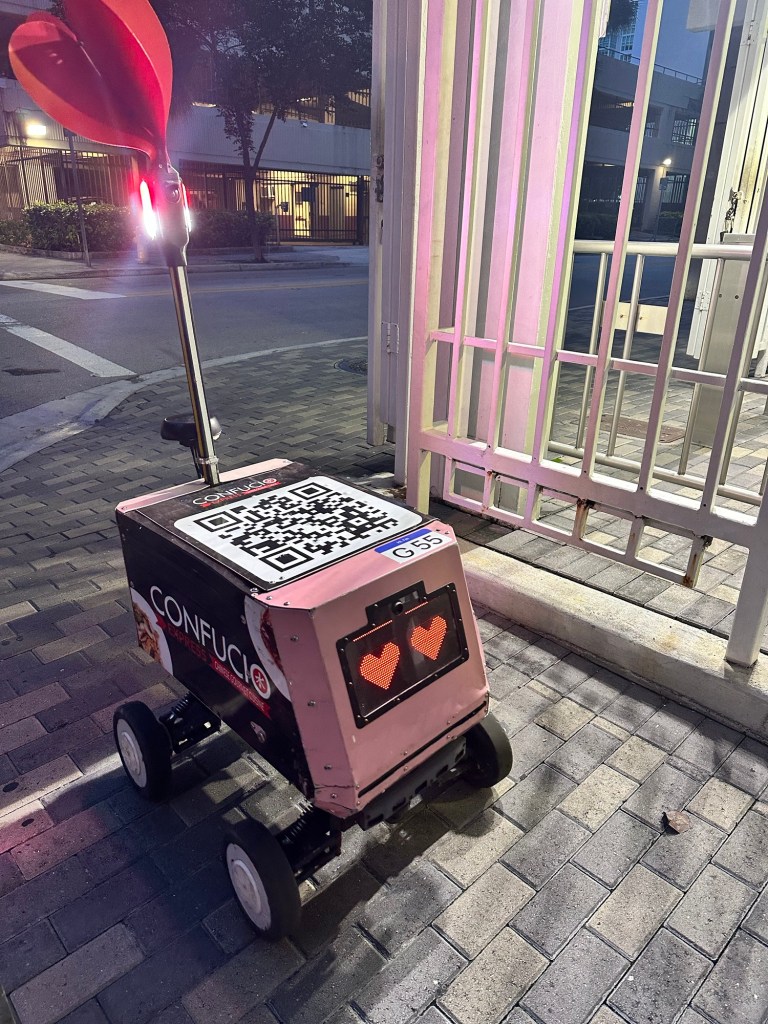
In Miami, especially in my neighborhood, you can see autonomous delivery robots everywhere. I’ve almost been run off the sidewalk by one before! On my block in particular, we often see the robots stopped on the corner, blinking their red heart eyes as they tentatively make to cross the street. Once, we saw one at each of the four corners, waiting patiently for their turn to cross and continue on their journey to their destination.
Sunday afternoon, on our way back from the grocery store, the sky opened up and it started to rain. We hid under a building for a while, but then decided to just go for it. As we ran-walked the two blocks home, squealing (“it’s worse under the trees!”), I saw a lone delivery robot hiding under the overhang by the garage entrance.
In that moment, I saw it not as a robot, but as a small puppy, shivering as it tried desperately to keep dry.
What is it about inspiring stories that make one tear up? I think all of us in the tea room were welling up as we listened to the stories the docents told of Eleanor Roosevelt’s childhood, dedication to human rights, and fierce independence and bravery.
This afternoon, on our second day at the Quoddy Writing Retreat for Teacher Renewal with Ralph Fletcher and Georgia Heard, most of us headed out on a little field trip to Campobello Island across the bay to have “Tea with Eleanor” and tour the cottage where the Roosevelts spent most of their summers.
As I rode in the back seat of Ralph and Jo Ann’s car, our phones switched to Atlantic Daylight Time. We drove out to Herring Cove Beach, collected pebbles and sea glass, then it was over to tea, where I learned so much more than I ever had about Eleanor. (Fun side note: one of my favorite books as a kid was A Letter to Mrs. Roosevelt by C. Coco De Young.)
One of those new facts was My Day, her 500-word daily news column that she wrote 6 days a week for 27 years, only missing a few days after her husband’s passing. The original Slice of Life, I think (and the inspiration for today’s post)!
I left the session with the delicious aftertaste of gingersnaps and tea lingering in my mouth, and a desire to learn more. Next we went to tour their cottage, where we saw the desk at which she wrote all of her thousands, maybe millions, of letters.
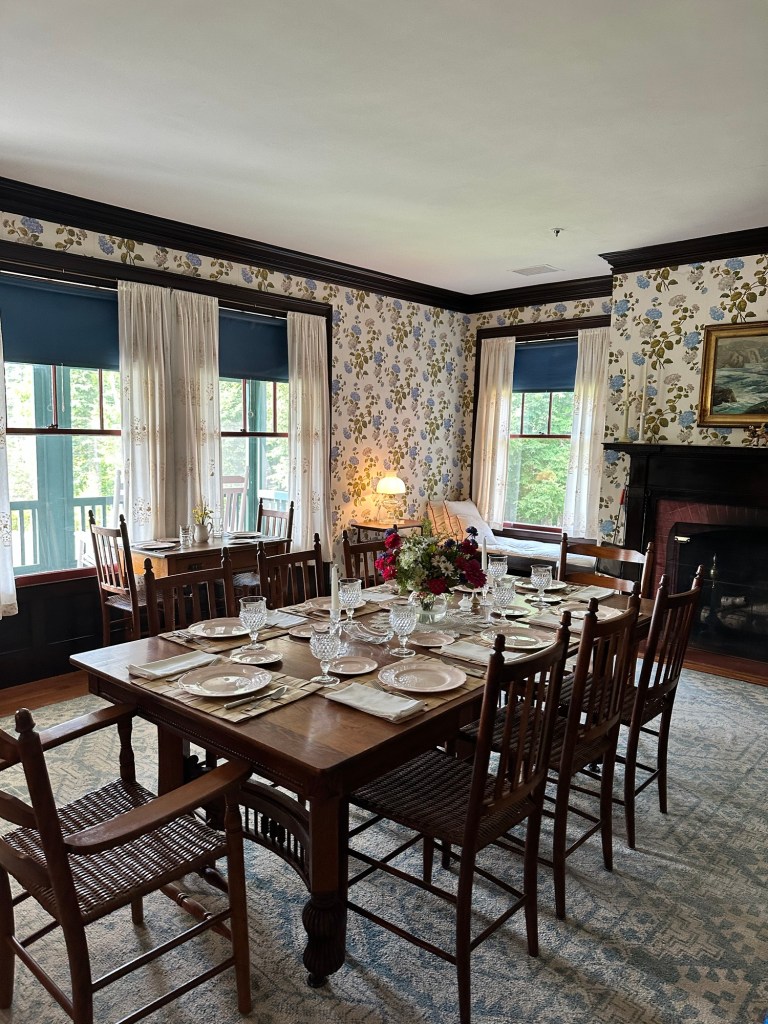
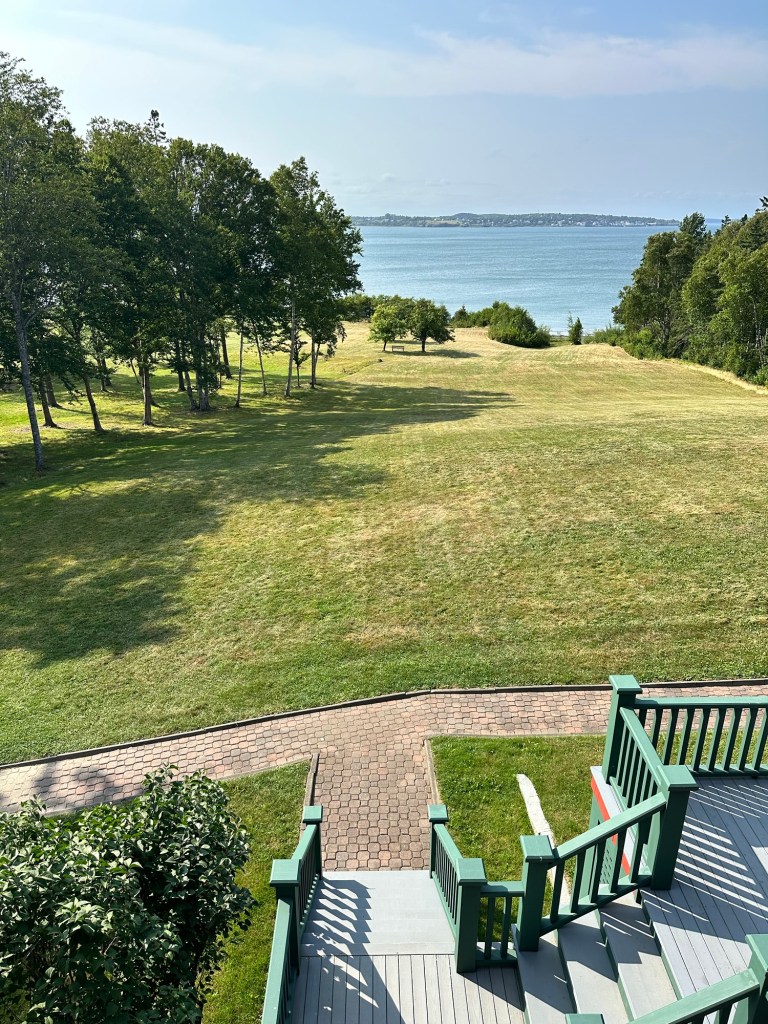
At 72, Eleanor renewed her gun licenseThe Roosevelt CottageEleanor’s writing deskDining room with the kid’s table behindIn the nurseryA dream view
Now it’s off to the one supermarket on Lubec to get a bottle of wine to share, and dinner with Ana by the water to watch the sunset!
Last Wednesday, I visited Julie upstate. We’re hoping to make it an annual thing. Her house is one of the most beautiful homes I know — filled with colorful, eclectic artwork, yet simple, modern, open, and bright. Their deck looks out onto their huge field, where the two German Shepherds enjoy running. It’s the perfect knitting/reading/tea-sipping spot in the mornings and early evenings, and their pool invites you in for the hotter hours of the day.
The morning view.
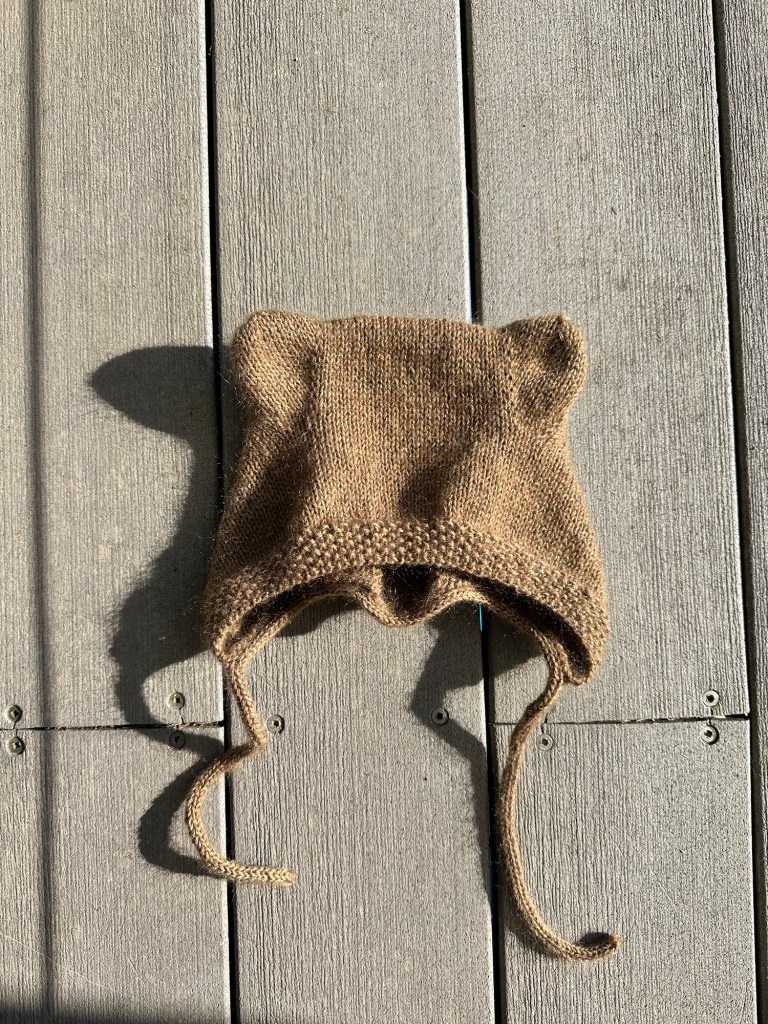
Of course I brought a knitting project, and Julie had hers. I finished the baby bear bonnet for Elena, something I’d been meaning to knit for months (sorry, Ana!). I love baby knits because they knit up so quickly! And this one is just so cute.
As I was knitting, though, I stumbled a few times — there were a couple of abbreviations that weren’t in the pattern’s glossary, a few instructions that were unclear. I was very attuned to it because my first night there, Julie and I had watched a podcast where the designers of this pattern explain how, when they began translating their patterns from Danish to English, a knitter gave them some feedback about how their American customers would need far more information than their Danish customers ever would! So it was funny that, even as an experienced knitter, I found the pattern wanting.
“Just do what the pattern says,” Julie told me, repeating the words her knitting teacher says whenever she gets stuck at a particular part.
So that’s what I did, asking her advice whenever I stumbled across another part. By Friday morning, the bonnet was complete!
On Sunday morning, back in my bed at my parents’ apartment, I was struck again with some mid-morning insomnia, and started scrolling through knitting patterns on PetiteKnit’s website to distract myself, thinking about what I will knit for my niece this fall, and my best friend’s baby due in early September.
As I fell into a “scroll hole” on her website, I came across her About Me page. There, she explains how studying medicine for 10 years impacted her work as a knitwear designer: “The scientific method of writing an article is in many ways the same as that of writing a pattern. My supervisor at university told me that a methodology section should be written so that anyone else would be able to do the same. The level of information should neither be too high so as to interfere with the meaning, or too low so as not to be adequate. In many ways writing a pattern is exactly the same. I write down each step in a way that anyone with a knowledge of the techniques should be able to arrive at the same result.”
I couldn’t help connecting her philosophy of pattern-writing to teaching, a career in which we are constantly writing patterns (our lesson plans/projections) and giving instructions.
I started to ask myself: How clear are we making the instructions that we give students? As a former dual language teacher, I often think about instructions, both verbal and written — it’s important to use simple language, give clear and concise steps, provide visuals. I am often hyper-aware of when I and other teachers falter here. It’s necessary to pre-plan so you can really think about the task and any materials students may need. But it doesn’t always pan out that way!
My insomnia brain started ruminating further.
Okay, clear instructions, yes, but what should we be giving these clear instructions about? What tasks should we leave up to the students? I started thinking about interactive modeling with Responsive Classroom and the start of the school year. The routines that we teachers decide on and the ones we co-create with the students.
And what should students themselves be able to write instructions for? Routines? After completing a project or solving a complicated math problem, shouldn’t students be able to explain what they did in a clear way? And if they can’t, why not? Is it something related to them not exactly understanding what it is they did, or is it more about the act of writing instructions (recipes, patterns) that they need more work on? We all have those students who, when explaining what they did, give you a simple, vague sentence, and then those students who explain what they did with far too much detail!
I don’t exactly have the answers to my many questions, but I found it interesting following the thread from knitting patterns to classroom instructions.
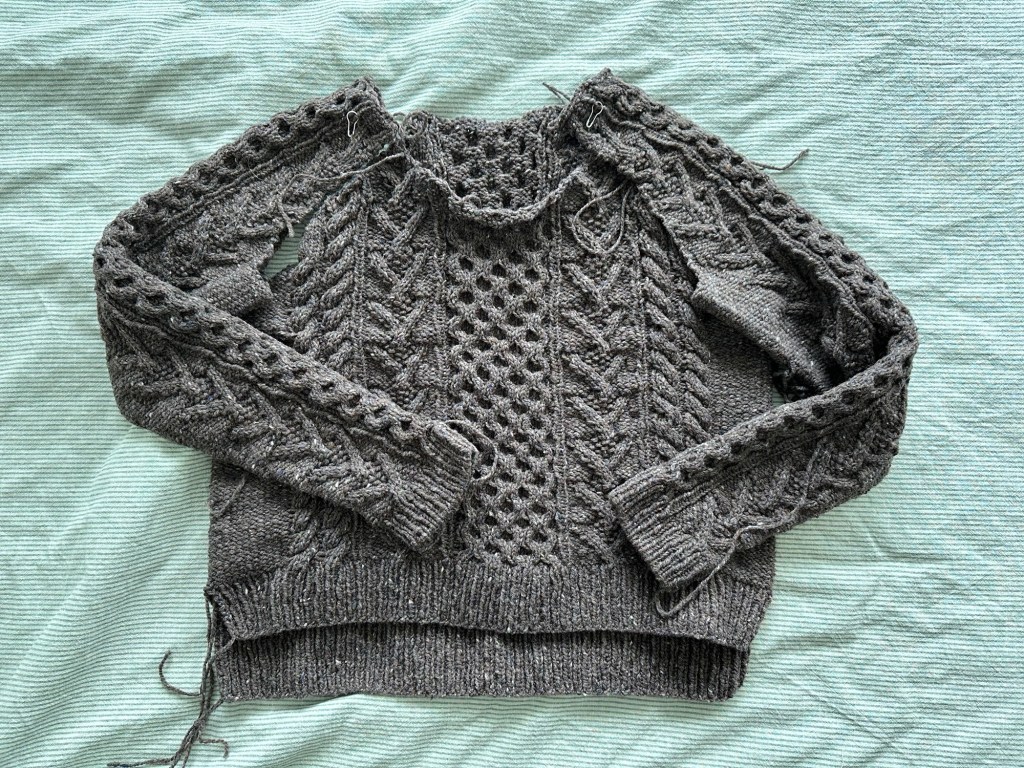
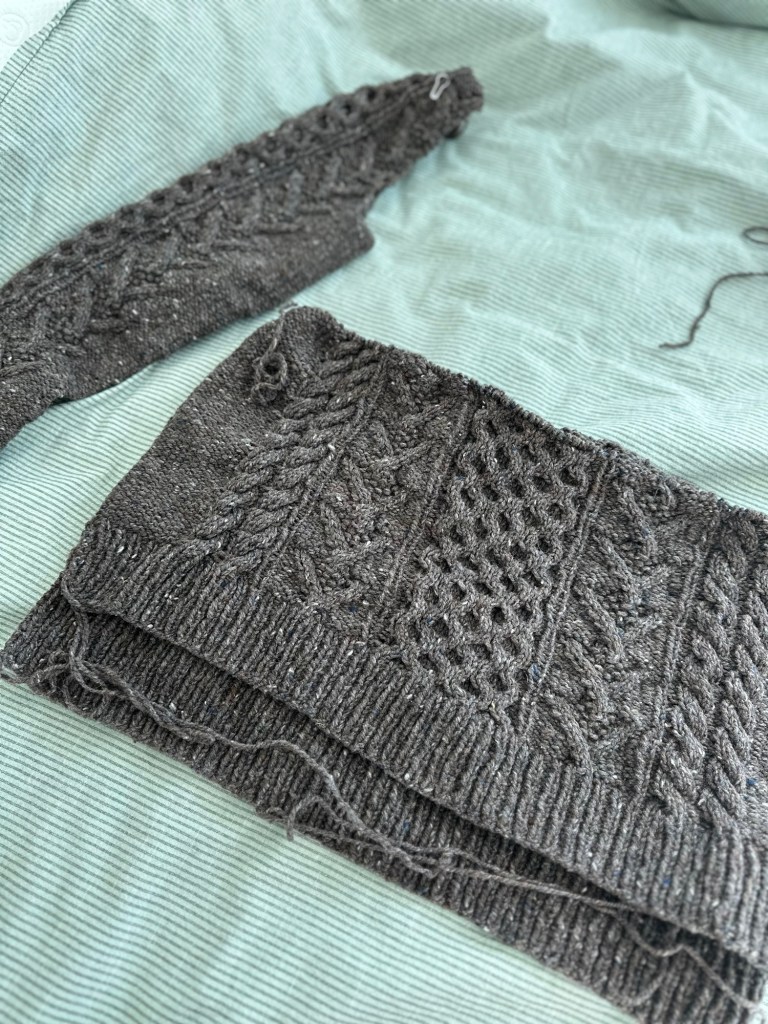
Where I left off on the Bronwyn sweater before my trip — blocking, seaming, and the collar are left. The Bronwyn sweater’s pattern is the opposite of PetiteKnit’s philosophy: 20-odd pages due to multiple sizes, making just the act of opening the PDF overwhelming!
It’s Tuesday, slice of life day, but I’m feeling uninspired.
I’ve just gotten back after an afternoon at Sojo Spa Club with a close friend, where we hopped from hot tub to hot tub and sauna to sauna, stepping into the cold plunge waterfall whenever we got too hot.
And New York is hot right now. 95 feels like 97, the air thick, though at least there’s a slight breeze.
I’m here for a couple weeks, staying in my childhood bedroom-turned-guest room, until I head to Lubec, Maine for the Quoddy Writing Retreat with Ana and Ralph Fletcher and Georgia Heard (so soon!).
On a day like today, where I’m feeling uninspired to write, I start to wonder if I’ll feel like that on this writing retreat. I have a kernel of an idea for what I’ll work on while I’m there, but I’m not sure if I’ll feel inspired to write about that once I get there. The imposter syndrome sets in. I’m not good enough for this retreat! And, what if I have writer’s block the whole time?! (My writing partner, Ana, would tell me to flip it: “What if you don’t? What if the whole time, you can’t stop writing?”)
My body feels extra relaxed after the spa. Phoebe is lying down at the foot of the bed. I wonder if she’s too hot with all that fur. My mom is on a work call in the next room. The fan spins overhead, the white noise I grew up sleeping to. The shutters are mostly drawn but the light comes in through the window. It’s dark to keep it cool.
I’ll wait a bit longer and then take Phoebe out for a slow walk.
Last week, I “unfrogged” a piece of knitting. (In knitting, when you “frog” something, it means you set it aside for an indeterminate amount of time, aka, you abandon it for a little while, or for a long while, or forever!)
It was the June Top, a silk tank top by PetiteKnit, a knitwear designer known for her simple, classic, and easy-to-follow designs. I bought the pattern and the yarn for it last summer when I was visiting Julie upstate, and started it when I got home with the intention of marling the yarn, but didn’t like how it was turning out. So it stayed in its project bag in a basket, untouched for months. This spring, after Julie and Chris came down for a visit and she asked what was on my needles (nothing), I decided to unravel it and turn it into a striped tank top, but I didn’t get very far before frogging it again.
Summer break seemed like the perfect time to get my hands back on a project, though. There’s something about the long vacation that leaves my anxiety tingling through my fingers. A restlessness, you could call it. I’ve gotten better about biting my nails, but not completely — my left thumbnail has beared the brunt of it (sorry, buddy). Knitting has always helped me with that urge to fidget or to bite, and that was initially why I pulled the project bag out of its spot under the coffee table and got back to work.
Soon, though, the joy of knitting re-emerged and took hold. There’s an almost addictive energy that forms as I physically sculpt a new garment. I once more felt grateful for my hands and fingers and the skill that I have honed since my mother and my grandmother taught me to knit as a young girl.
The tank top started taking shape.
Knit bottom up, in the round.
Once I had two stripes of each color, I was on a roll. I decided on the length (2 inches shorter than what the pattern called for, as I tend to wear cropped shirts and high rise pants) and separated for the front and back.
The front straps complete.
When a pattern is simple stockinette stitch, I’m able to knit without looking, and watch TV shows or movies as I do it. But once a pattern calls for more attention — short rows, bind offs, lace, or cables — I have to keep my eyes on it.
So this time, I decided to borrow an audiobook from the library to accompany me through the many hours of knitting I still had left to finish the top: The Maidens by Alex Michaelides.
The thriller ended up being the perfect companion to my knitting. I hung on every word, listening even when I showered and ate a solo meal. The voice actor who read it was excellent, and I felt as my students must feel during read aloud. I kept telling P how I couldn’t wait to get back home so I could listen and find out what would happen next!
And of course, I finished my June Top in no time:
Necessary mirror selfie after finishing and wet blocking.
I realized that I could combine two of my great loves: knitting and reading. And this realization gave me the boost I needed to pick up another project I’ve had frogged for a while: the Bronwyn pullover, a cable-knit beauty. Perhaps I’ll get her done before my trip to Maine.
I started this project in the winter of 2020! Let’s see if I can finish it in the next few weeks.
Which leaves me to search for my next audiobook companion. Are any of you audiobook listeners? Do you have any audiobooks that you’d recommend (ideally fiction, though I have loved listening to some nonfiction read by the author)? Or, have you read a book recently that you couldn’t put down and think would read well in audiobook format?
“Is she for real?” A guy behind me asks in disbelief to his friend.
A teenaged girl has just let her two rolling suitcases go flying down the escalators at LaGuardia Airport.
All of us look up at the sound of the plastic rubbing against the moving stairs at whip-fast speed, a loud “ZZZZZIP!” echoing through the terminal.
A flight crew member gets there in time to stop the suitcases from flying further on the tile floor and hitting anyone. The girl runs down after them, her hands covering her nose and mouth in shame. Her mom and, I assume, sister, look down from further up the escalator.
She’s very lucky no one was ahead of her. It’s still unclear if she purposefully tried to slide them down or if it was an accident.
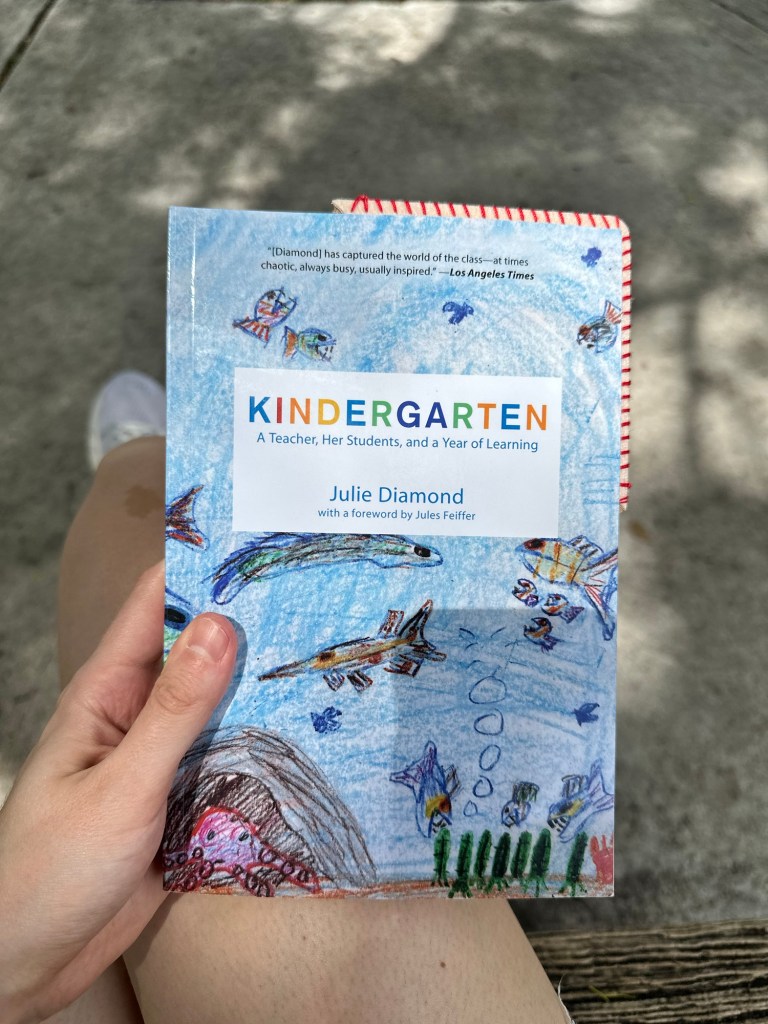
Wait a second, I thought. Julie Diamond? Could it be that Julie Diamond?
Sure enough, when I googled the book and the author, up popped my own kindergarten teacher from decades ago, with her short, gray, cropped hair. I immediately ordered the book from Amazon and patiently awaited its arrival.
On Wednesday, I went to a dog park with Phoebe while P taught a private soccer session, and began reading.
The gorgeous cover with Estelle’s bookmark gift peeking out.
I couldn’t put it down. I read, wishing I’d brought a pencil to underline and take notes in the margins. I reluctantly dog-eared the pages, swearing I’d unfold them as soon as I got home and write the notes I’d been meaning to (which I did).
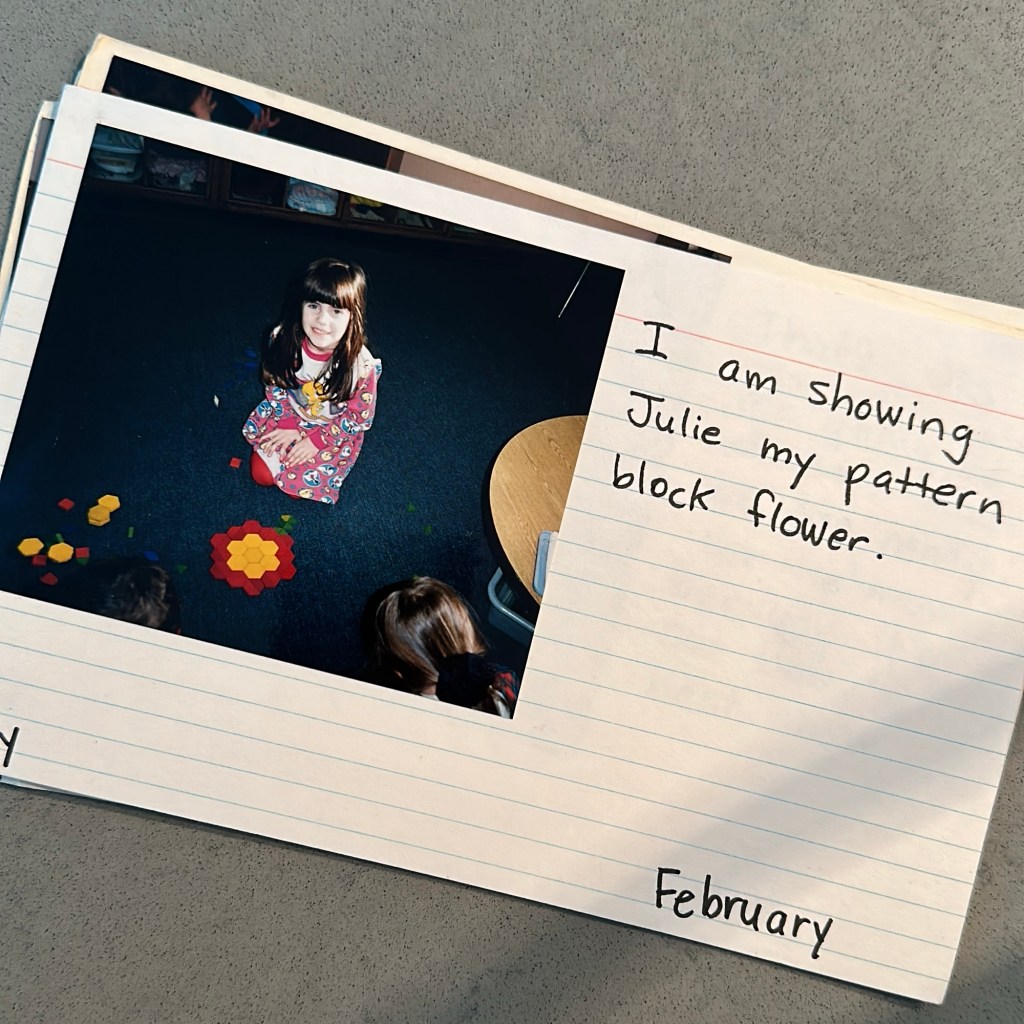
In a serendipitous way, I discovered, through reading Julie’s words, that my first elementary school teacher had a teaching philosophy truly aligned with my own. Progressive, project-based, child-centered, Reggio-inspired.
How much of my educational career, both as a student and now as a teacher, can I attribute to that first year of my schooling at PS 87 under her tutelage?
As Julie explains how she (and you, the teacher-reader can) truly listens to children and lets them guide their own learning, providing practical advice for setting up and running a classroom, I find myself affirmed, inspired, and impassioned. I am a sponge, soaking up as much teaching as she has left to share with me, some 28 years later.
Kindergarten me
I feel more excited about heading back to work in August than I have been in years, and I’m curious about setting an intention to write about the upcoming school year: “a teacher, her students, and a year of learning.” What a beautiful idea.
Perhaps the SOL community is a good starting place to hold me accountable.












 Writing With Abandon