Writing With Abandon

Reflections and ramblings about life as an educator, writer, reader, knitter, and over-thinker. Trying to do the writing only I can do.

Tag: two writing teachers

  • Bilateral Beach

    For someone who has lived in the Sunshine State for almost 4 years, I don’t go to the beach nearly as much as one might expect. Nor to the pool, even though each of the three buildings I’ve lived in since moving here has one.

    But every other Saturday since late October, I’ve been driving the 45-60 minutes up to Hollywood Beach to see an EMDR therapist in her tiny house whose street leads to the beach. Whether before or after my sessions, I make sure to come sit and look out at the rolling waves, feel the salty air lick my face, and stick my feet in the sand.

    The hottest day can feel bearable when you’re at the beach, the respite of the cool water just steps away. Likewise, I enjoyed coming out here on cooler mornings this “winter” in a light sweater, hugging my knees close.

    EMDR – Eye Movement Desensitization and Reprocessing – therapy works through bilateral stimulation, alternating beats or taps or a side-by-side visual. It helps people process traumatic memories, and it’s been far more effective for me than regular talk/cognitive behavioral therapy. I came here the first time amidst nonstop panic attacks, unable to eat or hold food down. Now, 4 months later, I have found a place of calm within me that hadn’t existed before. Or, perhaps it existed, but was buried beneath so much.

    I sit here, staring at the water, its blue and turquoise hues, and recognize my growth. I have only gratitude.

    There are big changes coming soon. I will leave the classroom after this year and see what’s next. There is fear, and excitement, and unease, and impatience.

    But like so many other transformative moments of my life, I will trust my gut, ride the wave, and come out the other side. I’ll step out onto a different shore, ready to greet what awaits me.

  • On Doing the Writing Only I Can Do

    I crack open the notebook I used for the Quoddy Writing Retreat this past August, led by Ralph Fletcher and Georgia Heard. The notebook I haven’t touched since landing back in Miami, even though I made promises — to myself, to my writing group — to set aside time to write. My streak of Tuesdays got away from me sometime in the early fall. Life happened, as they say.

    But Ralph told me that writing will always wait for you. If writing is important, it will come back to you. The muse will come knocking.

    I hope writing has been patient, as I’ve set her aside these past many months. I hope she doesn’t mind me picking her back up, dusting her off with the fabric at the bottom of my t-shirt.

    Because it’s the third Slice of Life challenge I’ll be participating in, and this time around, I have an even larger community doing it with me.

    I’m skimming these pages and gems are jumping out at me, quotes from Ralph and Georgia and other published writers. I’ll jot them here, in hopes I can return to them on the days when slicing just feels too hard. Reminding me that I’m in great company.

    ***

    Do the writing that only you can do.

    “Tell your stories. You own everything that happened to you.” – Anne Lamott

    Write with abandon.

    “It is, really, about heart; about a human being looking at life through her own lens and thinking and feeling it through and then making something – even something very simple – that says something new and truthful – something that reaches out to the reader in a spirit of commiseration.” – George Saunders

    “Be you. Be all in. Fall. Get up. Try again.” – Brené Brown

    “The bigger the issue, the smaller you write.” – Richard Price

    Let the image do the work for you.

    Revision is like chiseling away at stone, at clay.

    “Revision is not a way to fix a broken piece. It’s a way to honor a great piece.” – Ralph Fletcher

    The notebook is a playground.

    “We tell ourselves stories in order to live.” – Joan Didion

    ***

    It’s with these writers at my back that I embark yet again on this challenge. I will write with abandon, “just have fun with it,” as my dad says. I’ll do the writing only I can do!

  • A Friday Slice

    “Are you going to do the Slice of Life Challenge this year?” Ana asked me this morning as we passed each other in the halls. “Male and Angie are gonna do it, and Gi too.”

    “I don’t know…” I skirted. This year’s intention to slice every Tuesday started out strong and then waned in the fall as I dealt with some personal health issues. If I couldn’t commit to doing it weekly, how could I do it daily?

    *

    Later, when we met in my room, she mentioned it again.

    “I just sent an email to the second grade team. Darlyn is in!”

    “Maybe…” I smiled. We returned to the writing plans. I shared something funny a student had said about me moving the teacher’s desk.

    “That’s a slice!” Ana exclaimed.

    “Should I just write it and schedule it for March 1st?”

    “YES!”

    *

    At 3pm, while I was waiting to meet with Male, Ale left Ana’s office and Ana shouted, “Ale’s gonna slice, too!”

    “Okay, okay,” I laughed. With this many new slicers from our little school community, surely I could get motivated enough to slice again each day for the month of March. It was tough last year, but it was also fun and satisfying, connecting me not only with other slicers but with friends and family (hi, Mom!). Plus, I have a little time capsule now that captured a joyous month in my life when, among other things, I was falling in love.

    So, here it is. Today’s slice. Never mind that it’s a Friday:

    *

    This morning when I entered the classroom at 7:48am, I had visions of the documentation that would start to emerge on the bookshelves as I cleared them. But something wasn’t right. The table by the window always got in the way, and the chairs were all different sizes. There was all this dead space near the teacher table, too, and the math materials were blocked off and inaccessible to the students.

    So, I did what I always do when I realize the layout of the classroom doesn’t align with how we’re using it — I started rearranging.

    First order of business: moving some of the writing charts. Next? Swapping the teacher table with the long one at the window.

    The first students arrived at 8 to find me and all of our tables and chairs scattered.

    “Good morning!” I shouted.

    “Um, hi? What’s going on?” Two of the girls asked.

    “I’m rearranging the furniture. Help me!”

    “Okay!” They agreed. These two are always up to help with anything.

    “Is this table going to stay on the rug?” The other girl asked, skeptical.

    “No, no,” I assured her. “It’s just there while we get the rest sorted.”

    Then two of the boys arrived.

    “Happy birthday!” I said to one of them who turned eleven today. “Help us move these smaller chairs to the other room and grab all the big ones to bring in here?”

    They set off on their task as a few more students arrived.

    “We’re rearranging everything!” One of the first girls explained.

    “Why?” A student yawned.

    “I don’t know! For a change?”

    “Because Ms. Amy was doing it when we came in!”

    “But Ms. Amy, it’s so sunny over there! You’re going to fry like a grilled cheese!”

    “I liked it better before.”

    “Yeah, what about all the other teacher stuff that’s still over there? It’s so far away from your desk now!”

    Once everything was moved, and we were mostly satisfied with their placements, we gathered for Morning Meeting.

    I explained to the fifth graders that I got the rearranging “itch” from my dad. When I was growing up, he always moved around the furniture in our combined living room/kitchen/dining room. I’d wake up and come out to see things in different places. It would be a bit of a shock to the system, and then I’d get accustomed to it. Ever since, I have constantly rearranged my dorm rooms and apartments to whatever felt right. And I always found that rearranging gave me a refreshed feeling, a sense of starting anew.

    I’ve found that with classrooms, even the same one, once you see how the students of that year are using the space, it often becomes clear how best to arrange the furniture. (And it’s apparently good for their brains to have that change!) Sometimes you only need to rearrange once. Sometimes more! (Like last year, which one of our students hated, but Kim loved.)

    A half hour later, as we were teaching math, Sol came in and widened her eyes. She walked over to the desk.

    “I rearranged!” I said.

    “I see that,” she laughed. “Are you trying to slow cook us?” She asked as she shaded her eyes from the sun beaming in through the window.

    “Seriously, Ms. Amy,” M said. “Yesterday, this was you: ‘Oh my god, the window is so hot, we need to move things away from the window.’ This is you today: ‘I think I’ll put my desk by the window. Yeah, good idea…’”

    He’s not wrong, but I’ll give it a chance. I think it will work.
  • When Ralph Comes to Visit

    “Are you ready?” Betsy asked me in the morning as we readied the theater. It was thirty minutes before the second performance of our class’s theatrical adaptation of Flying Solo by Ralph Fletcher, and today, not only were the students’ parents coming, but so was Ralph, himself!

    “Ready! And nervous!” I spat out. We still needed the videographer to come to check the new prop placement, and he wasn’t replying to my texts.

    “Tranquila,” Betsy said. “Enjoy this!”

    And despite a little tech hiccup right before we let parents in, I did.

    I managed the changing of the digital backdrops and the sound effects, preparing to give cues if students needed, but mostly, I just enjoyed the show. Ralph and Ana sat to my right, and I kept warming at his audible reactions:

    “Wow, she’s good.”

    “Huh!”

    “That’s pretty clever.”

    When E as Mr. Peacock introduced him, and he stepped up to take his line (the line he wrote), the audience applauded loudly. Ralph! Here! A storyteller that inspires!

    The rest of the day was a whirlwind of professional learning sessions with him, organized by Ana. My brain buzzed with ideas, my pen moving rapidly to catch all of the wonderful things he had to say.

    One has stuck with me all afternoon into evening.

    Ralph says, many students think revision is to fix a piece of writing that’s broken. He sees revision as a way to honor a piece that’s good, a piece that means something to you.

    Flying Solo meant something to us. We went through more than seven revisions of the adapted script, honing it each time, whittling away, adding, molding, sculpting a dynamic play that could truly capture the magic we felt with the first read. And I think we honored that original magic today.

    I’m exhausted, and ready (in a way) to get back to our regular schedule without rehearsals. But mostly, I’m grateful.

    Thank you, Ralph. Thank you for writing this book and all the others. Thank you for giving us permission to adapt it into a play. And thank you for coming to see it, for meeting our students. The smiles on their faces meant so much.

  • Planning, Projecting, Pacing

    I have a rare gift of a late-start morning, thanks to a doctor’s appointment, so I figured I’d take the time I still have before I head over there to write my slice.

    We’re coming off of a long weekend, and I happily spent some time on Saturday planning this week and next’s reading lessons and pacing out unit 2 (nonfiction). The lessons were the first that I’ve planned independent of Ana — huge step! Wow! — and I felt confident finally in how I was writing them. I used all the tools that I’ve acquired thanks to her:

    • The recipe for the perfect teaching point (the what + the how)
    • The TC learning progression for narrative reading (which I’m kicking myself for not using until now)
    • Rubric creation for the final assessment
    • Our pacing and planning guide with titles of each session

    And once I was done with that, I took a look at the next unit, even though I had many other things to do, because I’m geeking out over teaching it.

    To give some background, our school has not had a consistent reading curriculum since I started teaching there, so this year I’m planning out all new units using our power standards and other curricular resources (Shifting the Balance, Jennifer Serravallo, TC units of study) so that they reflect a) what our students need and b) are more digestible for them. This means that much of what I’ll be (and have been) teaching them asks them to raise the level of their reading and interpreting to a point they’ve never been asked before. Which is really hard. But I know they’re capable.

    For the nonfiction reading unit, I’m keeping in mind the fact that Adam Fachler highlighted during the Thinking Maps Training of Trainers course I took with him so many years ago: you can’t learn new skills AND new content at the same time. It’s one or the other. So, I’m choosing new skills. Rather than requiring students to read about topics they don’t know much about, I’ll have them choose a topic they “sort of” know about (as Ana said, lol), or really: a topic they know well, but can still learn more about. The goal of the unit will be clear from the get-go: to prepare for a “knowledge fair” where they’ll teach younger students about the topics they’ve researched.

    The skills I’ll be focusing on this unit are:

    • Note-taking to capture, organize, and synthesize information, using text structure to guide
    • Summarizing by identifying main idea and important supporting details
    • Writing about reading to teach others

    I’m hopeful that this nonfiction unit goes better than nonfiction units I’ve tried in the past. If the projecting and pacing stage is any indication, it’s already going well.

  • The Magic Happening

    I missed my slice last week, and it’s already 9:28pm, but Ana sent me a text saying she wants to show up even if it’s just for four lines, so I figured I could do that too!

    The last couple weeks have felt nonstop, more so than in years past, and in spite of us having a fairly easy class behaviorally. When my nervous system gets disregulated due to outside factors, I often feel like I won’t be able to get it all done and just want to crawl into a hole and stay there for a while.

    Our head of schools gave me the advice of being present and focusing on the magic happening right in my classroom, so that’s what I’m going to try to do for this slice—think of four magic things that are happening.

    Here goes:

    1. A morning meeting activity: sentence types. A BrainPop image of the two presidential candidates. Students turning and talking and sharing smart and serious and funny sentences.
    2. All four committees of our Flying Solo play adaptation, fully engaged and working in tandem towards our November show. Their wonderful ideas. Quieter students speaking up.
    3. The way a few of our students take such care of our space—keeping stock of supplies, making labels for everything, organizing the pillows, color-coding the library shelves, folding the table rags, knowing who has what job when, following *most* of our routines.
    4. A reading conference with a student, starting her book together and helping her monitor and clarify, then watching as she made an un-prompted inference, and with guidance, found text evidence to support it. 🥹
  • Reggio, Meet Ralph.

    This summer, at the Quoddy Institute, one of the other teachers (I think it was Cheri!) mentioned that she and her 5th graders always start the year reading Ralph Fletcher’s Flying Solo, a book about a class of 6th graders and what happens when one day, neither the teacher nor his substitute show up. She told me how one year, they even did their own experiment where she and a colleague didn’t go back to the classroom after recess, instead watching what ensued from the window across the playground. Fascinating, I thought! I immediately went to my Amazon app, added it to my cart, and hit “purchase.”

    I read the book quickly before school started, then gave it to Kim to read as well. It’s short, around 150 pages, and it was perfect for the first read aloud as it had a great theme about integrity and would give them plenty of practice making inferences about story elements. I figured we’d read it within a couple weeks, then launch into Starfish by Lisa Fipps, a favorite from last year.

    But each day that I read Flying Solo to my fifth graders, I uncover another layer of the book that I hadn’t noticed before. Like how many references there are to democracy, or all the time jumps there are (perfect for teaching about the importance of flashbacks!), or Ralph’s excellent use of figurative language.

    And my students’ reactions have been unexpectedly thoughtful as well. It’s a fun book, a real kids’ book, so they’ve been very engaged from the beginning. But they’ve also shown deep empathy for some of the meaner characters (like Bastian, who teases the other kids, but “is probably doing that because he’s sad about moving and his dog, Barkley,” one of my students said). They’ve made many predictions about Rachel and whether or not she’ll speak by the end of the story. They laugh at Christopher saying “fact” and “opinion,” roll their eyes at lame jokes (and widen them at the can’t-believe-she-just-said-that jokes), and cheer on the students who stand up to the others. They endlessly wonder how Tommy Feathers died, shocked and saddened that it could happen to someone so young.

    They’ve practiced summarizing for their classmates who have been out sick, have distinguished between primary, secondary, and tertiary characters, and have talked endlessly about the plot and how they wish there was a movie.

    This is where the Reggio spark really begins:

    Two of our girls were walking alongside me in the hallway on the way to lunch when one said, “This book should be a movie!”

    And I replied, “I want to make that movie!” (Laughing to myself because the other night, as I told P about the book, he and I both said we could imagine it so clearly as a play!)

    Our conversation continued through the lunch line as we grabbed our plates, then sat at the lunch table with Kim and three of our boys. I opened up the Otter app to record our conversation, and let their ideas bubble up and build on one another:

    “We could do it for a show!”

    “We’d need another person that’s Rachel that speaks for her, because so much is going on inside her head. Like a voiceover.”

    “We could rehearse during read aloud.”

    “We could pick out the characters and think of ideas, act it out, and maybe write our own script. Or you can pick ideas from it?”

    “We might need to cut some of the characters that don’t have that many character traits.”

    “I want to be Rachel!”

    “I want to be Jessica!”

    “I want to be Christopher!”

    “Hold on,” I said, the gears turning in my head. Could this work? Could we make this happen? “I’ll need to email Ralph for permission first.”

    He replied within the half hour: “Yes, you have my permission…that would be really great.”

    We told the students at the end of the day and they cheered! That was yesterday. Today, they’ve been talking about it nonstop throughout the day. Ralph sent us a video of him talking about the book, which we watched in closing circle. This Thursday we’ll finish it and next week we’ll start our talks about writing a script. We’re all a little bit in disbelief… and a lot a bit excited.

    And that is how a Reggio project is born.

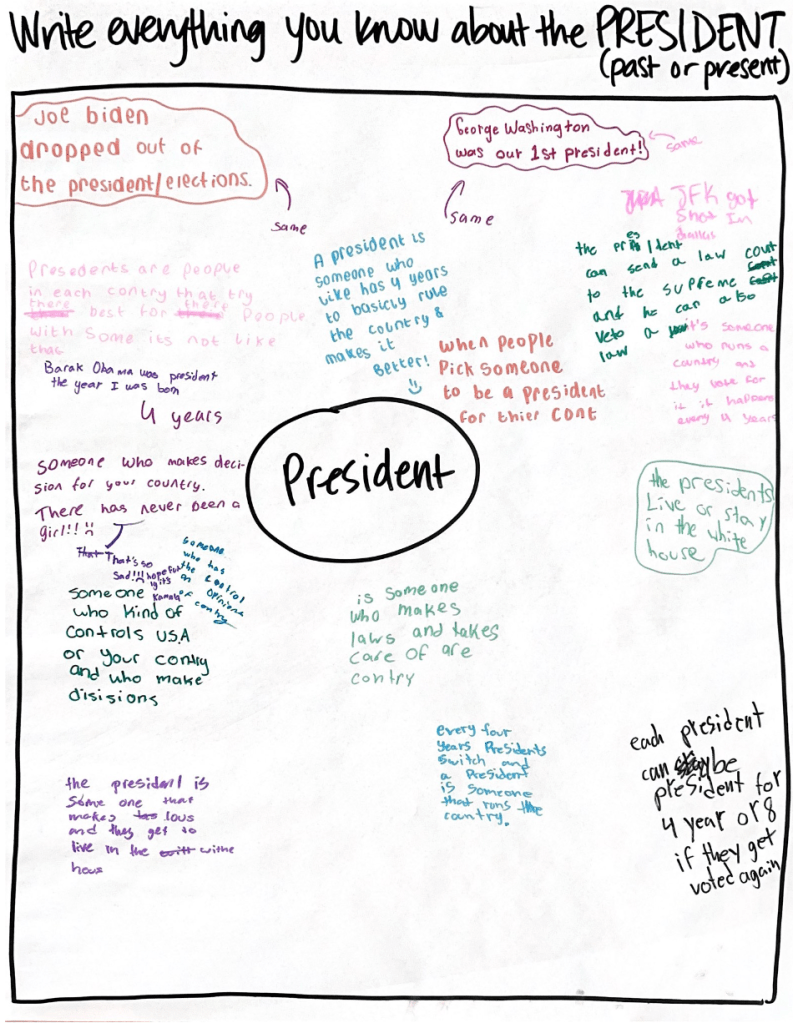
  • Starting With What They Know

    This is my second presidential election season as a 5th grade teacher and third since I started teaching. I can still remember that morning in 2016. I took the train uptown to Washington Heights, heart hurting for the third graders I would greet in my classroom. The train was so quiet. New York felt gray and sad, in mourning for the hopes we’d had, in disbelief at what was to come. It was like a somber layer, blanketing everything.

    In 2020, I was at home, teaching remotely. When Georgia turned blue, I flew out to the streets, cars honking, screaming an exasperated “YES!” Later that evening, I followed the cheers into Central Park where there was a celebratory roller disco happening.

    Election season is different this year. I live in Miami, in the heart of a not-really-swing state. I have to bite my tongue when certain topics get brought up, and dig my heels in when others do. Still, it feels like there’s some hope, especially after the change in the summer.

    But my own political views are not what I came here to write about, and they’re certainly on display in my classroom. That said, politics comes up in our classroom every day.

    As defined in Usborne’s Understanding Politics & Government, an excellent informational comic book about the topic, politics “actually covers the way people make decisions about how to work together in all kinds of groups, big or small.”

    Politics comes up when the students share that they’re starving before lunch and can’t concentrate on reading, so we decide to swap reader’s workshop and read aloud and bring an extra fruit from our early snack to munch on when we start to feel the hunger pangs. Politics comes up when the students vote on whether we should stay indoors for recess or risk going out when there’s a dark looming cloud over the playground. Politics comes up when one student tells her friend that Kamala Harris would be the first “Black woman president” and the friend replies, “the first WOMAN president at all!”

    In Reggio Emilia-inspired schools, we follow the children’s lead, listen to their theories, and give them the tools to prove or disprove those theories. As teachers, we keep in mind the skills they need to practice and the main content they need to know before they move on to the next grade. We go deep, instead of broad.

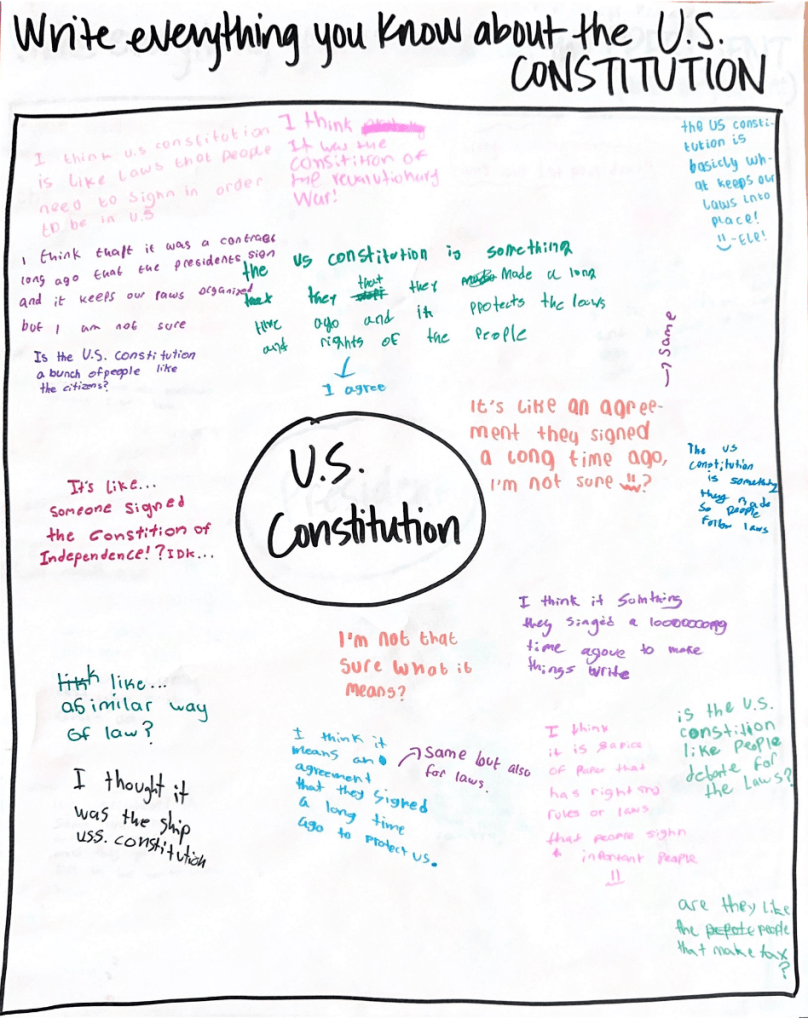
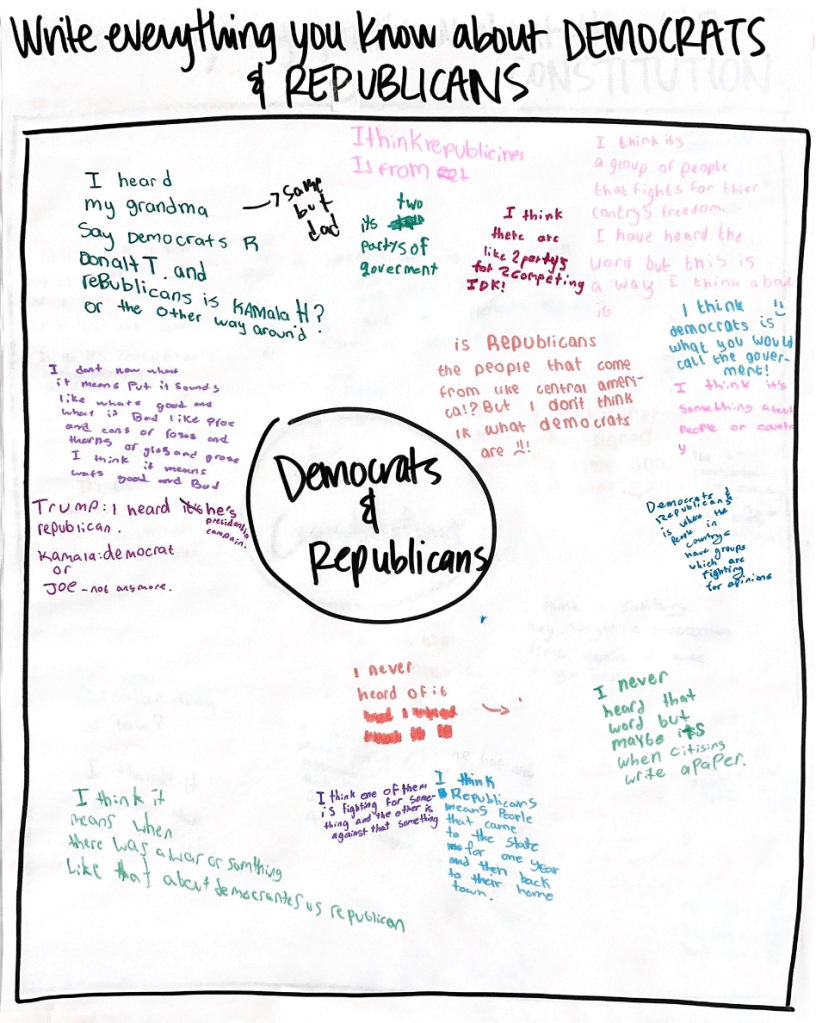
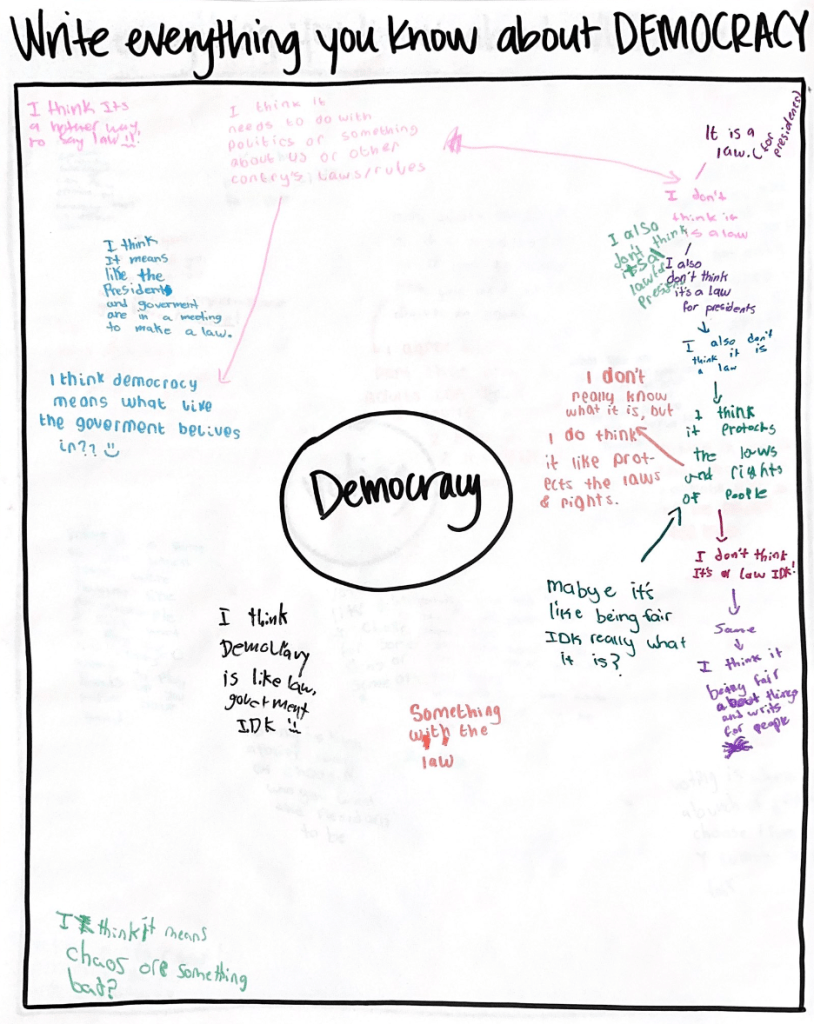
    The presidential election is happening, and our students are hearing about it. It’s important that they understand the basics of our government, their rights and responsibilities as citizens, and how an election works.

    But we start with what they know. So yesterday, we did just that.

  • A Better Reading Teacher

    My hope and dream for 24-25

    This year, my ninth year as a lead classroom teacher, is the year I want to tackle reading. My first few years in the classroom, I focused on dual language learning, math, and classroom management. Then, project based learning followed by writer’s workshop.

    Every year I’ve held off on reading. I’ve dabbled in it, I’ve led interactive read aloud and book clubs, I’ve ensured access to books and (mostly) protected independent reading time. But reading instruction? It’s always been a struggle. First, because I was teaching in dual language classrooms, later because it was just one more thing on top of all the other stuff I was doing.

    And mainly, because it just felt hard! Reading is something I love, but I don’t know how to teach, at least for upper elementary. Upper elementary is challenging, because we don’t get the training in phonics to help teach our students who have gaps. The students who are still learning TO read, and aren’t yet ready to confidently use reading to LEARN.

    But it’s time. I have to face it.

    So this year, my goal is to become a better reading teacher. This will include designing and developing reading units that are aligned with our new power standards, as well as implementing age-appropriate small group lessons for those students who need fluency and decoding support.

    We started by designing a launching unit to get the students excited about reading. The lessons included: cuing students to notice that we see reading EVERYWHERE; asking students to get curious about how they and their grownups learned to read; sharing some of the science of reading for students; sharing some fun reading history facts so students could realize how reading is a privilege; and helping students take ownership over their reading journals and the why/how of talking and writing about their books.

    Ana jokes that we should sell the unit, and I shake my head, but then I think, maybe we should! Because excited about reading? They most definitely are.

    Student jots, later categorized. My favorite has to be the Twilight Gossip!
  • On Letting Go and Watching Her Fly

    There’s something about teaching Writer’s Workshop that I feel oddly possessive about. It was something I grasped tightly to after meeting Ana, moving to Miami, and starting to work at KLA. It helped me through a tough couple of years in my personal life. It was something that I had control over, and which brought me and my students joy. It got me writing again, got me to see myself as a writer, just like I hope my students will see in themselves.

    So, letting go of it as a subject that I teach, that I plan, feels… scary, and uncomfortable, followed by guilt that I feel that way. It’s like a blanket being pulled off the bed that I’m still clutching to a corner of because I am desperate to stay snuggled up in it, even though I know the blanket is big enough for me and another.

    But that fear and discomfort gets replaced by awe and pride each time I watch Kim lean in and open up to the students, whose eyes light up with her stories. Every time I watch her implement all that she’s learned in just one year. There’s no doubt in my mind she will teach them so wonderfully. And I’ll be right beside her to support, to model conferencing, to be her mentor.

    “Writers, today I want to teach you,” she says, using that predictable language. And teach them she does.

    I can’t wait to watch her fly.

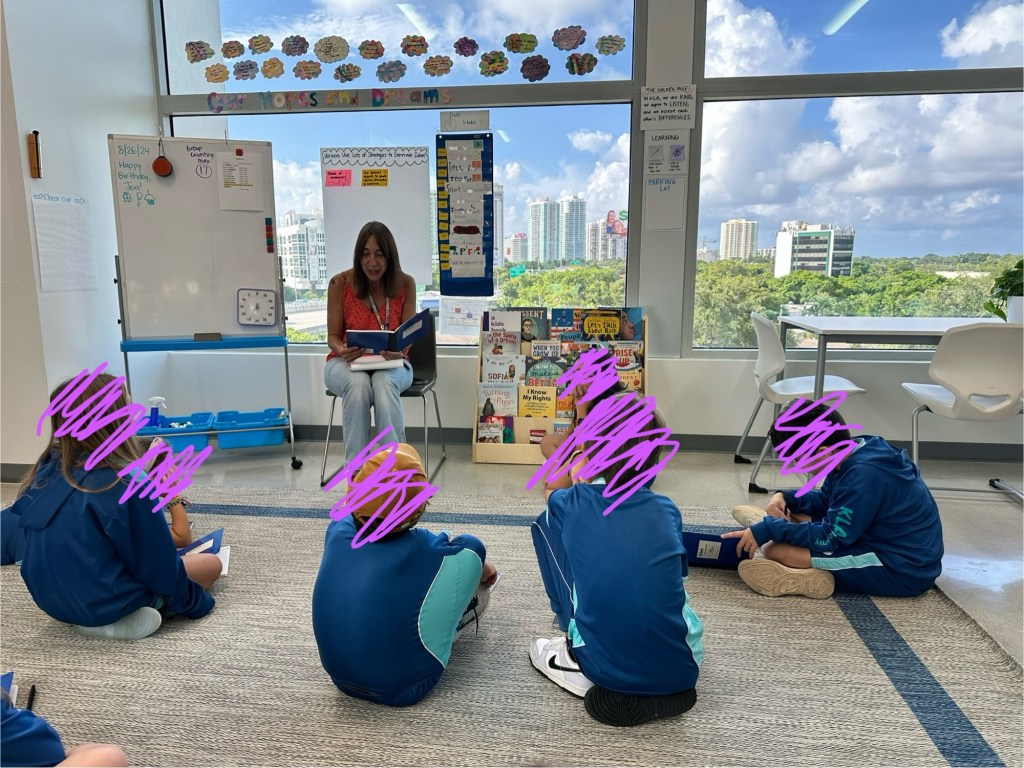
    Kim reading one of our student’s stories out loud, just like Georgia Heard did for us at the Quoddy writing retreat.