Writing With Abandon

Reflections and ramblings about life as an educator, writer, reader, knitter, and over-thinker. Trying to do the writing only I can do.

Tag: two writing teachers

  • Thank You For Your Service

    “Keep only those things that speak to your heart. Then take the plunge and discard all the rest.”

    I read The Life-Changing Magic of Tidying Up by Marie Kondo 9 years ago, and I remember being pretty moved by it. I liked the idea of dumping all of my clothes from every season onto my bed, going through them one by one, and asking if they sparked joy. I never accomplished her entire method, especially when I lived with others, but have gone back to her wisdom time and again whenever I get the buzz to do a deep cleaning.

    It was a couple weeks ago at my acupuncture appointment that my doctor recommended I use the KonMari method to say goodbye to teaching. She could sense the anxiety bubbling under my veins as she felt for my pulse.

    “Just as you thank an object for its service, for what it taught you, you can do the same for your job,” she said, then turned slightly as she acted out how she would do it. “Thank the classroom, thank the building, thank the people, your colleagues and the cleaning staff, thank everything for all that it taught you, for getting you here, to this moment.”

    As I drifted off into that deep, restive acupuncture sleep, I started thinking about all of the thank yous I would give. On my way home, I stopped at Target and purchased a pack of 24 thank you cards. Every day since then, I have written a few cards, working my way through a list I made on my phone’s notes app.

    For this slice, I went back to my copy of The Life-Changing Magic of Tidying Up and found Marie Kondo’s reasoning behind this gratitude-before-discarding thing: “The process of assessing how you feel about the things you own, identifying those that have fulfilled their purpose, expressing your gratitude, and bidding them farewell, is really about examining your inner self, a rite of passage to a new life.”

    As I read these quotes, I felt a warming in my chest. How much has it felt lately like I am shedding that which doesn’t serve me anymore? And how true is it that every time I have shed that which does not serve me, in spite of the fear that it may induce, I have ended up receiving so much more than I could have imagined?

    She continues: “To truly cherish the things that are important to you, you must first discard those that have outlived their purpose… Can you truthfully say that you treasure something buried so deeply in a closet or drawer that you have forgotten its existence? If things had feelings, they would certainly not be happy. Free them from the prison to which you have relegated them. Help them leave that deserted isle to which you have exiled them. Let them go, with gratitude.”

    Staying in or keeping ahold of something — a relationship, a job, a place — that no longer serves you is not fair to you or them. It holds both of you back. I am so grateful to KLA and 5th grade and the families for everything they have brought me, and I also know it’s important that I step away now, so that the next teacher who will best serve that role can step in.

    But it’s hard, and that’s where the act of truly considering the role each thing has played in your life comes in: “When you come across something that you cannot part with, think carefully about its true purpose in your life. You’ll be surprised at how many of the things you possess have already fulfilled their role. By acknowledging their contribution and letting them go with gratitude, you will be able to truly put the things you own, and your life, in order.”

    I am tidying my life, I suppose, with this transition. That’s the metaphor for it. Making space for a new career that brings me joy.

    One final quote: “It is not our memories but the person we have become because of those past experiences that we should treasure. This is the lesson these keepsakes teach us when we sort them. The space in which we live should be for the person we are becoming now, not for the person we were in the past.”

    Which reminds me of the other wisdom I received a few months ago: Don’t ask “what next?” But rather “what now?”

    I can’t wait to find out.
  • Just One More Game

    “I’m nervous,” J said, hugging me. “I’ve never played laser tag before.”

    “You’ll love it!” I reassured her.

    We were on our last field trip of the year to a bowling alley, part of the final celebrations for our fifth graders during a week we deemed “Blast Off Week.”

    After listening to the instructions, we went into the dressing room to gear up. J turned to me in her giant vest and I helped her tighten the sides.

    “I don’t get it,” she told me mid-battle. “How do I know where I’m aiming?”

    “See the red dot?” I asked, showing her the laser beam of my gun against the barrier we were hiding behind. “When you click the trigger, you’ll see it. Here, try.”

    She pulled the trigger, aiming her gun at the barrier. She saw the red dot, her eyes lighting up, grinned, and ran off to attack her friends.

    Ten minutes later, when the game ended, she had been converted: “That was soooo fun, I want to play again!”

    I laughed. “We only get one game, but I’m so glad you had fun!”

    I went to sit down next to another student who was fading, not having gotten much sleep the night before. J squeezed in next to me.

    “Ms. Amy, can we please play another round?”

    “I told you, it’s just one game, but you can come back another time with your family or friends.”

    “What if I asked the girl who works here?”

    “What’s going on?” M asked, walking over.

    “I want to play laser tag again!!” J explained.

    “Me too,” M agreed.

    “Can we please ask the girl?” J pleaded, giving me puppy eyes.

    “Alright, go see if you can charm her,” I told them. They skipped off, but came back defeated.

    “She says it’s just one game and her manager isn’t here.”

    “I told you! We had one game included in the package,” I said, thinking this was it.

    It was not.

    For the next ten minutes straight, J wouldn’t give up.

    “Please, Ms. Amy! Please ask them to let us play another round of laser tag.”

    Soon her friends joined in.

    “Please, Ms. Amy, this is our last field trip ever!”

    “Come on, Ms. Amy!”

    “Ms. Amy, please!!!”

    “Can we ask the woman again?”

    “You can ask again,” I told the group, “but they already gave an answer!”

    Two girls went off with high hopes and came back with news: “She said we only paid for one game, but that if we want to, we can each pay $10 for another!”

    “$10 for each of you is a lot of money. There are 21 of us including teachers.”

    “Not everyone has to play!”

    “Yeah! I don’t care if I play alone!”

    “Well,” I wavered, “I’d still have to ask your parents, and we’re leaving soon. It might be too last minute…”

    “My mom will happily give $200,” E said.

    “That’s a lot of money!”

    “She’ll give it if it’s for us having fun!”

    “Please, Ms. Amy!”

    “My mom will say yes to give me $10!”

    “This is the time to do it, Ms. Amy!”

    By this point they were all practically on top of me, J laying in my lap with those puppy eyes, singing a chorus of “please”s.

    “Alright, give me a second.”

    I pulled out my phone and texted one of the moms who is always sure to respond quickly: The girls are begging us to play another game of laser tag and they won’t let us unless we pay $10 per kid. I’m only texting because they have never asked me any question so many times in a row. 😂😂😂

    Her response was not what I expected: Happy to pay! Want me to Venmo you?

    Do you think the other parents would too?

    I’ll send you the money and text the parents. If they want to cover, fine. If not, I’ll handle it.

    And that is how J and the other girls got just one more game of laser tag.

  • Exits as Entrances

    Yesterday, Maggie Rogers published an essay entitled “Maggie Rogers: The Truth About Dreams” in the New York Times, which was adapted from her NYU commencement speech.

    Some lines particularly stuck out to me:

    “I’d tell her to keep the dreams bigger than the fear.”

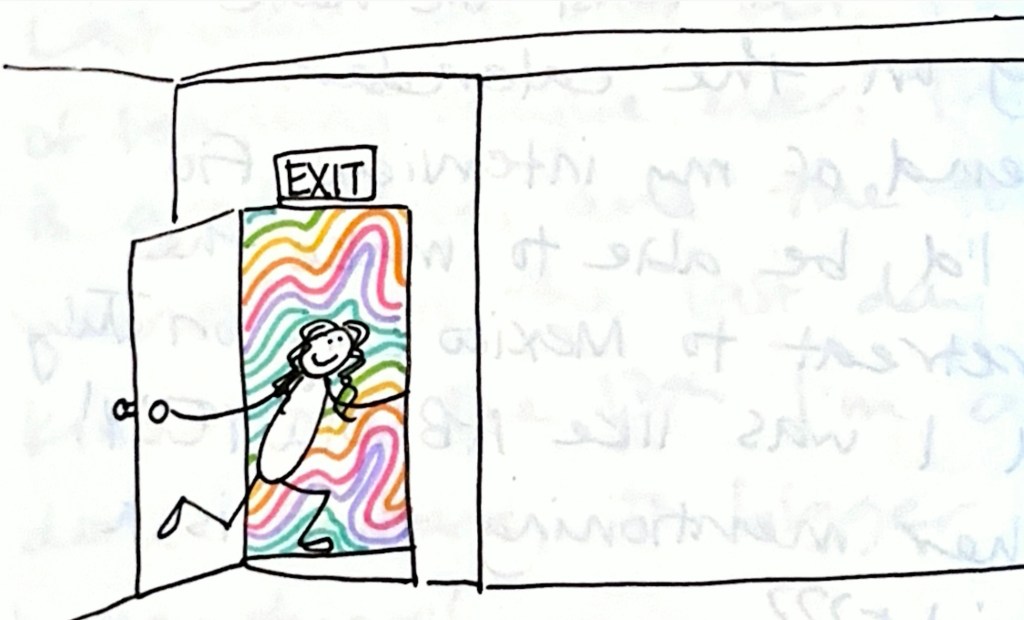
    “Maybe, just maybe, all exits can be entrances, too. Maybe it’s about embracing the time in between — the minutes we have left. And all that will always be left unsaid.”

    That one in particular inspired me to make this doodle in my journal:

    Stick figure me, exiting one room and entering something brighter.

    As 5th grade graduation comes this Friday, my last one as a teacher, all the clichés run through my head:

    When one thing ends, another begins.

    It’s not the end of the book, just the end of a chapter.

    But they’re clichés precisely because they ring true. Yes, it’s the end of an era, but it really is the beginning of another. Exits really can be entrances too.

    That’s all exits are, I suppose: entrances to the outside. To fresher air. To the sunlight that blinds you when you leave a movie theater in the middle of the afternoon.

    It takes a moment to adjust, but then, you take a breath and a step and begin the rest of your day.

  • On Faith

    A few weeks ago, before the conclave that would select the successor to Pope Francis, Patrick and I went on a pope film spree. 

    First, we watched Conclave. Next, The Two Popes. And finally, at Patrick’s brother’s suggestion, A Man of His Word, the documentary about Pope Francis. Each of the films kept me thinking, and inspired deep conversations about faith. 

    I grew up agnostic. My mom is a reformed Jew, and my dad was raised Episcopalian, but neither of my parents are religious, and so they didn’t raise us to be. They simply raised us on the golden rule: “Treat others the way you wish to be treated.”

    That said, I’m no atheist — I’ve always felt that there was something greater. I nerd out about astrology, I’m into human design, and I have been finding myself more and more surrendering to faith when faced with the unknown. 

    In Conclave, Cardinal Lawrence greets his fellow cardinals with a speech:

    “Certainty is the great enemy of unity. Certainty is the deadly enemy of tolerance. Even Christ was not certain at the end. ‘My God, my God, why have you forsaken me?’ he cried out in his agony at the ninth hour on the cross. Our faith is a living thing precisely because it walks hand-in-hand with doubt. If there was only certainty and no doubt, there would be no mystery. And therefore, no need for faith. Let us pray that God will grant us a Pope who doubts. And let him grant us a Pope who sins and asks for forgiveness and who carries on.”

    I looked at Patrick, my arms covered in goosebumps. Cardinal Lawrence was right — if everything was already known, why would anyone even need faith, need religion?

    I am less than 4 weeks away from leaving teaching, without a solid idea of what is next for me. The future is unknown. And fear lingers at every turn of thought, giving its unwanted opinions with “what if”s that leave me reeling. 

    But fear is a liar. I’ve been here before. I’ve listened to fear and let it keep me trapped in a situation that did not serve me, and when I finally got out, what did I learn? That everything I feared would happen, didn’t. 

    In fact, only good came my way. What was meant for me found me, because I turned away from fear, out of love for myself, and kept faith that everything would be okay. (Having the best support system here in Miami didn’t hurt, either.)

    As I move forward into the unknown yet again, I am reminding myself to keep faith. And if there is a god, well, Pope Francis did say, “God’s love is the same for each and every person. No matter what your religion, even for an atheist, it’s the same love.” So, maybe there really is a higher power watching over me and my loved ones. Maybe that higher power is simply unconditional love. We can never know with any certainty. 

    But it’s that unknown, that uncertainty, that mystery of life, that inspires any faith at all. And for all the unexpected people and experiences life has granted me, I am only ever grateful and full of love. 

    Thank you, thank you, thank you.

  • One More Month

    One more month until I take my final look around a ready-for-summer-kind-of-clean classroom.

    Four more weeks until I gather my books to bring home.

    Three weeks and one day until I say goodbye to our students, wishing them the best of luck in middle school.

    Two weeks and three days until our fifth graders graduate. We’ve got to get cracking on their speech.

    One week and one day before our school’s celebration of learning, the evening where we’ll be presenting our findings after the 21-day digital detox. I’m about halfway through editing the video.

    Three more days until report card grades and comments are due. Grades are mostly in. Comments? 🙃

    One more hour until we head to the car and drive to work.

    Each day has been a trudge lately.

    Some glimmers, but mostly a trudge.

    I find myself watching the clock until 3:10 when I can take them downstairs for dismissal. Checking the calendar to see how many more days.

    I wish it were different, but this is my reality lately:

    One foot in.

    One foot out.

    Impatiently waiting one more month until both feet can be together, and take me somewhere new.

  • Not the Outfit I was Planning to Wear

    This morning I was really excited to wear the new cardigan that I had just finished knitting over the weekend. I got dressed, took a few quick photos that I sent to my mom and Julie, and filmed an “after” video for the before/after blocking reel I wanted to make and show to my knitting club girls.

    My reel! Follow me on @acreknits 🙂

    In morning meeting, my fellow knitters were all compliments: “We love it!” “Is it itchy?” “Oh my god it looks so pretty!”

    It was a bit itchy, but no mind. It was the perfect coziness for our classroom’s powerful AC.

    Fast forward to 10:53am on the rooftop. Recess was almost over. Kim and I were sitting on the turf in the shade. Well, she was squatting. My computer was in my lap and I was focused on what I was doing, until it started to drizzle a bit, the tiny droplets landing on the screen.

    I shifted my weight and felt something wet underneath me. That’s when I remembered why Kim was squatting — she’d made a quick remark about the turf being wet, but I must not have felt it with my thicker jeans. Until now.

    I shot up.

    I arched my back to look, touched the dark line at the back of my thigh. Yup. Wet.

    Cold, wet denim.

    “Ms. Amy, it’s not raining!” M shouted at me as I began walking off the field. The rain started coming down a bit harder, but still light enough that, were my pants not soaking wet, I would have let them keep playing. But they were wet. Wet wet. The kind of wet where someone can see an outline of your butt and will most certainly assume you’ve peed your pants.

    “Nope, we’re going downstairs!” I shouted back.

    “But what about recess?” H whined.

    “You can have 5 minutes to chat, but then we’re doing math!” I said as I continued rushing out.

    The girls followed, confused. I turned my back to them and pointed: “My butt is soaked!”

    “Oh, Ms. Amy,” E said playfully, shaking her head as she ran alongside me, ever the teacher’s assistant.

    “Do you have a change of clothes?” M asked, always the most concerned.

    “I only have extra t-shirts!” I said as we raced down the stairs.

    When we got into the classroom, I grabbed my flannel and tied it around my waist. I remembered the coaches had some samples of new uniforms for next year that had been sitting on their desk.

    I texted Patrick: “Do you have any change of pants or shorts up there?” while running back upstairs.

    He was reading my text as I arrived.

    “I think Rosie may have gotten rid,” he frowned, opening his office door. Sure enough, the pile of uniform samples was nowhere to be seen.

    I ran back out.

    “Rosie! Where did you put those uniform samples?”

    She gave me a sheepish look. “Err, I donated them to Cuba.”

    “Ah, okay, no worries!” I said, hitting the elevator call button. I remembered last year when a student had gotten her period for the first time and needed a change of bottoms, the lobby had provided her with a pair of shorts. She was my size — surely they’d have something that would work downstairs.

    I got to the lobby and saw Nayelis, Ashley, and Cooper at the desk.

    “Hi Nayelis! Hi Ashley! I need a favor…” I began, explaining the situation. “Do you have any extra shorts or pants that might fit me?”

    “You sure you didn’t have an accident?” Cooper joked. He loves to pull pranks, ever since April Fools.

    “Let me see if we have something,” Ashley said, then disappeared into the car tunnel.

    While I waited, Nayelis showed me a couple phone cases she was considering. Between the pink and black one, I voted for black. Classic.

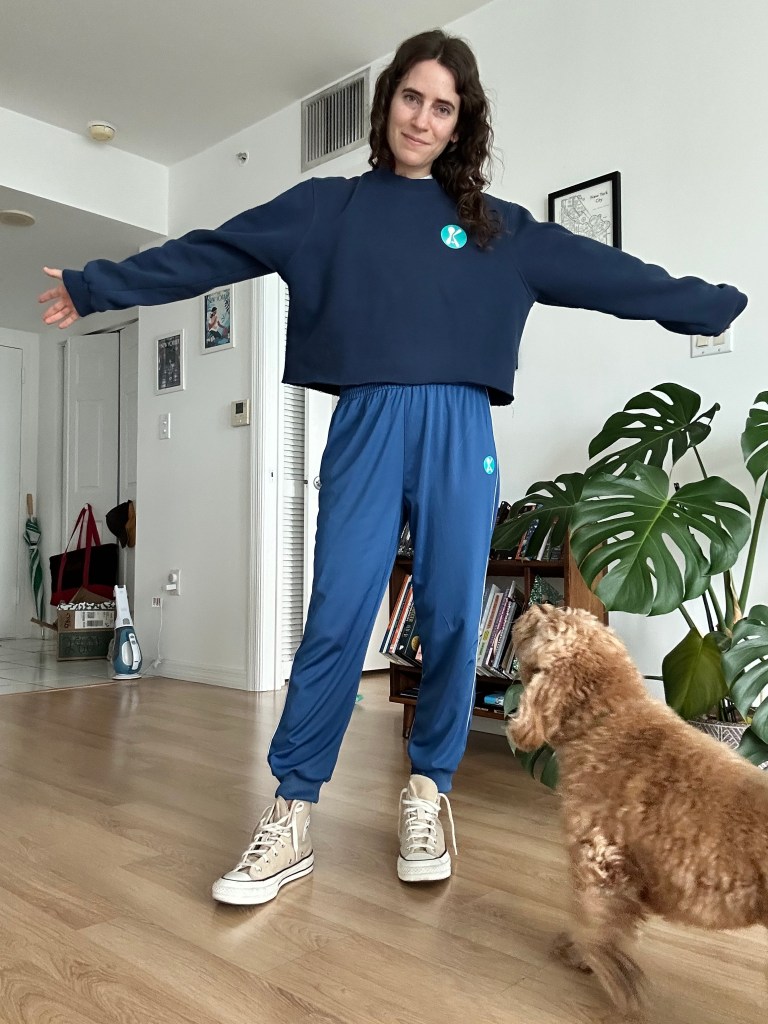
    Ashley came back, a pair of joggers in her hands.

    “You’re a lifesaver!” I said, grabbing them from her. Size 16, but I’m pretty small, so they would have to do. I ran to the bathroom, shrugged off the cold and wet jeans, and pulled on the joggers. A perfect fit.

    I tied my shoes, threw on my sweater, and headed back to class.

    The rest of the day, my colleagues stopped me and asked for the story. Ana particularly found it humorous.

    When I texted her about how I hadn’t sliced today, and was in between writing about AI or the two pope movies I’d watched last week, she sent me a voice note: “Why aren’t you slicing about the pants? In my head, when I saw you walk with those, I thought, this is a typical slice of life.”

    So there you have it. It was not the outfit I was planning to wear, but it was super comfortable.

    I dunno, should I keep them?!
  • Could you have known?

    Dear 2021 Amy,

    Do you remember that first writer’s workshop session?

    It was just after 2pm on a weekday in August. You had a class of just 13 students, no co-teacher, squeezed onto the rug of that tiny room. Everyone was wearing masks, including you — yours was fabric, a light blueish-green with stripes that your dad’s bandmate’s wife had made. You could feel your breath warming as you spoke; you yanked the mask down slightly to be heard over the loud air conditioner, looked down at your lesson plan:

    Session 1. We Are Writers

    You hugged your notebook to your chest, which you had just decorated the weekend before at a friend’s house. You cut out patterns and letters from magazines. Your name — A-M-Y — on the front, your two words — JOY and CONNECTION — on the back, a quote from Jason Reynolds — “Writing is like any other sort of sport. In order for you to get better at it, you have to exercise the muscle.” — collaged between images that spoke to you, photos of family and friends. Under your chair, behind your legs, 13 fresh composition notebooks sat in a bin, waiting to be handed out.

    “Good afternoon, writers,” you started, feeling the hum of those words take flight and dip into the ears and minds of the students before you. “This year, we will write for many purposes and audiences. We will embark on this writing journey together.”

    Ana’s lesson plan said: “(Make a big fuss handing out NBs.)”

    So, of course, ever the good student, you did, handing each notebook to a pair of reaching hands as you told them that next week, they’d have the opportunity to decorate their notebooks with photos, drawings, quotes, and more.

    You settled back into your chair, leaned forward ever so slightly.

    “Today I want to teach you that the only thing writers need is a pen, paper, and a beating heart. We write about what we know, what we see, what happens to us or others. Everything we experience can become a story if we capture it in our notebooks.”

    Could you have known then that you were giving them the tools they’d need to write their own slices of life?

    Could you have known then that this lesson is timeless, that “today and every day,” you really can “see every idea that pops in your head as a possibility for a story”?

    Could you have known then that Ana would become much more than a mentor, a writing partner, a friend?

    Could you have known then that you would have so many more magical moments with those students, and the next group, and the next, and the next?

    The half groups in 2022, in the bright windowed corner room. The writing conferences where a student’s pen started racing across the page before you stepped away. The independent writing time when you were writing too, and it was so silent you could hear a pin drop because you’d forgotten to put on the music, but it didn’t matter because everyone was in flow.

    Could you ever have known then that by teaching kids to believe themselves to be writers, you’d be helping the writer in you find her way out onto the page again?

    Could you have known then that you were speaking as much to yourself, the dormant writer, as you were to them, the writers-to-be?

    I know now, so I write to the you of then:

    Writer’s workshop will, without a doubt, change your life.

    Yours, always,

    Amy

  • Things I Wish I Could Text You On My Phone-Free Walk

    As part of my commitment to be as device-free as possible while my 5th graders do their 21-day digital detox challenge, I am charging my phone outside of the bedroom, trying one phone-free weekend day, and aiming to take daily walks with just my keys and Phoebe.

    I find myself much more aware of my surroundings and relaxed on these phone-free walks — I can feel the breeze of the perfect Miami spring weather as it lifts the peach fuzz on my arms; I can hear the faint music from a boat out on the water; I smile more at the people who I pass. Sometimes I see dolphins in the water, like we did on Sunday as we walked around Brickell Key. With no phone, I can’t take a photo or a video, so I am forced to just absorb it, be with it, in the moment. And I love being this present.

    Today, though, there were oh so many things I wished I could text you on my walk. You wouldn’t have responded; you are teaching a private soccer lesson until 6. But if I’d had my phone today, this is more or less what your WhatsApp notifications would have looked like:

    4:57pm: Omg you would not believe it. I got into the elevator with Phoebe and there was a couple in there, and she, of course, started getting all the cuddles from the guy. But then — HE PICKED HER UP. Like, just grabbed her up off the ground and nuzzled her! WTF?! Who does that??

    5:01pm: Omg Phoebe just sprinted across the grass after this golden retriever, acting like she wanted to play, but then the dog’s owner let go of the leash and he was chasing her, and she was squealing and running SO far! And when she finally came back, and I went to grab her harness, she squealed at ME! 😭😩😩

    5:05pm: Okay now she has fake-squatted for a poop twice. 🙄 Leaving this grass and continuing on my walk.

    5:07pm: Fake-squat #3! This dope!!!!

    5:10pm: And just when you thought she couldn’t fake you out anymore, she does it AGAIN. This time, she peed.

    5:14pm: Literally this dog is so crazy. She just squatted for a 5th time!!!

    5:16pm: Okay, guess 6th time’s the charm! 💩 success! 💪💪

    5:19pm: Some guys are sharing a joint and one of them is literally using his parked, open convertible as a speaker for their music. Miami is weird.

    5:28pm: Just picked up a cool historical fiction book at the little free library! 🤓

    But I didn’t have my phone, so I couldn’t text you all of that. Instead, I just laughed to myself each time Phoebe fake-squatted, let my mind wander, and drafted this slice in my head.

  • Ramblings on Memoir

    As a middle schooler, I wrote stories about fictional characters, manifesting events that I hoped would unfold in my life (I remember one specifically about a girl who goes to a lake in the summer with friends, her crush telling her he liked her, them sharing a kiss on a boat one afternoon). I wrote fiction because I didn’t know how to write about my life other than writing in my diary. I had file after file of stories on my eMac computer, most lacking endings. 

    In high school, a few of my teachers had us write stories in the style of an author, which was my favorite way to show my understanding of a novel (like writing a “grotesque” a la Winesburg, Ohio by Sherwood Anderson, or writing in the style of Virginia Woolf in Mrs. Dalloway, the sentences verging on run-ons, lyrical and open). One teacher had us write page 200-something of our life memoir. I wrote about taking the crosstown bus to see my sister and meet my niece/nephew for the first time. 

    My friends and I became obsessed with freewriting after our teacher, Annie Thoms, had us get in the habit at the beginning of her writing workshop each day: set the timer, 10 minutes, only one rule — Don’t. Stop. Writing. Gemma would message me prompts on iChat in the evenings, a spattering of seemingly disconnected words — rose, schoolbus, blood, feather, bag of chips — and I would give her one in return — water bottle, field, purse, knife, lamp. We’d set our timers and see what would come out.

    In college, I went to school for creative writing and literature, thinking I’d write the Next Great American Novel. What I found was that I was much more interested in writing creative nonfiction than anything else. In my fiction classes, I’d end up writing memoirs thinly disguised as stories, and I wouldn’t get away with it. 

    “The craft is good,” my fiction professor would tell me when it was my turn for feedback, “but it doesn’t read as fiction.”

    I was lucky to take a class with professor and writer Kirsten Lunstrum, who encouraged my genre-bending and personal narrative writing. The first personal essay I wrote for her seemed to climb its way out of me, my fingers racing across the keyboard as I hurried to catch it all. I later took an independent study with her where I practiced more memoir writing and dipped my toes into fiction in a safe, brave space. But she left before my senior year, and I never got the mentorship — nor had the confidence — I felt I needed to finish with a strong creative writing project. I set aside my 30-page personal essay about me, my sister, and my mom, and focused on my literature thesis. I dropped the final required creative writing seminar and graduated without the double major. 

    I carry a lot of shame around that decision. 

    What was wrong with me that I couldn’t write actual fiction? What was wrong with the other creative writing professors that they couldn’t see the value in memoir? 

    I didn’t feel “good enough,” whatever that meant. And I stopped writing, for a long time. I’d come back to it in spurts, as the files on my computer prove to me:

    • STARTING MAY 2013
    • Starting oct 2017
    • One file from 2019 in a folder titled simply: “ramblings”
    • Three files in a folder titled “2020 Writings”

    But mostly, I let it slip away until I started teaching writer’s workshop in August 2021.

    Two weekends ago, Ana and I met up to record a few podcast episodes and go on our first writing date for a while at Books and Books. We ate delicious sandwiches, I purchased some books and a new notebook, and then we set out to write. I opened up my laptop to the fictional story I had started a few days earlier (my “novel,” I was calling it — no name, no real direction, just a feeling). I typed a few sentences and then felt it creeping up: the imposter syndrome. The “not good enough.” The you-don’t-even-know-how-to-write-a-short-story-so-why-would-you-try-a-novel? The if-you-can’t-write-a-fictional-story-are-you-even-a-writer-at-all?

    “I’m just going to read,” I told Ana, my cheeks flushed. Her fingers were racing across the keyboard, clacking away as she typed at a story that had materialized in her mind, big magic blooming.

    I opened up Refuse to Be Done by Matt Bell, finding comfort in his encouraging words: “Start writing, and the draft will come.” 

    Later, I found discomfort in a podcast episode Ana sent me — a man telling his listeners that before you write it, your novel needs to have an elevator pitch, otherwise it’s probably not a very good one. He had some good advice, but most of it was lost in a sea of other advice that made me feel very, very small.

    “I don’t have an elevator pitch,” I told her. “I don’t know what my novel is about.” 

    I didn’t write for a week. 

    Then, a few days ago, I opened up the other book I’d purchased: Body Work: The Radical Power of Personal Narrative by Melissa Febos, a writer who had taught at my college the year before I arrived. My friend Bob always told me I would have loved her classes. 

    And her words lit something up in me. 

    “But my own story wouldn’t leave me alone,” she writes in the first chapter. “It called to me the way I have since come to recognize is the call of my best stories, the ones that most need to be told. So I wrote it” (Body Work 7).

    I could feel again the sensation of that first story I wrote for Kirsten’s class, how it nagged at me until I got it out, how it flew out of me effortlessly. I know writing does not always come that easily — trust me, I do. 

    But I also know what it feels like to have a story that won’t leave me alone. And for me, that’s never been fiction. 

  • A List Poem

    Things on my mind:

    how many fungus gnats will be on the yellow sticky traps today

    why the copy machine on the 4th floor struggles so hard to print on card stock

    my lack of a plan for dinner tonight and how I’d better figure something out before Emily comes over

    why Phoebe insists on barking every time someone is in the hallway

    why my upstairs neighbor insists on playing his DJ music so loudly that it vibrates our ceiling and makes me feel like I’m “in da clurb”

    the overnight trip on Thursday and Friday

    making sure I’m fully packed for the overnight trip on Thursday and Friday

    feeling untethered

    but holding onto faith

    the students of mine who want to try a month without their phones or tablets

    the fact that I don’t know if I could survive a month without my phone or tablet

    the fact that it’s not that I don’t know if I could, it’s that our society is designed in such a way that if I went a month without my phone, I’d probably run into some trouble

    the vlogs that my students recorded this afternoon

    “What is UP, y’all?”

    “Hey guys, welcome back to my channel.”

    as though they’d been doing it forever

    our podcast and how we managed to record another episode in less than 10 minutes

    (“I couldn’t do this with anyone else,” Ana said, and I agreed)

    what the F is going on in Yellowjackets and how I just want to rot into the couch and binge watch it

    how I can’t just rot into the couch and binge watch it yet because I need to finish this slice and figure out dinner before Emily gets here

    the fact that I don’t know how to end a list poem

    but the other fact that this ending will have to do