For today’s slice (day 9! wow!), an excerpt from my writer’s notebook entry yesterday.
***
The sun dapples differently in the morning, the humidity still thick. The brown vines hang and sway from the branches of the trees, almost like they’re dancing in the wind. I can hear birds chirping and roosters clucking. Car engines as they drop children off at school.
What if you could mute the sounds one at a time?
Take away the white noise of the whooshing air on the highway. Take away the rumbling car engines. Take away the whistles from the rooftop.
Leave the air rustling the leaves on their branches. Leave the birds tweeting in the trees. Leave the rustle of pen and paper, children’s voices.
Blankets of pollen coat the benches, allergy culprits. Like fairy dust, causing sneezing and watery eyes.
M found a worm, inching along his leg. We gave him a post-it pack home.
“He has good abs,” M said. “I’m gonna call him squiggly.”
This morning, I told the students to gather quickly with their writer’s notebooks and a pen or pencil, because we were taking our workshop outside to the park.
“No way!” They shouted. “Yessss!”
We headed downstairs and out to the park that faces our school, congregating around one of the picnic tables so I could tell them the teaching point.
“Writers, today I want to teach you another strategy for generating ideas for poems,” I said. “Poets see the world with eyes that are alert to the smallest details.”
I pointed to the vines hanging from the tree branch above us.
“Look at how the sun is glinting off of the vines, making them look golden. Notice how they’re waving in the wind, swaying.”
“Almost like they’re dancing!” T chimed in.
“Exactly!” I smiled back. “I think I’ll write that down. I might be able to use it in a poem later.”
I pulled out a mini-anchor chart with steps for the teaching point.
“Poets, today you’ll look at the park with new eyes. You’ll write long in your notebooks about what you observe, what you notice, and what you think about what you see. All of this can be used as inspiration for later poems! Now, spread out and find a spot where you can really fine tune your poet’s eyes. Off you go!”
And they all dispersed.
For the next thirty minutes, pens scribbled in notebooks, eyes gazed around in wonder, and when we gathered again, almost everyone shared an excerpt from their writing.
On our way back to the school building, we brought back plenty of new ideas, as well as a moth and a tiny inchworm.
As the door closed behind us, one student asked, “Can we have writer’s workshop outside every day?”
As a teacher, I don’t like to take days off from work.
Whether it’s for self care or a true sick day (like today), the thought of not coming in and showing up for your kids makes you feel even more ill.
Because teachers can’t just take a day when they’re not feeling well. We have to find subs and create sub plans, knowing all too well that most likely, we’ll need to reteach it anyway.
Luckily at my current school and at my last school, I’ve had co-teachers. That’s a game changer.
Still, there’s always a sense of guilt as you let them know they’ll be managing on their own for the day.
The only thing that makes it better is when you return the next day and the kids brighten and say, “Ms. Amy’s back!”
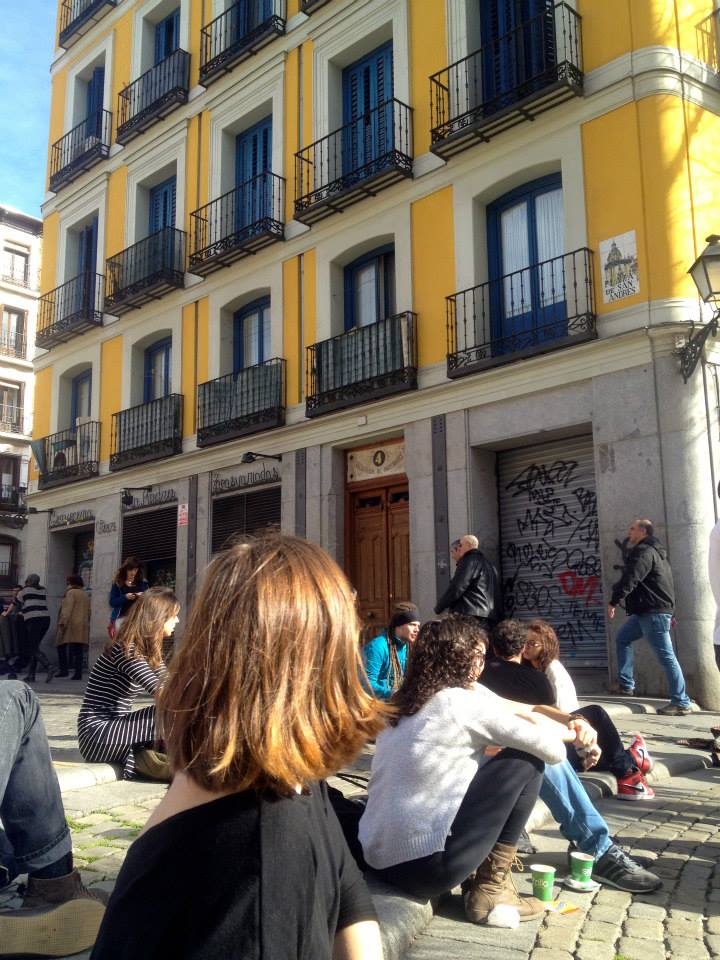
I lived in Madrid for two years in my early twenties, working four days a week at an elementary school as an English language and culture assistant. That first year, I rented a room in an apartment with 5 other girls that became known to us as “el piso paraíso.”
The other girls were there on Erasmus, Europe’s study abroad program, completing a year of either their bachelor’s or master’s degrees. We were new to Madrid and excited to explore all it had to offer.
And Sundays were the best.
Usually nursing a resaca from a fun night out, we’d slowly greet the day in the kitchen with an espresso and some eggs or cereal. Then we’d shower, get dressed, and get ready for a slow walk through el Rastro, Madrid’s huge open-air flea market in the La Latina barrio.
We’d grab a tapa and a caña (a little hair of the dog always helped) from Calle Cava Baja, then stroll down the hill of the main street of the market. El Rastro had everything — from cheap sunglasses and leather belts, to vintage dresses and Levi’s jeans. We’d walk the side streets and find shops with antique trinkets and used books. A few times, we’d wander into Mercado San Fernando for lunch, some groceries, and a little bit of salsa. Other times we’d find a plaza and sit in the sun for a while.
Sun-kissed and tired after an afternoon of walking and shopping, we’d eventually meander home, where we would spend hours in the kitchen talking as we cooked and ate dinner, until finally it was time for us each to go to bed.
“Buenas noches, chicas,” my friend Giada would call out before she FaceTimed her mom and sister back home.
I’d fall into bed full and warm without a care in the world, catch the moon glinting off the window of my balcony, and drift swiftly off to sleep.
At recess on Thursday, one of my students was lingering by the jungle gym where I sat looking out at the group of boys playing soccer.
“So, _,” I asked, “what do you plan to do over your long weekend?”
He grabbed onto the bars above him and swayed a bit as he replied.
“Play basketball, probably.”
“Basketball? What happened to soccer?” He’d been newly into soccer for the past few months, so I was surprised to hear a new sport take the stage.
“Yeah, it’s all basketball now,” he said decidedly. “I mean, I’ll probably still play soccer at school and stuff, but my new focus is basketball.”
It reminded me of my own rotating carousel of hobbies, specifically with sports.
As a kid, I played soccer from 4 to about 16, when I developed a Haglund’s deformity in my right heel and couldn’t play anymore because of the pain.
After surgery and physical therapy, I was able to run, and I got into long distance running after graduating college. I ran four half marathons between 2014 and 2019, among a slew of other 5ks, 10ks, and other races. I love running, how it’s like meditation, but the high-impact of road running left me with shin splints and other aches and pains.
I have always done yoga on and off, but usually only about once or twice a week.
I love to bike.
Just before and during the pandemic, I started the Vertue Method, a 12-week, at-home, low-impact strength-training program, and was very committed to this until I’d seen each video enough times that I’d memorized all of Shona’s jokes and wanted something new.
Moving to Miami, I was inspired to pick up rollerblading again, an activity I hadn’t done since I was a kid. I took classes that helped me to feel more confident on the wheels, and which also incorporated extra fitness like squats. I was obsessed for a while.
But, some hip pain in the summer kept me from working out for many months this fall.
Finally, once I was feeling better, a friend introduced me to pilates reformer classes. I took it up with gusto.
This weekend will be a slow one, without any fast movements, as I recover from vertigo. But I smile thinking about all the sports I’ve done and can do, a variety of options I can choose from to keep my body active.
La humedad molesta, tener que manejar a todos lados es pesadísimo, y ser residente de la Florida puede ser… complicado.
Pero una tarde como hoy, después de un día agotador, pasando el atardecer con amigas en el jacuzzi de una de ellas, pienso: “Esto sí me gusta. Esto hace que todo lo demás vale la pena.”
Mi cuerpo se relaja, y como las burbujas en el agua caliente bajo mis dedos, las preocupaciones del día se van evaporando una tras otra.
Contenta estoy.
Una chica de Miami.
Bubbles
Sometimes, I don’t like living in Miami.
The humidity is annoying, driving everywhere is tiresome, and being a Florida resident can be… complicated.
But on an afternoon like this, after an exhausting day, as I spend the evening with friends in one of their jacuzzis, I think: “This, I like. This makes the rest worth it.”
My body relaxes, and just like the bubbles in the hot water under my fingertips, the worries of the day evaporate one after the other.
Today one of my students brought his writer’s notebook with him to our social studies lesson, sneaking poetic lines in between notes taken on his classmates’ presentations. Yesterday, he asked if he could bring it down to music, because he thought he might get distracted, and knew having the notebook there to write in would help him. Later, he asked if he could take it home.
“Of course,” I replied.
Because isn’t this what we as writing teachers hope for?
That a child will want to bring that notebook with them everywhere, to catch thoughts before they disappear from their minds? To capture vivid images and fierce wonderings?
Today he left his notebook at school, and he won’t be back tomorrow. As I got home, I saw an email from him saying that he left the notebook at school, asking if his sister could get it for him tomorrow morning, because he really wants to share the poems he wrote today with his mother.
“Of course,” I replied.
Of course.
This unexpected enthusiasm for our new poetry unit is magic.
Students reading their poems out loud at the end of workshop today, smiling as they read, sharing their inner worlds with their peers, receiving snaps at the end.
Oh! Let me be like my student who can’t wait to bring his notebook home, who can’t wait to put pencil to page, to put mind to words.
“Oh! You would be so proud of me,” I started saying to Ana at dismissal. She herded a child out the front door, wishing them well, and then turned back to me. I took a breath. “I—”
“Stop.” She grabbed my shoulder, cutting me off. “Why do you keep saying I ‘would’ be so proud of you? I am proud of you!”
I struggle sometimes to turn inward and tell myself, Look at you! You rocked it. I’m proud of you. But I’m trying to get better at it, so here we go: I made leaps and bounds in my conferring skills this past unit.
My big goal during this unit on journalism was to know what my students were writing so I could best support them through conferring and small groups. I had dabbled in conferring during the first two units, but felt ill-equipped to actually support my students apart from giving a compliment and moving on, which often felt like I was going, “You’re doing great! Keep it up, byeeee!”
Ana told me that in order to truly plan for conferring and small groups, I needed to know what the heck my students were able to do and what they were still working towards. And I could only do this if I actually read their writing.
So, the day after Thanksgiving break, I requested all students turn in their writer’s notebooks so I could see what was up. Skimming through the stack of notebooks was eye-opening, to say the least. I noticed which students weren’t generating ideas, which students had already written multiple news reports, and which students were still stuck writing what appeared to be narratives (which can happen during a genre switch like this). I did it again a week later, once students had started drafting.
In order to keep track of where students were at, I used a conferring notes document created by Amy Ellerman and outlined in depth in her blog post on Two Writing Teachers. I revised the teaching points at the top to work for my unit, and downsized it so it would fit on one page. Here’s what I ended up with:
Second set of conferring notes, taken after students started drafting out of the notebook.
This document is GOLD. Ellerman’s pattern-seeking strategy helped me so much, not just to figure out which teaching points I could revisit with which students in a small group, but also with my one-on-one conferring sessions.
With a quick visual of data, aligned to the major teaching points of my unit, I could come to a conference ready to go with both a compliment and a teaching point. This was a game-changer for me, and for my students as well. I believe many of them wrote better articles because I knew where they were at, knew where they still needed to go, and was prepared with supports for them when we met.
However, I did struggle with a couple of students (as we always do!). One of them is Enrique, who basically listened to my suggestions for revisions without implementing any. We had one small group session the day after I took stock of students’ notebooks that ultimately got hijacked by us butting heads (him: “Why do I have to _____” and me: “Because I said so!” Ohhh, shame).
Ana even had a short one-on-one conference with him where she suggested he keep his reader in mind as he drafted and revised, which he replied to with a, “Hm, yeah I’ll think about it.” She looked at me and shrugged.
But then something glorious happened. I had a small group conference with Enrique and his writing partner, Marcelo, who also happens to be his best friend.
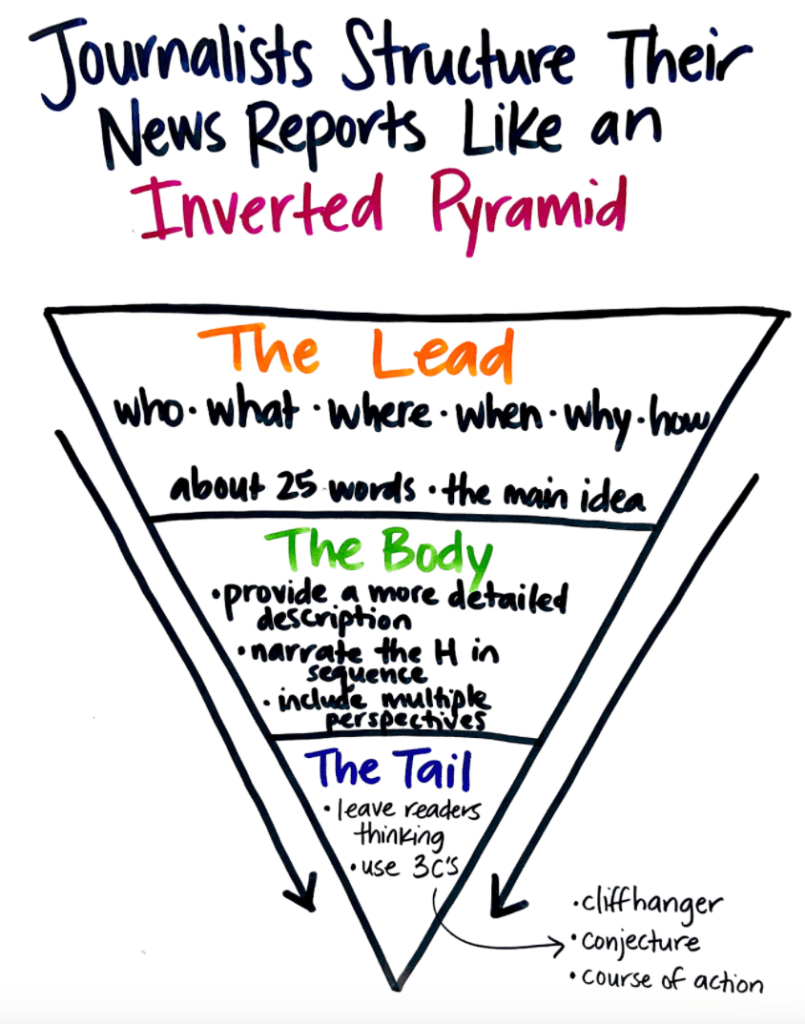
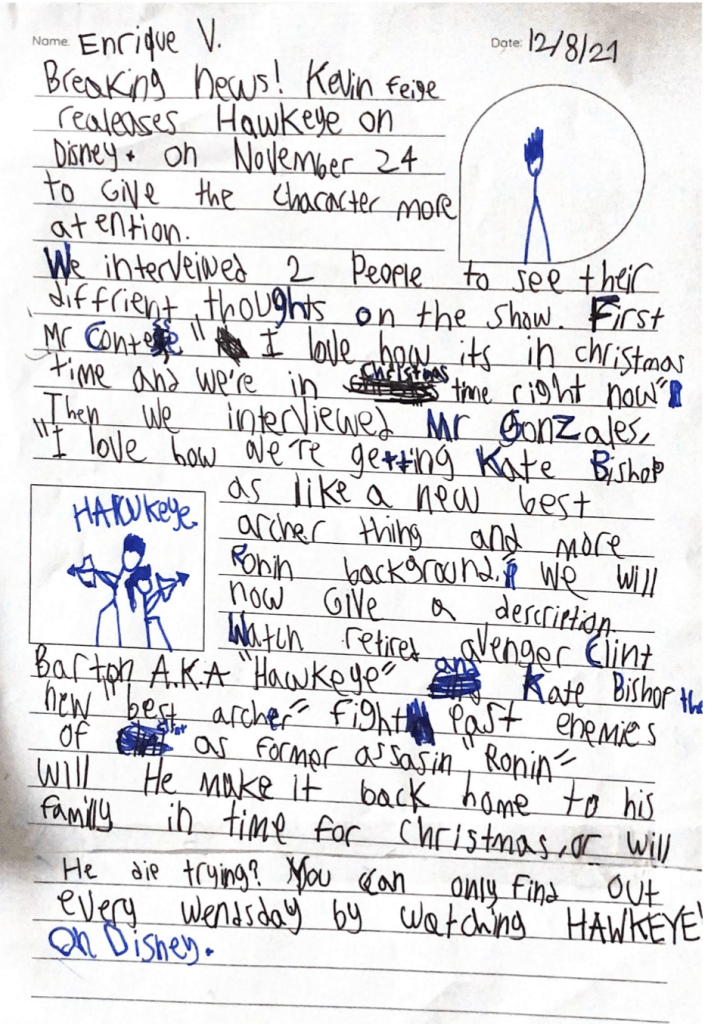
As I could see from my conferring notes, neither of them had a lead that included the 5 W’s and H. Enrique was writing about new Disney Plus shows and had really just listed a bunch of items and saved his most important information for last, which was almost the opposite of the structure the students were supposed to be aiming for. Marcelo had written a catchy lead, but it was lacking some details that the reader really needed in order to understand what his article was about.
I started the small group conference with a compliment. I said: “You both generated a great newsworthy idea and are using an officious tone, just like a journalist! I think you are ready to look at the structure of your news reports to see if they follow the inverted pyramid. Let’s start at the top with the lead.”
They both flipped to the mini-anchor charts pasted in their notebooks and reminded themselves of what should go in a strong lead.
At Ana’s suggestion, I started including mini print-outs of anchor charts the class and I had co-created in my conferring toolkit. Both Enrique and Marcelo already had one of these already in their notebooks from a previous conference.
I had them take a highlighter to their drafts and highlight where they saw the 5 W’s and H. I did the same to my mentor article. Both boys realized quickly that their leads were falling short.
So we went back to our strategy from a mini-lesson a couple weeks prior: jot down each of the 5W’s and H and fill them out, then make a sentence or two with all that information. (Note: This strategy is inspired by Judith Hochman’s strategies to help students write complex sentences.) They started filling it out, and that’s when the lightbulb moment happened.
“How do I choose the ‘what’ in my article? There are so many shows!” Enrique asked.
“Maybe it’s the one you’re recommending at the end,” I ventured.
“So, Loki?” Enrique confirmed. He started jotting it down.
“I don’t think the most newsworthy one is Loki,” Marcelo interjected. “I think it’s Hawkeye, since that just came out.”
Enrique paused, thought about it, and then nodded. He erased what he’d written down and wrote: “Hawkeye.”
He filled out the rest of his page with ease.
The two of them then moved on to the body, figuring out they could interview each other to provide alternate perspectives in their articles, and finally onto the tail, both deciding to conclude with a follow-up course of action.
When Enrique showed me his revised article at the end of the independent writing period, it looked nothing like his first few drafts. It was a complete overhaul—a “major surgery” as we often say in our workshop. I gave him a huge hug.
Later that week, when he’d finished his published piece, I sent Ana a scan of his writing, from generating ideas to final product.
“I am SO PROUD OF HIMMMM!” I texted Ana.
I smiled at her reply: “I am SOOO PROUD OF YOUUUUUUUU!”
I guess I am proud of me, too.
Generating seed ideasFirst draft in the notebookThird draft out of the notebookNotes during small groupFinal draft with editsFinal published news report before adding pictures Click through the images above to see Enrique’s writing process




 Writing With Abandon