Writing With Abandon

Reflections and ramblings about life as an educator, writer, reader, knitter, and over-thinker. Trying to do the writing only I can do.

Tag: teaching

  • A Beginner’s Mindset: Rollerblading in the Learning Pit

    A Beginner’s Mindset: Rollerblading in the Learning Pit

    This October, I decided to get back into rollerblading. Perhaps “get back into” is a generous statement, seeing as aside from the occasional outing as a child and one semester of rollerblading P.E. my junior year in high school, I was never really “into” rollerblading to begin with.

    But when I moved to Miami this summer, I had rollerblading on my mind. My friend Arta had lived here in one of our first years out of college, and one of the things she loved about Miami was the ability to do so many outdoor activities like boating and biking and, yes, ‘blading.

    So in October when I mentioned this to another friend, Meryl, and was met with equal enthusiasm, we both made a promise to skate together and promptly purchased some stylish 90’s-esque inline skates in bright pastels.
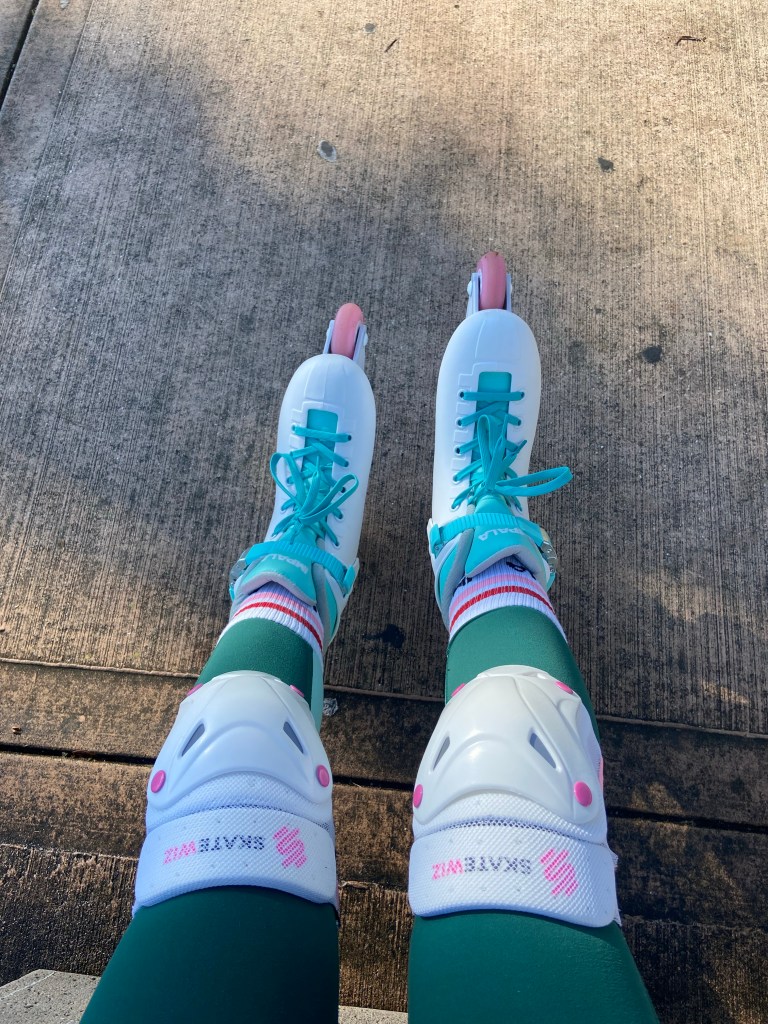
    My new Impala inline skates

    And when the skates arrived, we upheld that promise and went on our first skate date! Meryl picked me up and drove us out to Virginia Key, where we strapped on our new skates and our pads and realized very quickly that we were quite wobbly, the ground was not smooth as we’d imagined, and we both had no clue how to brake, especially when going downhill. So after that outing (which was quite enjoyable truly, filled with long talks and good views and a post-workout smoothie), I put my blades in their new bag, and shoved them in a corner of my closet.

    Where they sat for the next three months. Untouched.

    I will be honest: all of the joy and enthusiasm for blading that I had felt when I purchased them and put them on, wheeling around my apartment for the first time, dissipated at the early signs of challenge and the very real fears of falling on my butt. I didn’t want to feel that sort of failure again. I was embarrassed, and I was scared. It was easier to make excuses — not enough time, too tired, “oh, I’m trying to get back into running and circuit training actually now” — easier to give up, than to face the fact that if I wanted to improve I’d have to work at it.


    In the education world, there’s something called the Learning Pit.

    The Learning Pit, by James Nottingham

    I’ve taught about the Learning Pit a couple times over the past few years. It comes up at the start of the year usually, when we’re talking about having a growth mindset in the face of challenging academic tasks. I teach my students that it’s important to participate in productive struggle, and how mistakes help you learn because they cause synapses to fire in your brain (Jo Boaler, you are a goddess). We make lists of things someone with a fixed mindset might say (“I can’t do it” or “I’m not a math person”) and things someone with a growth mindset might say (“I’ve got this” or “If I just keep trying, it will get easier”).

    But here I was, preacher of all things growth mindset to my students, shoving my rollerblades into the darkest corner of my bedroom closet, letting the dust bunnies slowly devour it until I could no longer tell it was there (except that I could, because the bag was so big).

    Then two things happened:

    1. It was the new year, and you know, we set intentions. After spending winter break in freezing New York, I was determined to take advantage of my new city and go outside more often during the week.
    2. I got COVID in January and it completely knocked me out, forcing me to take a two-week break from working out.

    So I made a choice. I took a long hard look at myself and thought, “You know what, Amy, you’re the one who wanted to start this new hobby. You’re not going to become a rollerblading sensation overnight. And I know that it sucks, but you’ve got to start somewhere. Just put them on and commit to taking them out once a week and practicing. You can only get better from here.”


    That first Saturday morning of February, after fully recovering from my run-in with omicron, I strapped up, padded up, and took my blades out for a spin on the Venetian Causeway. It wasn’t perfect. I still couldn’t brake. But you know what? It was fun. It was more fun than I’d had in a long time. I felt… like a kid.

    The next Saturday, I bladed again, this time in Margaret Pace Park with the sole intention of practicing using my brakes. I felt silly in my pads and frustrated because it was still so hard, but the views and the music in my AirPods made it worth it.

    The following week, Meryl and I woke up early and drove out to the Miami Beach boardwalk where we skated for an hour, laughing and gawking at the views, and then had a delicious brunch of açaí bowls.

    Each time I skated, I felt a joy so authentic and innocent that it bubbled out of me. I came home feeling elated.


    And then last Saturday, after blading and realizing that while I love to be independent, I was going to need some outside support if I wanted to make significant improvements, I miraculously found a rollerblading group class that was starting in a few days and signed up.


    It’s a simple and generous rule of life that whatever you practice, you will improve at.

    Elizabeth Gilbert, Big Magic

    I’m climbing out of the Learning Pit now. This morning, I woke up early and skated to Dorsey Park to practice the new skills I learned during my Thursday class.

    As I head home, I smiled and thought to myself, “I think I’m starting to get this.”

    I’m not over the edge yet, but I’ve got the rope in my hands, and I’m enjoying the journey up.
  • Off-Script: Creating New Paths

    I’ve always struggled to follow a curriculum. My first year of teaching, my fellow teacher newbie and I visited our new school a week before we had to report to get some materials and start planning for the first month of school. Our math coach placed the teacher’s guide for our school’s math curriculum in front of us and began narrating how a typical lesson would go, her finger tapping at the top of each page as she went. It felt sterile, void of life, indifferent to the human children that would be learning from its pages. The next week, I remember giving it a go like she’d shown us, playing the video that went along with the lesson, only to shut it off as the cartoon character’s high-pitched voice made me (and my third graders) cringe.

    “Enough of that,” I said, and the students breathed a sigh of relief. So began my journey into developing my own curriculum for my students.

    I had an assistant principal that year who, though not entirely helpful for much else, did say something wise about curriculum guides during one grade-team meeting: “The teachers guides are like a script, but you are the actors. You make it come alive.”

    Corny metaphor aside, I saw what she meant. We weren’t meant to teach from the guide. We weren’t meant to have them in our laps as we spoke to the children, glancing down to make sure we were saying everything “correctly.”

    Fast forward six years later, and teachers guides for me are just that: guides. Supports. A jumping off point when you’re not sure where to begin. The real planning? That comes from my heart, from what I am passionate about, and from that year’s students’ strengths and interests and passions.

    I’m a creator, and creating is part of why I love teaching so much. Even in the grades that I’ve taught more than once, I’ve rarely taught the same lesson or unit in the same way twice. With each year repeating a grade, what I actually gain is more confidence and expertise in the content, the landmark skills that I know my students need to learn in order to be successful in their future academic careers. Additionally, I’ve witnessed my growth as a teacher by seeing the shifts in which “subject area” I focus on developing professionally. My first three years, it was math. My fourth and fifth, integrated studies and themed, project-based learning units, with a hint of writing revolution (Judith Hochman). All intertwined heavily with multilingual language-learning, as I was teaching in dual language classrooms at the time.

    This year, I’m finally focusing on writing, thanks to a colleague, mentor, and friend who is pushing me professionally and personally (ahem… this blog). I find myself once again looking at curriculum guides for Teacher’s College Writer’s Workshop units and setting them aside in favor of creating my own units based on what I see my students needing and wanting.

    This winter’s informational writing unit was a big success, for me and for my fifth graders. I grew in helping students to set and achieve goals through one-on-one and small group conferencing. A final mini-bend allowed students to transfer their new knowledge to quick-writes about our science content: writing informational brochures on the new Chromebooks, which ended up incredible. And last week’s informational on-demand provided confirmation in the data: almost all of them jumped up half a year to a full year’s growth.

    A ready-made curriculum is a map that promises to deliver your students to a certain destination. This year, I tried to follow one of those maps when I taught the realistic fiction unit, only to realize that the path wasn’t the right one for my students. So I continue to take the risk of scanning the map, situating myself in the terrain, and creating new paths, knowing that I have a pretty good sense of direction. And my fifth graders? They’ve reached the destination each time.

  • Shitty First Drafts

    à la Anne Lamott.

    Hello, internet!

    Ana suggested I start blogging about my experiences teaching, so here I am.

    I’m Amy, a born and raised New Yorker-turned-Miamian. After 5 years teaching Spanish dual language in NYC public schools in both Washington Heights and The Boogie Down Bronx, I find myself now at an independent, Reggio-inspired school in Brickell. Quite the jump, bringing with it a ton of change.

    That said, in a strange way, I’m in somewhat familiar territory: founding a new grade for the third time in my short teaching career. Founding a grade brings with it the expected fear and anxiety, but also unforeseen joy and excitement. Through this blog, I hope to document this rollercoaster ride and reflect on what’s gone well and what could go better.

    For, after all, founding a grade is in its way a shitty first draft, as the title states. There will be much to add and cut and revise for next year. I hope to give myself grace, quiet the perfectionist within me. You’ve got to write the whole thing before you can fix her up!

    So here’s to it, and to connecting with other educators along the way.

  • My 5th Graders have Senioritis

    Originally written in late May 2021.

    I wake up and sit in front of the laptop, start the Zoom meeting at 8:30am, and watch them trickle in slowly. I say good morning to many who say nothing back. Cameras off. Microphones muted. Perhaps one will write “good morning” in the chat. I appreciate that. And of course there are a few who are up and at ‘em, ready to go, or don’t care that they’ve just rolled out of bed and their hair is a mess. The black squares don’t bother me anymore. I don’t think it’s right for a teacher to demand cameras be on, even if it hurts my soul to teach to what looks like nothingness. What I can’t take, though, is when there’s no response, no “reactions,” no chatting, no unmuting and speaking up. And as we creep ever closer to June 25th, the days are getting a lot quieter.

    Any teacher will tell you that students and teachers alike experience burnout by the end of the school year. Of course, this year has been unlike any other. COVID closures robbed my school’s first graduating class of a trip to D.C., organized by our Parents’ Association, a real graduation, and the ability to say goodbye to their friends and teachers before heading off on summer vacation and potentially never seeing one another again.

    Last year, we attributed the kids’ burnout mostly to the pandemic. We were all experiencing collective trauma unlike anything we ever had before. I had a panic attack the weekend before Mayor De Blasio closed the schools back in March of 2020, and most of those first few weeks online, I was simply trying to hold it together, taking deep, shaky breaths in front of my laptop, which was propped up on my tiny kitchen table, my chair backed into a corner against the spices, before starting the Zoom meeting. April was a frenzy of getting in touch with families who hadn’t connected yet to Google Classroom or Zoom, but in those early days, online learning was fun in the way that all new things are. The students were excited about being able to “do school” from home. The expectation was that we’d be closed until spring break, and then return afterward, so they saw it as a sort of 6-week vacation. We all know how that turned out. 

    As the spring wore on, we saw our students’ withdrawal as a symptom of the trauma the pandemic was inflicting on us all. Slowly, more and more cameras turned off and we were left staring at black squares and teaching into the ether. Eventually we took any student contact with school as a win, counting them present, urging them to return to the next class, and to come back tomorrow too. My school set up weekly events to encourage participation and boost morale, and it worked for the most part. We were pleasantly surprised at our Zoom graduation ceremony to have 100% attendance, even from those who had never shown their faces on a Zoom call. 

    The group I’m teaching now has been fully remote since September, not counting the three months of last school year. They started the year with cameras on, smiling, joking, eager to learn and connect again with one another. In September, if I put on a dance video, they’d all stand up and get silly with me.

    Now, I never know what to expect. Will they arrive with energy and laughter, willing to take on the day, leaving me ever impressed by their resilience and maturity? Or will they arrive late, stay muted and unresponsive as I call their names, their Classkick and Google Slides pages empty? 

    It’s still burnout, but different than last year’s case; my co-teachers and I are calling it senioritis. That’s really the only way we’ve been able to describe the atmosphere in our classes to our colleagues. In staff meetings, we wait our turn to share out and find ourselves leading with disclaimers: “So in fifth we’re dealing with a lot of resistance to work. Just keep that in mind as we share this…” Asynchronous work? Maybe 12 out of 39 students will do it. We scrapped that long ago. Everything we do is synchronous. Are you here now? Okay, let’s get to work then. Class is over? Go enjoy your free time. 

    Miriam Webster defines senioritis as a noun meaning “an ebbing of motivation and effort by school seniors as evidenced by tardiness, absences, and lower grades.” If you type the word into Google’s search engine, their English dictionary will specify that senioritis is a “supposed affliction of students in their final year of high school or college.” Fifth graders shouldn’t be affected by it, but I can assure you that ours are.

    Perhaps it’s the knowledge that in a few months, they’ll be on summer break, going to a new school in the fall. Maybe it’s the hormones, some of them starting to have real crushes, and wanting to spend as much time socializing as possible. It could also be a defense mechanism: tamping down the hope they’d had for a “normal year.” Whatever the cause, fifth grade senioritis starts like a true virus, first infecting just a few, even the most prepared, and then spreading rapidly until you’re all consumed and trying to remedy it by any means necessary.

    The coupling of senioritis with this second year of remote learning is extreme, and difficult. The parents feel it too. Just last week I received messages from a couple of them, echoing one another: “I just can’t anymore. I don’t know what to do with them.” 

    Fifth grade is supposed to be the magic year—in children’s literature, it’s the eleven-year-old protagonist who makes that leap from childhood to adulthood. I urge my students to turn on their cameras so I can feel their presence, imagining that for them, remote learning would be much more enjoyable if they were able to feel that sense of community too. But what about socializing in this 2-D world is normal? How are they supposed to test their voices, react spontaneously, show off their newfound autonomy, when only one microphone can be unmuted at a time? 

    Right now, our students are writing letters to their representative about water issues in their community, like the presence of lead in school plumbing systems, and the pollution of the Bronx River, which runs behind our school. They’re as engaged as they can be. But they’ll be done with the letters in a couple of weeks, and what then? We’ll still have four more weeks. Four more weeks of black squares, talking to myself, and hoping they engage.

    Maybe we need to fully flip the script. We’ve already switched around our schedule, starting with an extended morning meeting to ease into the day, and it’s shown a lot of promise. Perhaps we can cure this bout of senioritis by putting the power into their hands for the end of the year: what do you want to learn about? And how do you want to learn it? Our year-long essential question is “How can you use your voice to create change in your world?” We’ll let students lead the way. We’ll step back, give them and ourselves some grace, and see what happens. Come the morning, when I start the 8:30am meeting, I hope they’ll be waiting, ready to share with excitement what they’ve come up with.