I have a student who tends to get sick a lot. Sometimes it’s his immune system, and sometimes it’s psychosomatic (like when I explained to the children a couple weeks ago that I was experiencing vertigo, and after recess he told me, “I think I’m having what you had!” with a hand to his head).
Today after PE, as we sat down for math, he told me he was feeling nauseous, and I could see how it was making him nervous. Thinking it was a combination of thirst from exerting himself in PE and hunger (lunch was 45 minutes away), I told him to drink some water, try going to the bathroom, and wait to see if he felt better after eating something.
On the lunch line, though, I could feel his anxiety radiating from him. I suddenly recognized myself in his fear — this weekend, overwhelmed with my own health crisis, I broke down to my therapist. Not only was I run down from the health issue itself, but I was exhausted by the anxiety I was having over it, losing actual sleep and making myself sicker with worry.
So I leaned into that.
As he waited for his food, I rubbed his back and told him how when I get sick, I feel just like him. I told him that what helped me was to talk back to my anxiety, to remind myself that yes, I didn’t feel well, but I was going to get past this. This wasn’t forever. I would feel unwell and then I would get better.
“Tell your brain, ‘I’m going to be okay. I’m safe,’” I told him.
I felt him sigh under my hand, the tension releasing.
“Do you feel like you can eat?” I asked.
“Yes,” he nodded, and made sure to get some pork in addition to the rice I had suggested.
He still felt sick afterward, and I called his mom to pick him up, but I hope I helped make that fear go away, at least.
I grew up just a couple blocks away from the St. Agnes Public Library in New York City. I remember my first library card, and all the amazing books I borrowed from there. Scratching mystery crust off of pages, but turning them all the same, eager to finish new stories, experience new worlds. From middle grade books to the dramatic young adult series I read (hello Sarah Dessen and Jodi Picoult!), I devoured them, borrowing stacks at a time.
When I lived in Madrid, I visited the Pedro Salinas library, found their tiny English fiction section, borrowing British editions of literary novels like Zadie Smith’s On Beauty.
Back to New York, I lived and worked in Washington Heights. I loved the children’s section in the library closest to my apartment, and took my third graders to the Fort Washington Library for a magical field trip.
A few years later we lived on East End and 78th, and I had the Webster Library just steps from my front door. I adored the used bookstore in its basement.
When COVID hit, I couldn’t take books out for a while, so I borrowed them from the NYPL and the Brooklyn Public Library on my Kindle. I continue to borrow books on my Kindle constantly. (The airplane mode trick is the best, if you don’t know it yet.)
The first week I moved to Miami, I set out walking under the blazing July sun to visit the main branch of the Miami Dade Public Library. I sent my parents a selfie with the three books I found and borrowed that same day.
Today I returned to that branch with my class. Though they weren’t initially excited, the anticipation grew. Parents emailing us that their children were begging them to get library cards in time, and would the e-card work to take out physical books, otherwise their daughter would “kill them”? Children bouncing on line before going in, as though we were going to Six Flags. And finally, the visit — in awe of all the information the library had to offer, and each of them finding a small (or large!) stack of books to borrow.
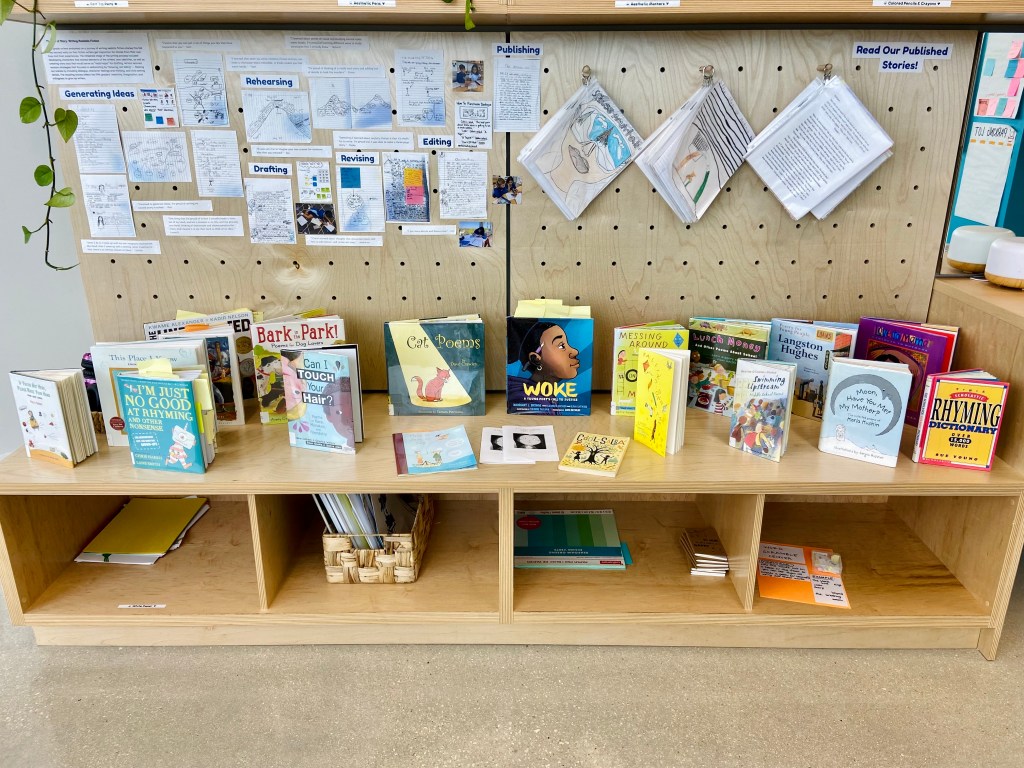
All but 3 of these poetry mentor texts are from the public library.Day 15 of 31
Every month or so, on professional development Tuesdays, we have an “Ask the Expert” session with Lina Acosta Sandaal, a psychotherapist, child & adolescent development expert, and creator of Stop Parenting Alone. She is amazing and I always feel that I learn so much from a session with her.
Here are some notes I took from today’s session that really stuck with me, and which I want to keep in mind:
We all have a confirmation bias that makes us see what we want/expect to see. Especially at this point in the year, we are struggling and are allowing our confirmation bias to take over. It’s automatic. So we have to take an extra step to reset every day until the end of the year.
Our brains are the best virtual reality equipment ever.
Guilt is a horrible feeling to feel, but it shows you have love and caring and compassion within you.
If you model resetting, you give kids the opportunity to reset.
Remember, it’s not messing up the day, it’s just messing up a moment.
Two ways to calm your body and your nervous system when you’re especially overstimulated or stressed:
ONE – Find your feet. Find 3 tight spots to loosen. Take a breath. Speak.
TWO – Find your feet. Expand your eyesight — widen out.
Three musts of caregiving: consistency, routine, teamwork amongst caregivers.
When we give kids a crutch, we need to give them a crutch with a plan. “That is there because we are working towards __.”
Around age 8, children move from caregiver-motivated to self– and peer–motivated. This is why it’s especially important in the early years to motivate with responsibility, integrity, and perseverance — not pleasure.
After a big event or project culmination, kids will disengage. Plan accordingly: make time to process, reassess, and get excited about what’s next.
When I lived in Spain and started to really become fluent in Spanish, I loved learning the augmentative forms of words. I knew about the diminutives (perrito, cajita). But the augmentative — intensifying, indicating greatness in size, exaggerating — was new to me.
Ojos súper bonitos became ojazos.
Muy cansada was cansadete.
Today I feel eso — un cansancio tan grande que me siento cansadete. Agotada.
It was an events-filled week, where there’s a lot of fun, but the routine gets thrown off.
Entonces, esta noche, solo pienso en mi cama, y lo rico que será dormir esta noche sin alarma.
For today’s slice (day 9! wow!), an excerpt from my writer’s notebook entry yesterday.
***
The sun dapples differently in the morning, the humidity still thick. The brown vines hang and sway from the branches of the trees, almost like they’re dancing in the wind. I can hear birds chirping and roosters clucking. Car engines as they drop children off at school.
What if you could mute the sounds one at a time?
Take away the white noise of the whooshing air on the highway. Take away the rumbling car engines. Take away the whistles from the rooftop.
Leave the air rustling the leaves on their branches. Leave the birds tweeting in the trees. Leave the rustle of pen and paper, children’s voices.
Blankets of pollen coat the benches, allergy culprits. Like fairy dust, causing sneezing and watery eyes.
M found a worm, inching along his leg. We gave him a post-it pack home.
“He has good abs,” M said. “I’m gonna call him squiggly.”
This morning, I told the students to gather quickly with their writer’s notebooks and a pen or pencil, because we were taking our workshop outside to the park.
“No way!” They shouted. “Yessss!”
We headed downstairs and out to the park that faces our school, congregating around one of the picnic tables so I could tell them the teaching point.
“Writers, today I want to teach you another strategy for generating ideas for poems,” I said. “Poets see the world with eyes that are alert to the smallest details.”
I pointed to the vines hanging from the tree branch above us.
“Look at how the sun is glinting off of the vines, making them look golden. Notice how they’re waving in the wind, swaying.”
“Almost like they’re dancing!” T chimed in.
“Exactly!” I smiled back. “I think I’ll write that down. I might be able to use it in a poem later.”
I pulled out a mini-anchor chart with steps for the teaching point.
“Poets, today you’ll look at the park with new eyes. You’ll write long in your notebooks about what you observe, what you notice, and what you think about what you see. All of this can be used as inspiration for later poems! Now, spread out and find a spot where you can really fine tune your poet’s eyes. Off you go!”
And they all dispersed.
For the next thirty minutes, pens scribbled in notebooks, eyes gazed around in wonder, and when we gathered again, almost everyone shared an excerpt from their writing.
On our way back to the school building, we brought back plenty of new ideas, as well as a moth and a tiny inchworm.
As the door closed behind us, one student asked, “Can we have writer’s workshop outside every day?”
As a teacher, I don’t like to take days off from work.
Whether it’s for self care or a true sick day (like today), the thought of not coming in and showing up for your kids makes you feel even more ill.
Because teachers can’t just take a day when they’re not feeling well. We have to find subs and create sub plans, knowing all too well that most likely, we’ll need to reteach it anyway.
Luckily at my current school and at my last school, I’ve had co-teachers. That’s a game changer.
Still, there’s always a sense of guilt as you let them know they’ll be managing on their own for the day.
The only thing that makes it better is when you return the next day and the kids brighten and say, “Ms. Amy’s back!”
At recess on Thursday, one of my students was lingering by the jungle gym where I sat looking out at the group of boys playing soccer.
“So, _,” I asked, “what do you plan to do over your long weekend?”
He grabbed onto the bars above him and swayed a bit as he replied.
“Play basketball, probably.”
“Basketball? What happened to soccer?” He’d been newly into soccer for the past few months, so I was surprised to hear a new sport take the stage.
“Yeah, it’s all basketball now,” he said decidedly. “I mean, I’ll probably still play soccer at school and stuff, but my new focus is basketball.”
It reminded me of my own rotating carousel of hobbies, specifically with sports.
As a kid, I played soccer from 4 to about 16, when I developed a Haglund’s deformity in my right heel and couldn’t play anymore because of the pain.
After surgery and physical therapy, I was able to run, and I got into long distance running after graduating college. I ran four half marathons between 2014 and 2019, among a slew of other 5ks, 10ks, and other races. I love running, how it’s like meditation, but the high-impact of road running left me with shin splints and other aches and pains.
I have always done yoga on and off, but usually only about once or twice a week.
I love to bike.
Just before and during the pandemic, I started the Vertue Method, a 12-week, at-home, low-impact strength-training program, and was very committed to this until I’d seen each video enough times that I’d memorized all of Shona’s jokes and wanted something new.
Moving to Miami, I was inspired to pick up rollerblading again, an activity I hadn’t done since I was a kid. I took classes that helped me to feel more confident on the wheels, and which also incorporated extra fitness like squats. I was obsessed for a while.
But, some hip pain in the summer kept me from working out for many months this fall.
Finally, once I was feeling better, a friend introduced me to pilates reformer classes. I took it up with gusto.
This weekend will be a slow one, without any fast movements, as I recover from vertigo. But I smile thinking about all the sports I’ve done and can do, a variety of options I can choose from to keep my body active.
 Writing With Abandon