Writing With Abandon

Reflections and ramblings about life as an educator, writer, reader, knitter, and over-thinker. Trying to do the writing only I can do.

Tag: student writing

  • When Ralph Comes to Visit

    “Are you ready?” Betsy asked me in the morning as we readied the theater. It was thirty minutes before the second performance of our class’s theatrical adaptation of Flying Solo by Ralph Fletcher, and today, not only were the students’ parents coming, but so was Ralph, himself!

    “Ready! And nervous!” I spat out. We still needed the videographer to come to check the new prop placement, and he wasn’t replying to my texts.

    “Tranquila,” Betsy said. “Enjoy this!”

    And despite a little tech hiccup right before we let parents in, I did.

    I managed the changing of the digital backdrops and the sound effects, preparing to give cues if students needed, but mostly, I just enjoyed the show. Ralph and Ana sat to my right, and I kept warming at his audible reactions:

    “Wow, she’s good.”

    “Huh!”

    “That’s pretty clever.”

    When E as Mr. Peacock introduced him, and he stepped up to take his line (the line he wrote), the audience applauded loudly. Ralph! Here! A storyteller that inspires!

    The rest of the day was a whirlwind of professional learning sessions with him, organized by Ana. My brain buzzed with ideas, my pen moving rapidly to catch all of the wonderful things he had to say.

    One has stuck with me all afternoon into evening.

    Ralph says, many students think revision is to fix a piece of writing that’s broken. He sees revision as a way to honor a piece that’s good, a piece that means something to you.

    Flying Solo meant something to us. We went through more than seven revisions of the adapted script, honing it each time, whittling away, adding, molding, sculpting a dynamic play that could truly capture the magic we felt with the first read. And I think we honored that original magic today.

    I’m exhausted, and ready (in a way) to get back to our regular schedule without rehearsals. But mostly, I’m grateful.

    Thank you, Ralph. Thank you for writing this book and all the others. Thank you for giving us permission to adapt it into a play. And thank you for coming to see it, for meeting our students. The smiles on their faces meant so much.

  • On Letting Go and Watching Her Fly

    There’s something about teaching Writer’s Workshop that I feel oddly possessive about. It was something I grasped tightly to after meeting Ana, moving to Miami, and starting to work at KLA. It helped me through a tough couple of years in my personal life. It was something that I had control over, and which brought me and my students joy. It got me writing again, got me to see myself as a writer, just like I hope my students will see in themselves.

    So, letting go of it as a subject that I teach, that I plan, feels… scary, and uncomfortable, followed by guilt that I feel that way. It’s like a blanket being pulled off the bed that I’m still clutching to a corner of because I am desperate to stay snuggled up in it, even though I know the blanket is big enough for me and another.

    But that fear and discomfort gets replaced by awe and pride each time I watch Kim lean in and open up to the students, whose eyes light up with her stories. Every time I watch her implement all that she’s learned in just one year. There’s no doubt in my mind she will teach them so wonderfully. And I’ll be right beside her to support, to model conferencing, to be her mentor.

    “Writers, today I want to teach you,” she says, using that predictable language. And teach them she does.

    I can’t wait to watch her fly.

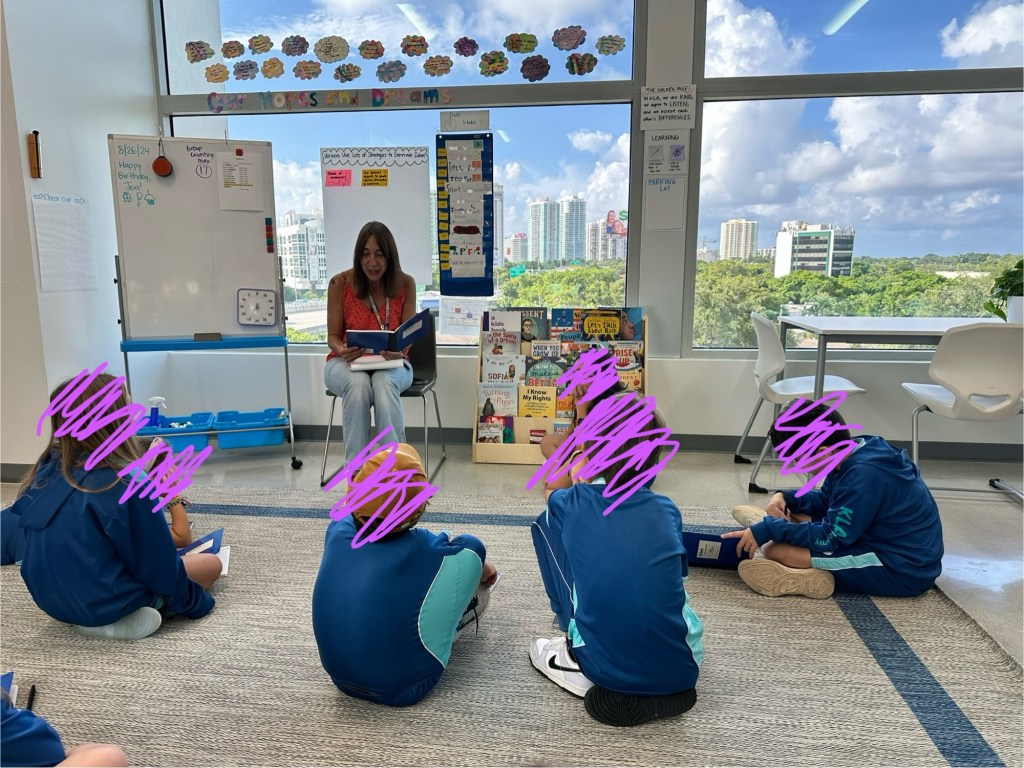
    Kim reading one of our student’s stories out loud, just like Georgia Heard did for us at the Quoddy writing retreat.
  • The First Writer’s Workshop

    It’s 5:30am and I’ve already been up for an hour. I’ve been struggling with morning insomnia for a few months now — waking up around 4 or 5 to pee, and unable to quiet my brain enough to fall back asleep. I have a notebook beside my bed to help me dump these thoughts, the goal being to train my brain to deal with them later, but tomorrow is moving day and so I’m too excited to settle back down.

    Besides, it’s the perfect time to get my slice of life out of the way. And I do have a goal for my Tuesday slices, now that the school year has started — I’d like to document a year in the life of a 5th grade teacher and her class and the learning we all do. So I thought I’d begin with the first Writer’s Workshop.

    ***

    This year is a little different. It’s the first year at KLA that I don’t have Ana in the classroom across from mine or down the long hallway, and it’s not because she’s on maternity leave or has moved away. Ana has gotten the job we’ve all been hoping for (and more!): instructional coordinator. This means she is more available to do coaching work with teachers, coordinate curriculum for the school, help streamline and align all-school practices, and so much more. This spring and summer, she also wrote a whole new WW launching unit for us: The First 20 Days of Writer’s Workshop, a beautiful unit that emphasizes talk, encourages teachers to join in the writing, and keeps writers in their notebooks to help them develop a strong repertoire of strategies for generating ideas of what to write about.

    To be honest, my head hasn’t been in the right place since starting school, what with everything that’s been going on (see my last post), but I knew I needed to start this year off right with a first Writer’s Workshop lesson that would hook my writers. That need became even more apparent when, during our morning meeting share, students expressed their feelings (good or bad) about writing — some saw it as something to enjoy, when they got to write made up stories or jot down their feelings to destress, while others cited it as being boring, hard, or tedious, unless they were passionate about the topic.

    I knew this first lesson would be important in convincing my reluctant writers that maybe, just maybe, there could be something to enjoy about writing this year. (And I have verbal — and written — proof from previous years that I’ve been able to do this. Many students who previously didn’t like writing either fell in love with it or found the utility in it.)

    So, as they gathered on the rug in rows for the first mini-lesson, I took a breath, told them I needed a moment to put on my writing teacher’s hat, and then leaned in close, as if letting them in on a secret: “Good morning, writers.”

    Envisioning language, a suspenseful story, big eyes and smiles, audible surprise — I wish I could have filmed the lesson from my perspective. It was a beautiful example of engagement, when every single kid is there with you, one of the utmost highs of teaching.

    And then, the planned conversations for oral rehearsal — one partner talking, the other asking follow-up questions. By the time I sent them off to write, there was no question that the notebooks would be filled. When the timer beeped, you could feel that they would have kept going.

    But it’s the first six weeks of school. The first 20 days of writing. And so we go slow to go fast.

    I’m ready for day 2.

  • The Joy of Writing Mentor Texts

    It’s my fifth year teaching fifth grade, and my third year teaching Writer’s Workshop to fifth graders. Last fall, I was excited to attend an online session with Hareem A Khan and Eric Hand for their new Graphic Novels unit for Grades 4-6. I was blown away by the work they did and immediately pre-ordered the unit. When it came in the spring, I eagerly launched into teaching it, knowing my student writers would love it.

    Last year, though, we were only able to do the first bend, as it was close to the end of the year and we had limited time. Instead of writing my own mentor text, I based mine off of Hareem’s, which is great, as it worked for all of the mini-lessons, but it wasn’t my own. I didn’t have to actually go through the writing process of generating an idea, bookmapping, considering panels as I sketched my thumbnails, or really working on my cartooning skills either when drafting. I didn’t have (or get) to experience the time-consuming yet rewarding process of creating my own short graphic novel. Until this year.

    This year, we had enough time to teach the full unit. I didn’t reinvent the wheel with the first bend, so I still used my Hareem-inspired graphic novel for that. For Bend II, in which the children write graphic memoirs, I knew I wanted to challenge myself to create my own, and I knew exactly the small moment I wanted to use for it: the fridge debacle.

    Throughout the unit, Kim has remarked over and over again how incredible it is to watch the writers’ engagement in this medium. As graphic novel lovers, they thrived (with only a few gripes here and there of “I’m no good at drawing!” — but once they realized they could get away with stick figures, it was full steam ahead). And for me, as someone who enjoys doodling herself, I was thrilled to be working in the new medium as well. I even enjoyed students’ feedback for revisions during mini-lessons, such as the lesson where I modeled how to build suspense by deciding on the number of tiers and panels within each tier. I revised an original thumbnail of 3 tiers, 2 panels per tier, to 3 tiers, one panel per tier, because as R suggested, it would be much more impactful: dun, dun, DUN! Or when E remarked that I could start the story right at the loud noise waking me up, and flashback to the preceding trouble later on.

    And the result has been so much more rewarding than creating a mentor text that I can use for future teaching: I used writing and cartooning to create art out of one of the more annoying and stressful moments of my adult life. It took lots of time, stolen at lunch, or while the children were reading or writing or taking a math test, or at home while I watched Netflix. The joy of sharing this piece with my students who have followed along and assisted me in the process has been so special, as has sharing it with my friends and family who experienced the debacle alongside me.

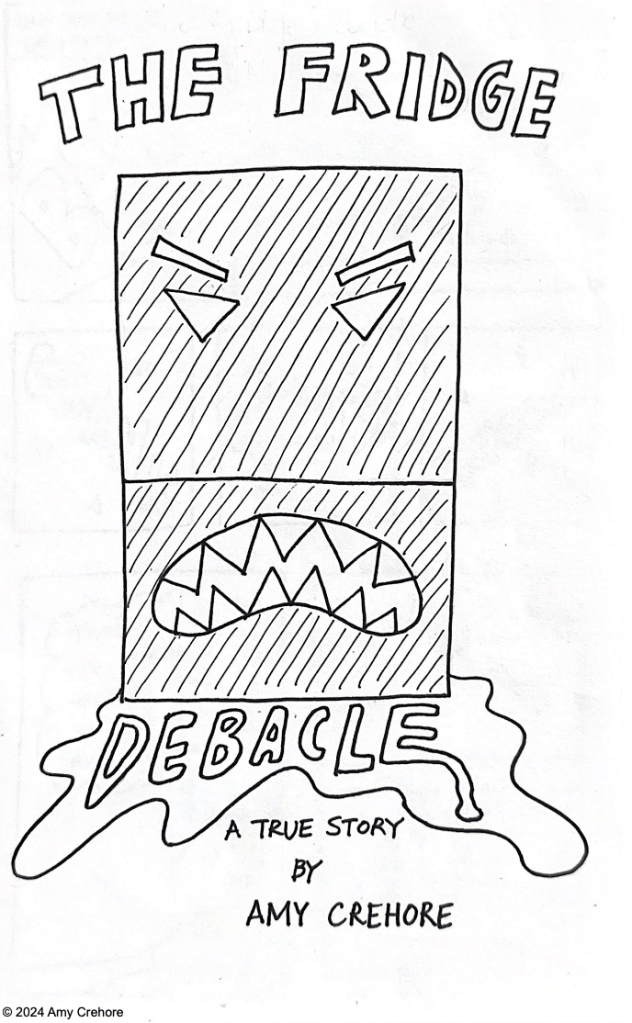
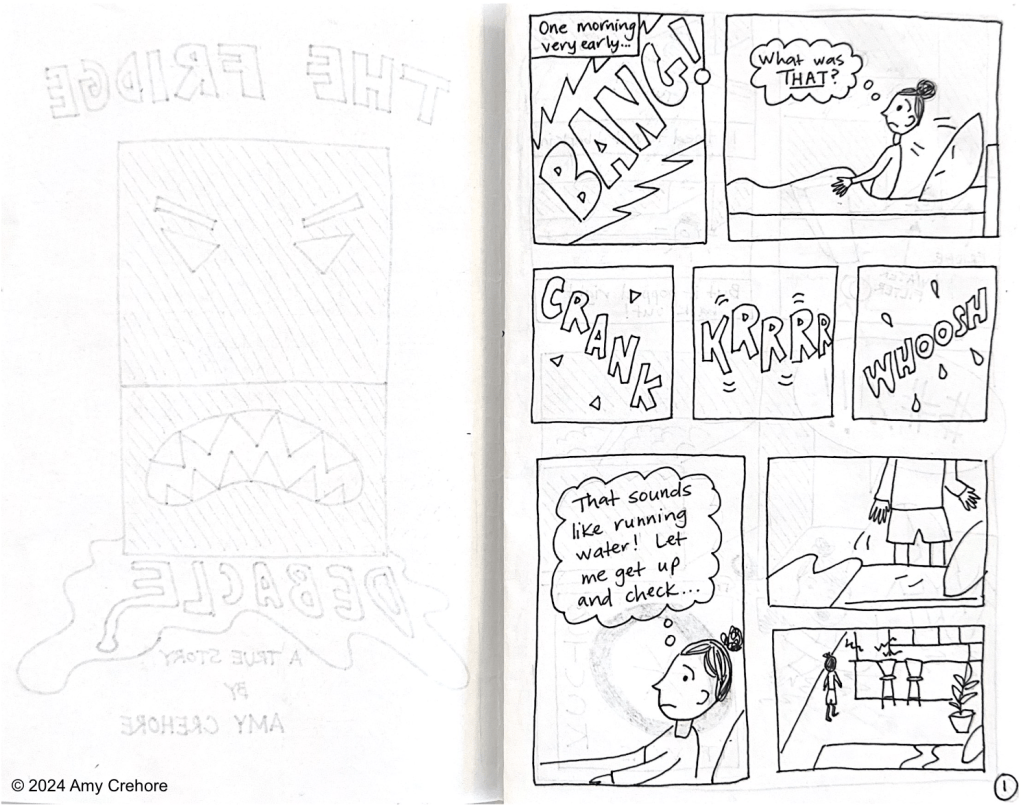
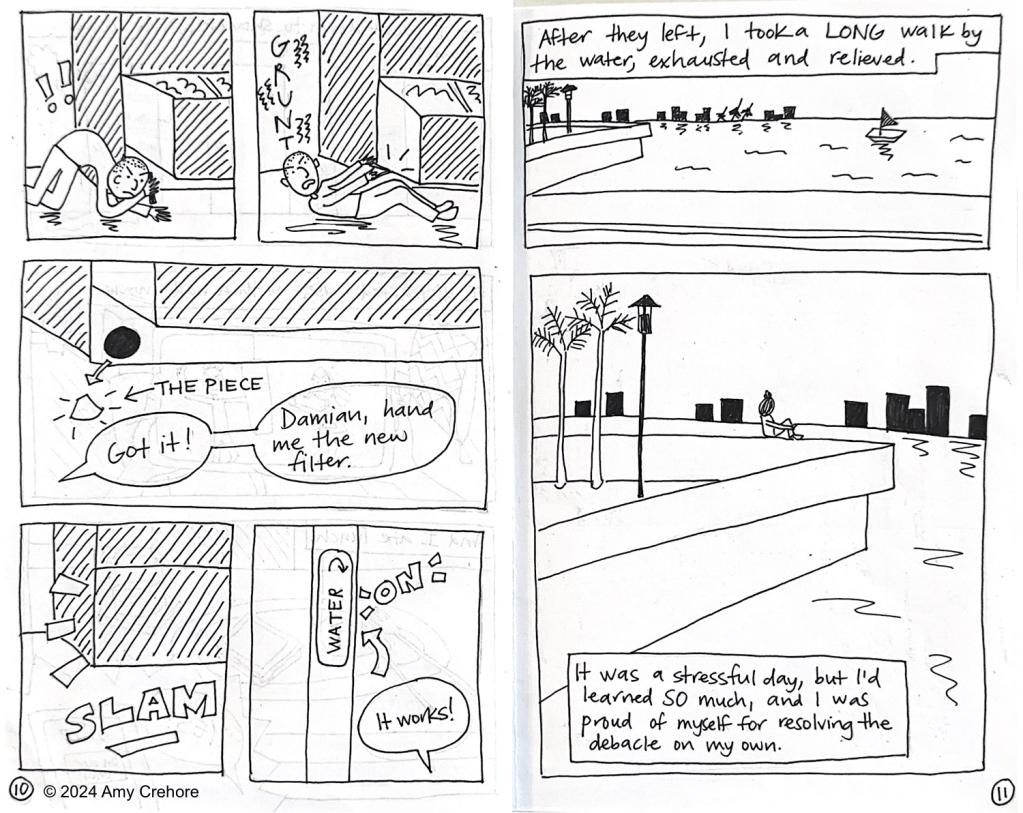
    I present to you, The Fridge Debacle:

  • The Final Slice (For Now)

    I tell people all the time one of the most beautiful paradoxes to me is writing. And the reason why is because in order to do it one has to live in an extraordinary place of humility, in the process of making something that perhaps might be shared with the world. On the flip side, the mere notion that someone wants to make something that might be shared with the world is rooted in ego.

    Jason Reynolds, from an episode of Unlocking Us with Brené Brown

    I can’t believe March is over. What a month to have documented daily. An exhausting month. A scary month. An emotional month. A month that finally, thankfully, is coming to an end, turning itself over to April and new beginnings.

    I was wary about this challenge, as it’s probably the most disciplined I’ve been writing in years. Maybe even a decade.

    I have always been a writer.

    As a kid, I would write stories and create fake newspapers on AppleWorks on my iMac. In middle school, I started blogging on Xanga and LiveJournal with camp friends. For years in high school and college, I wrote every day, whether journaling or free writing, or writing stories and memoirs. I surrounded myself with other writers and edited Caliper, Stuyvesant’s literary magazine, my senior year. I even went to college for Creative Writing. I started running an open mic with my friend, as well as a one-page flyer-style lit mag, and consistently participated in both. But in my final semester, I dropped the major because of a logistical conflict (and conflict between professors) with my other major.

    After that, I let writing fall by the wayside. I didn’t feel that I could do it, that anyone would want to read what I wrote. I journaled off and on, but could never quite get back into a groove.

    During COVID, I started journaling again more consistently, but I wasn’t producing writing for any audience aside from myself.

    It wasn’t until I started teaching writer’s workshop that I rediscovered the love of writing within me, through teaching kids how to go through the writing process themselves. Their excitement and nervousness inspired me to write mentor texts, and then their feedback to those mentor texts fueled me further. In our memoir unit this year, one student said, “I don’t understand why you’re a teacher. Why aren’t you a writer?”

    Well, I am both. I am a teacher. I am a writer. I write for me, I write for audiences (blog followers, my students, my friends when I write love letters to them). I am a copywriter, using words to advertise and persuade.

    This writing challenge wasn’t easy. It was quite difficult in fact. And not every post was a real “piece,” if you will. But it was something. And I put myself out there. And for that I’m proud. I hope to keep the momentum going — Tuesday slices? SOLC 2024?

    I wrote every day for the 2023 Slice of Life Story Challenge run by Two Writing Teachers.
  • Writing Conference with Myself

    If a writing teacher were to come up to me right now, 8:17pm on a Tuesday night, 28th slice of 31, ask me the magic words: “How’s it going?”

    If it were I in the writer’s seat, pen in hand, notebook open before me, I would reply: “Not well.”

    “Not well?”

    “I can’t think of anything to write today. I’m plumb out of ideas.”

    “What tools do you have for generating ideas?”

    “I know, I know. Think of places and people and memories close to your heart. Make a list, choose one, write everything down. Use Ralph Fletcher’s ‘breathing in and breathing out,’ or a photograph, or an observation out my window. But I’m telling you, I’m stuck.”

    “Let’s try. What’s one small moment from today, just an image, that gave you joy?”

    Ugh, I’d think. Fine, I’ll try.

    And close my eyes. And breathe. And think about what moment today was not hectic, not loud, not tiring.

    “I’ve got it!”

    “Great. Now write it down.”

    Tuesday, March 28th

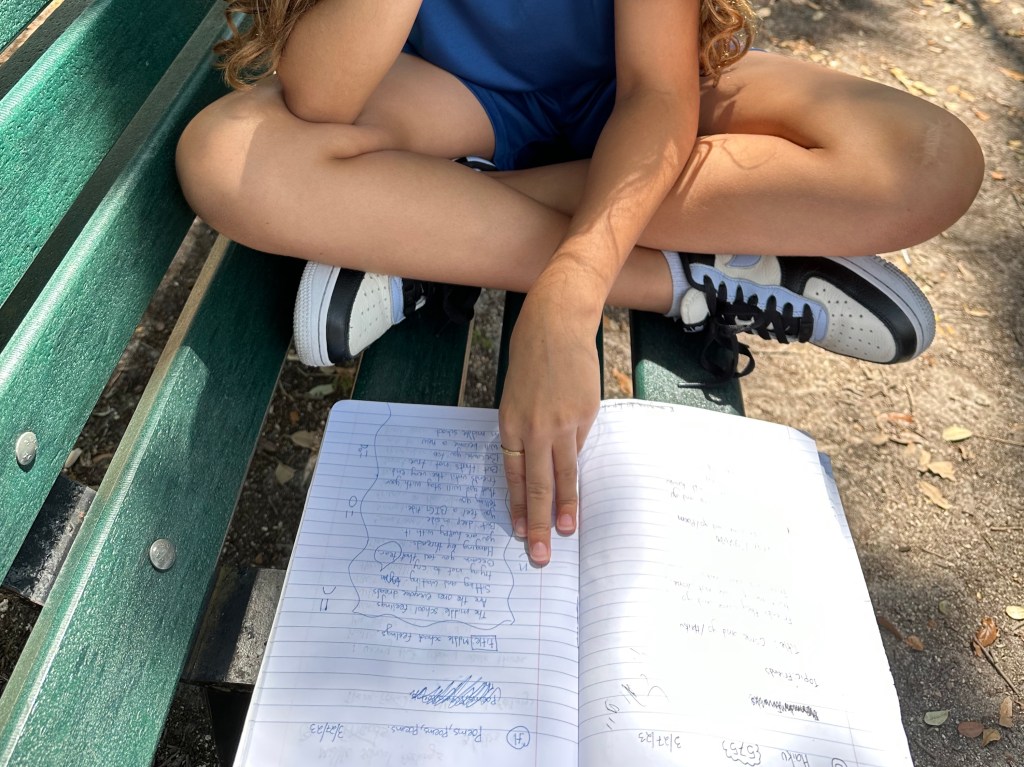
    At recess, my student brought her notebook down to the playground, led me to a bench, and read me her poem about #middleschoolfeelings. Legs crossed on the bench, notebook open in her lap. Voice soft, yet powerful. We workshopped a few possible endings. She borrowed my pen to ink the chosen one. Then went off to share it with a friend.

    Day 28(!!!) of 31
  • Friday Haikus

    HOW-TO HAIKU

    Taught kids to haiku

    They tried traditional ones

    And silly ones too

    *

    FUNNY KID

    Reluctant writer

    Manages to write the best,

    Funniest haikus

    *

    SPRING BREAK

    It’s finally break

    School is out — Quick! Run away!

    Ready to relax

    *

    SOCIAL MEDIA

    Deleted TikTok

    It is a total time suck

    Now screen time is low.

    *

    HYDRATE

    Remember to drink

    It’s important to hydrate

    Gotta love water

    Day 17 of 31
  • Taking Workshop Outside

    This morning, I told the students to gather quickly with their writer’s notebooks and a pen or pencil, because we were taking our workshop outside to the park.

    “No way!” They shouted. “Yessss!”

    We headed downstairs and out to the park that faces our school, congregating around one of the picnic tables so I could tell them the teaching point.

    “Writers, today I want to teach you another strategy for generating ideas for poems,” I said. “Poets see the world with eyes that are alert to the smallest details.”

    I pointed to the vines hanging from the tree branch above us.

    “Look at how the sun is glinting off of the vines, making them look golden. Notice how they’re waving in the wind, swaying.”

    “Almost like they’re dancing!” T chimed in.

    “Exactly!” I smiled back. “I think I’ll write that down. I might be able to use it in a poem later.”

    I pulled out a mini-anchor chart with steps for the teaching point.

    “Poets, today you’ll look at the park with new eyes. You’ll write long in your notebooks about what you observe, what you notice, and what you think about what you see. All of this can be used as inspiration for later poems! Now, spread out and find a spot where you can really fine tune your poet’s eyes. Off you go!”

    And they all dispersed.

    For the next thirty minutes, pens scribbled in notebooks, eyes gazed around in wonder, and when we gathered again, almost everyone shared an excerpt from their writing.

    On our way back to the school building, we brought back plenty of new ideas, as well as a moth and a tiny inchworm.

    As the door closed behind us, one student asked, “Can we have writer’s workshop outside every day?”

    If only!

  • Poets

    Today one of my students brought his writer’s notebook with him to our social studies lesson, sneaking poetic lines in between notes taken on his classmates’ presentations. Yesterday, he asked if he could bring it down to music, because he thought he might get distracted, and knew having the notebook there to write in would help him. Later, he asked if he could take it home.

    “Of course,” I replied.

    Because isn’t this what we as writing teachers hope for?

    That a child will want to bring that notebook with them everywhere, to catch thoughts before they disappear from their minds? To capture vivid images and fierce wonderings?

    Today he left his notebook at school, and he won’t be back tomorrow. As I got home, I saw an email from him saying that he left the notebook at school, asking if his sister could get it for him tomorrow morning, because he really wants to share the poems he wrote today with his mother.

    “Of course,” I replied.

    Of course.

    This unexpected enthusiasm for our new poetry unit is magic.

    Students reading their poems out loud at the end of workshop today, smiling as they read, sharing their inner worlds with their peers, receiving snaps at the end.

    Oh! Let me be like my student who can’t wait to bring his notebook home, who can’t wait to put pencil to page, to put mind to words.

    “Can this be a poem?”

    “Can I write this in my poem?”

    Of course.

  • In My Feels: Anticipation

    All. The. Things.

    At the launch of every new writing unit, I feel a wave of anticipation that teeters dangerously between excitement and overwhelm.

    Excitement because it’s a new genre, and there are so many great tools and resources, and I have some new systems I want to put in place, and this time I swear I’ll be more intentional with picking the mentor texts and modeling in my own writer’s notebook.

    Overwhelm because there are TOO MANY great tools and resources! And how will I teach all the new systems and still give writers time to write? And how will I get these on-demands graded in time? And, oh god, there are so many things to teach them, where do I even begin?

    So I’m taking a break from the grading to write this post and remind myself to BREATHE.

    To just take it “bird by bird,” as Anne Lamott says. The unit will pick up speed as the writers step into it, and I will know how to sift through the tools and use what I need once I see what they’re producing.

    I am leaning towards excitement as I gear up for tomorrow, for two main reasons.

    First, Consuelo and I have decided to split the class in half for reader’s and writer’s workshop, aligned with their book clubs and their writing partners. This way we can take advantage of both instructors and get a 12:1 student:teacher ratio. We’ll also have more time and freedom to conference with students, which I’m really excited about. After attending the TCRWP’s Virtual Saturday Reunion, as well as Ana’s last WW meeting on the teacher work day, I’ve got so many ideas about how to make small groups work better for both me and the kids. That’s a big goal for me as a teacher this unit.

    Additionally, as I was preparing a “This Unit’s Mini-Lessons” anchor chart, an idea Ana and I had for student accountability, Consuelo gave me the idea to make small cards to give to the students for each teaching point. That way, it could live on the anchor chart AND in the students’ notebook for reference.

    Here are how the first three lessons’ cards turned out. I’m looking forward to seeing how this helps cement the teaching point for each writer!

    It’s important for the card to include a visual, and I also added in which stage of the writing process it applies to. I’m hoping this helps empower students when we confer!