Writing With Abandon

Reflections and ramblings about life as an educator, writer, reader, knitter, and over-thinker. Trying to do the writing only I can do.

Tag: reading

  • Planning, Projecting, Pacing

    I have a rare gift of a late-start morning, thanks to a doctor’s appointment, so I figured I’d take the time I still have before I head over there to write my slice.

    We’re coming off of a long weekend, and I happily spent some time on Saturday planning this week and next’s reading lessons and pacing out unit 2 (nonfiction). The lessons were the first that I’ve planned independent of Ana — huge step! Wow! — and I felt confident finally in how I was writing them. I used all the tools that I’ve acquired thanks to her:

    • The recipe for the perfect teaching point (the what + the how)
    • The TC learning progression for narrative reading (which I’m kicking myself for not using until now)
    • Rubric creation for the final assessment
    • Our pacing and planning guide with titles of each session

    And once I was done with that, I took a look at the next unit, even though I had many other things to do, because I’m geeking out over teaching it.

    To give some background, our school has not had a consistent reading curriculum since I started teaching there, so this year I’m planning out all new units using our power standards and other curricular resources (Shifting the Balance, Jennifer Serravallo, TC units of study) so that they reflect a) what our students need and b) are more digestible for them. This means that much of what I’ll be (and have been) teaching them asks them to raise the level of their reading and interpreting to a point they’ve never been asked before. Which is really hard. But I know they’re capable.

    For the nonfiction reading unit, I’m keeping in mind the fact that Adam Fachler highlighted during the Thinking Maps Training of Trainers course I took with him so many years ago: you can’t learn new skills AND new content at the same time. It’s one or the other. So, I’m choosing new skills. Rather than requiring students to read about topics they don’t know much about, I’ll have them choose a topic they “sort of” know about (as Ana said, lol), or really: a topic they know well, but can still learn more about. The goal of the unit will be clear from the get-go: to prepare for a “knowledge fair” where they’ll teach younger students about the topics they’ve researched.

    The skills I’ll be focusing on this unit are:

    • Note-taking to capture, organize, and synthesize information, using text structure to guide
    • Summarizing by identifying main idea and important supporting details
    • Writing about reading to teach others

    I’m hopeful that this nonfiction unit goes better than nonfiction units I’ve tried in the past. If the projecting and pacing stage is any indication, it’s already going well.

  • A Better Reading Teacher

    My hope and dream for 24-25

    This year, my ninth year as a lead classroom teacher, is the year I want to tackle reading. My first few years in the classroom, I focused on dual language learning, math, and classroom management. Then, project based learning followed by writer’s workshop.

    Every year I’ve held off on reading. I’ve dabbled in it, I’ve led interactive read aloud and book clubs, I’ve ensured access to books and (mostly) protected independent reading time. But reading instruction? It’s always been a struggle. First, because I was teaching in dual language classrooms, later because it was just one more thing on top of all the other stuff I was doing.

    And mainly, because it just felt hard! Reading is something I love, but I don’t know how to teach, at least for upper elementary. Upper elementary is challenging, because we don’t get the training in phonics to help teach our students who have gaps. The students who are still learning TO read, and aren’t yet ready to confidently use reading to LEARN.

    But it’s time. I have to face it.

    So this year, my goal is to become a better reading teacher. This will include designing and developing reading units that are aligned with our new power standards, as well as implementing age-appropriate small group lessons for those students who need fluency and decoding support.

    We started by designing a launching unit to get the students excited about reading. The lessons included: cuing students to notice that we see reading EVERYWHERE; asking students to get curious about how they and their grownups learned to read; sharing some of the science of reading for students; sharing some fun reading history facts so students could realize how reading is a privilege; and helping students take ownership over their reading journals and the why/how of talking and writing about their books.

    Ana jokes that we should sell the unit, and I shake my head, but then I think, maybe we should! Because excited about reading? They most definitely are.

    Student jots, later categorized. My favorite has to be the Twilight Gossip!
  • Unfrogging

    Unfrogging

    Last week, I “unfrogged” a piece of knitting. (In knitting, when you “frog” something, it means you set it aside for an indeterminate amount of time, aka, you abandon it for a little while, or for a long while, or forever!)

    It was the June Top, a silk tank top by PetiteKnit, a knitwear designer known for her simple, classic, and easy-to-follow designs. I bought the pattern and the yarn for it last summer when I was visiting Julie upstate, and started it when I got home with the intention of marling the yarn, but didn’t like how it was turning out. So it stayed in its project bag in a basket, untouched for months. This spring, after Julie and Chris came down for a visit and she asked what was on my needles (nothing), I decided to unravel it and turn it into a striped tank top, but I didn’t get very far before frogging it again.

    Summer break seemed like the perfect time to get my hands back on a project, though. There’s something about the long vacation that leaves my anxiety tingling through my fingers. A restlessness, you could call it. I’ve gotten better about biting my nails, but not completely — my left thumbnail has beared the brunt of it (sorry, buddy). Knitting has always helped me with that urge to fidget or to bite, and that was initially why I pulled the project bag out of its spot under the coffee table and got back to work.

    Soon, though, the joy of knitting re-emerged and took hold. There’s an almost addictive energy that forms as I physically sculpt a new garment. I once more felt grateful for my hands and fingers and the skill that I have honed since my mother and my grandmother taught me to knit as a young girl.

    The tank top started taking shape.

    Knit bottom up, in the round.

    Once I had two stripes of each color, I was on a roll. I decided on the length (2 inches shorter than what the pattern called for, as I tend to wear cropped shirts and high rise pants) and separated for the front and back.

    The front straps complete.

    When a pattern is simple stockinette stitch, I’m able to knit without looking, and watch TV shows or movies as I do it. But once a pattern calls for more attention — short rows, bind offs, lace, or cables — I have to keep my eyes on it.

    So this time, I decided to borrow an audiobook from the library to accompany me through the many hours of knitting I still had left to finish the top: The Maidens by Alex Michaelides.

    The thriller ended up being the perfect companion to my knitting. I hung on every word, listening even when I showered and ate a solo meal. The voice actor who read it was excellent, and I felt as my students must feel during read aloud. I kept telling P how I couldn’t wait to get back home so I could listen and find out what would happen next!

    And of course, I finished my June Top in no time:

    Necessary mirror selfie after finishing and wet blocking.

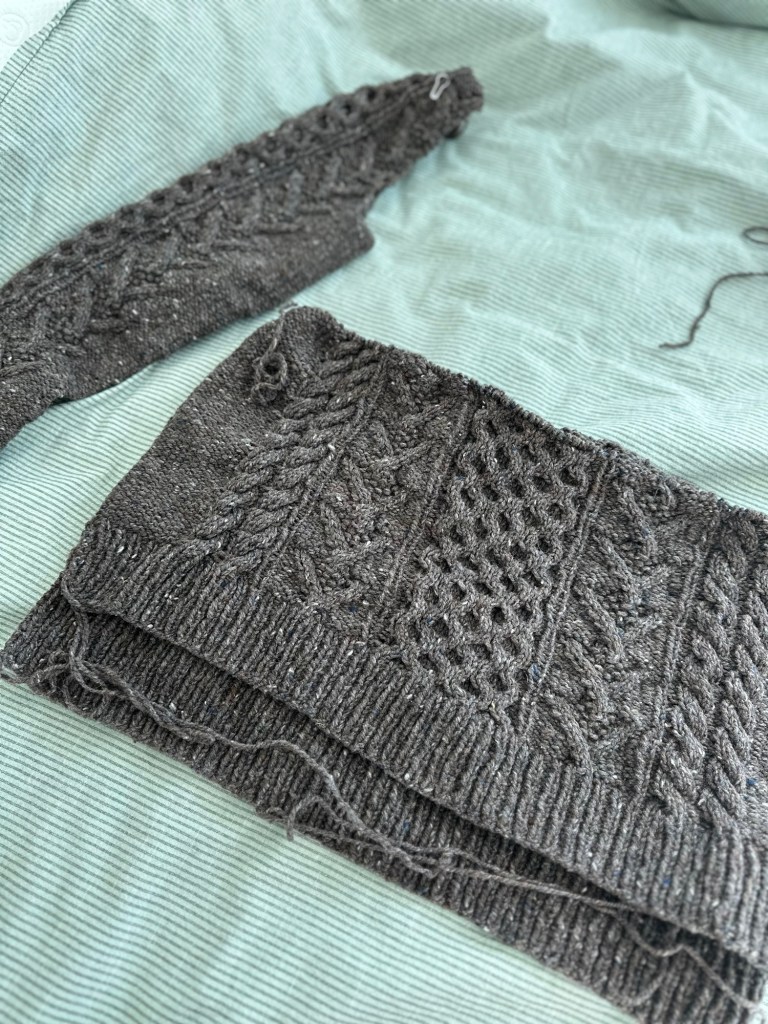
    I realized that I could combine two of my great loves: knitting and reading. And this realization gave me the boost I needed to pick up another project I’ve had frogged for a while: the Bronwyn pullover, a cable-knit beauty. Perhaps I’ll get her done before my trip to Maine.

    I started this project in the winter of 2020! Let’s see if I can finish it in the next few weeks.

    Which leaves me to search for my next audiobook companion. Are any of you audiobook listeners? Do you have any audiobooks that you’d recommend (ideally fiction, though I have loved listening to some nonfiction read by the author)? Or, have you read a book recently that you couldn’t put down and think would read well in audiobook format?

  • Day 20: Reading Stations

    This week, Kim and I started reading stations.

    We’d tried TC’s 5th grade reading units with a workshop model and had little success with them. As a new school, we haven’t had a curriculum that students have followed since kindergarten, meaning there are large gaps and inconsistencies in what students are capable of doing. We were finding it hard to engage all students in the mini-lessons, whether reading happened earlier in the day or at the end of the day. We also saw a need for more consistent language study (vocabulary, spelling, grammar, conventions), but couldn’t figure out how to fit it in our day. Squeezing it in at the end of writer’s workshop was too rushed, and when we missed it, it just… wasn’t happening.

    In the fall, we both took the Shifting the Balance upper elementary course and realized that there were many other practical activities we could be doing, but that didn’t fit into our reading block as it was. When our investigation stations that we began in January were so successful, we decided to try a similar model for reading.

    There are six stations: indie reading, read with friends, write about reading, fluency practice, word study (using Structured Word Inquiry), and sentence study (using Judith Hochman’s Writing Revolution). The two language study stations are teacher-led, and the others are independent. Students go through two stations in a day (20 minutes in each), and cycle through all six after 3 days. Then it repeats.

    With February break and our theater show and the overnight, we couldn’t start the stations until this week. Today, after the second class, the students shared during Closing Circle some of the things they were enjoying about reading stations so far. Here’s what a few of our boys had to say (boys who are semi-reluctant readers!):

    “Something that I like about reading stations is that we get to do many things, we get to move from one to another. It really makes me feel like I get so many options to do super cool stuff to read. Like, I never knew that. When I hear reading, it’s just like, reading, indie reading. Now I know that there are many things to do when it comes to reading. Super cool.”

    “Something I like about reading stations is the word study and kind of like, it changed like, I saw that reading isn’t only looking at a paper and seeing the words.”

    “Something that I liked about reading is the word study and the sentence study and indie reading because I like to read by myself.”

    “Something I’m enjoying in reading stations is learning new words and the history of words.”

    We headed to dismissal feeling buoyed by their positivity. I’m so grateful to work with Kim, who’s just as enthusiastic about trying new things as I am, and I’m excited to see how reading stations go for the rest of the year!

  • An Ode to Public Libraries

    I grew up just a couple blocks away from the St. Agnes Public Library in New York City. I remember my first library card, and all the amazing books I borrowed from there. Scratching mystery crust off of pages, but turning them all the same, eager to finish new stories, experience new worlds. From middle grade books to the dramatic young adult series I read (hello Sarah Dessen and Jodi Picoult!), I devoured them, borrowing stacks at a time.

    When I lived in Madrid, I visited the Pedro Salinas library, found their tiny English fiction section, borrowing British editions of literary novels like Zadie Smith’s On Beauty.

    Back to New York, I lived and worked in Washington Heights. I loved the children’s section in the library closest to my apartment, and took my third graders to the Fort Washington Library for a magical field trip.

    A few years later we lived on East End and 78th, and I had the Webster Library just steps from my front door. I adored the used bookstore in its basement.

    When COVID hit, I couldn’t take books out for a while, so I borrowed them from the NYPL and the Brooklyn Public Library on my Kindle. I continue to borrow books on my Kindle constantly. (The airplane mode trick is the best, if you don’t know it yet.)

    The first week I moved to Miami, I set out walking under the blazing July sun to visit the main branch of the Miami Dade Public Library. I sent my parents a selfie with the three books I found and borrowed that same day.

    Today I returned to that branch with my class. Though they weren’t initially excited, the anticipation grew. Parents emailing us that their children were begging them to get library cards in time, and would the e-card work to take out physical books, otherwise their daughter would “kill them”? Children bouncing on line before going in, as though we were going to Six Flags. And finally, the visit — in awe of all the information the library had to offer, and each of them finding a small (or large!) stack of books to borrow.

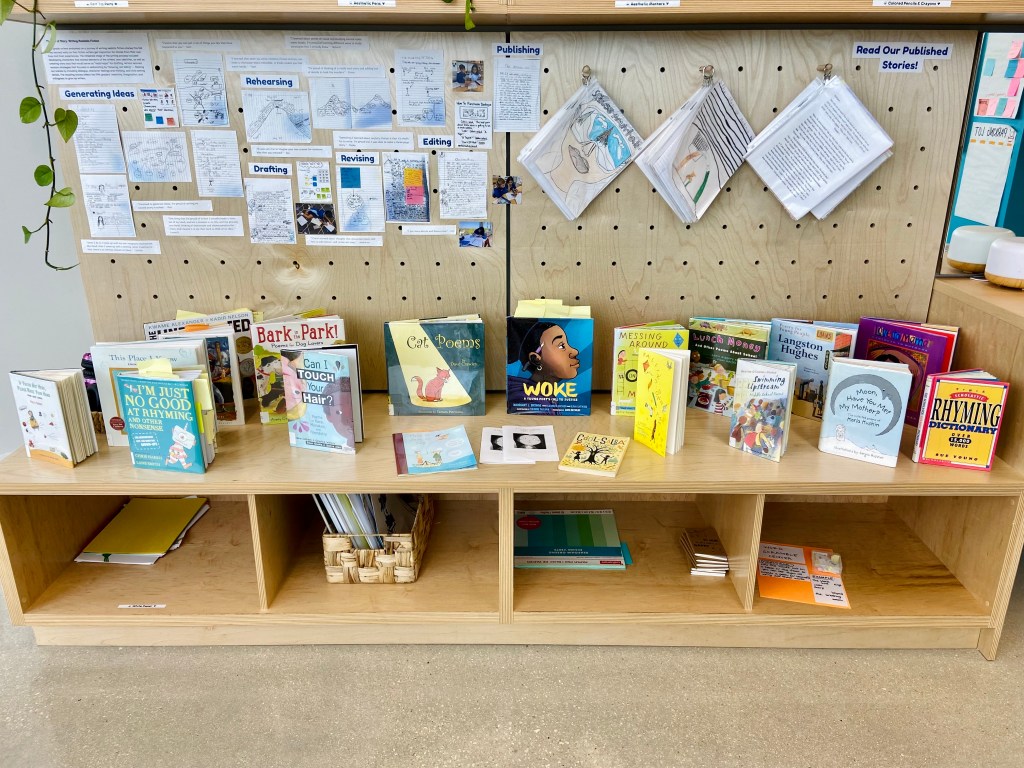
    All but 3 of these poetry mentor texts are from the public library.
    Day 15 of 31
  • A Reading Spot

    “Netscape” by Konstantin Grcic, photographed by Larry Speck

    Yesterday, I forced myself out of the apartment for an evening stroll. I walked past the construction of the new bridge and highway towards Maurice A. Ferré Park, taking in the greenery.

    I made my way towards the Perez Art Museum and climbed up to their back deck, overlooking Biscayne Bay. There, I saw a set of netted swings that I’d never noticed before. I tentatively sat on one, worried it might trigger my vertigo.

    It didn’t.

    In fact, it felt wonderful.

    With one leg down and the other hiked up, I rocked myself back and forth, pulled out my Kindle, and enjoyed my new favorite reading spot in Miami.

    Current read – Follow me on The Storygraph!