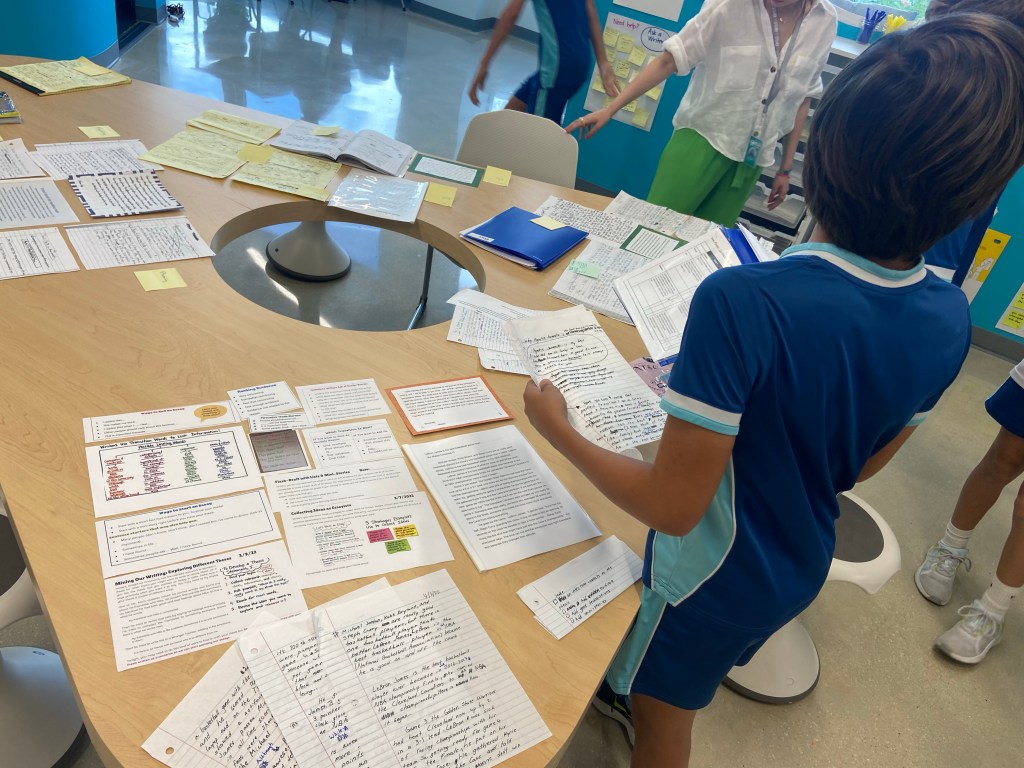
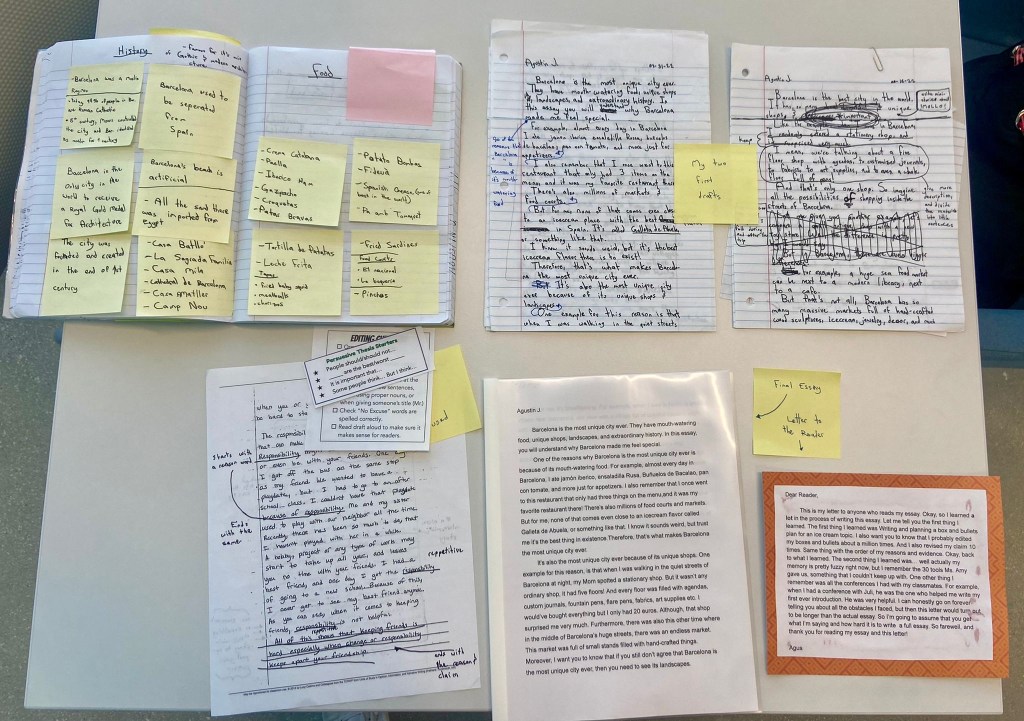
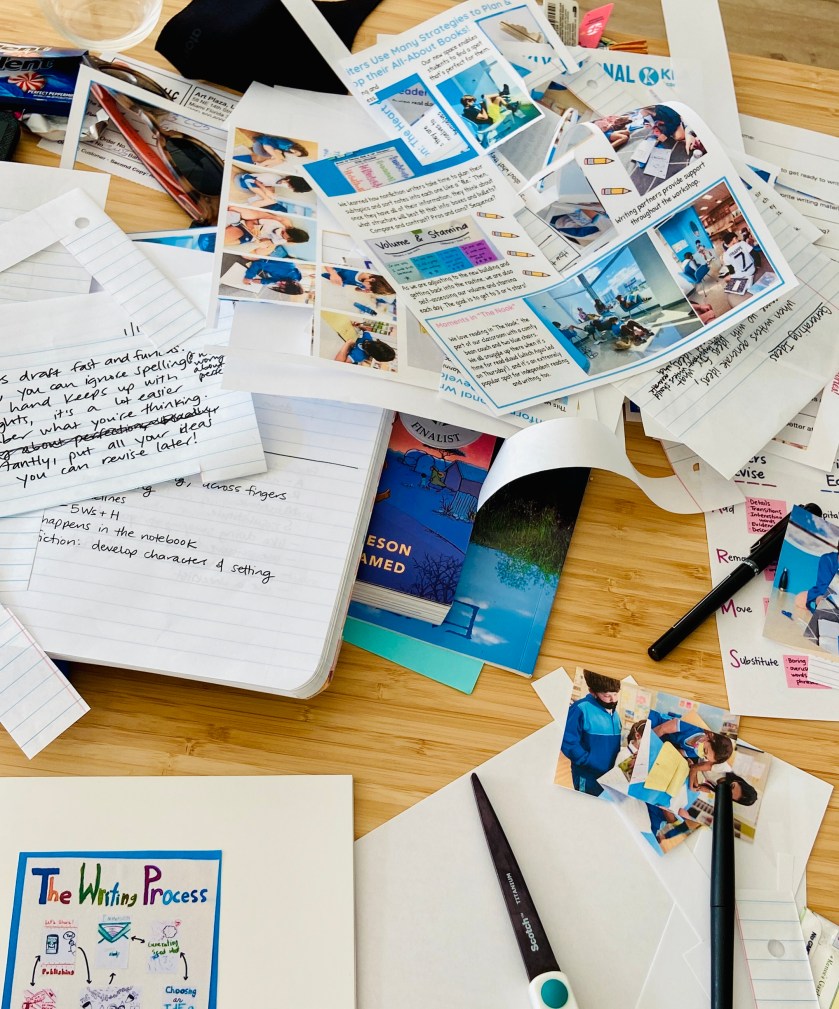
This morning we held our essay writing celebration. I gifted students their typed final drafts in plastic report covers, their letters to the reader pasted on patterned cardstock. They set up their writing displays, encircling their essays with all the work that went into them: the ideas in their notebooks, their plans, their revised (and revised again!) drafts, the tools and strategies they used to help them. Some students grabbed post-its to label each page. Some flocked excitedly to their classmates’ areas, peeking at what they had put out.
At 10:30 on the dot, Isa squealed, “They’re here!” and opened the door to a group of parents streaming out of the elevator.
Each student greeted their parent warmly and guided them towards their writing display. And then the work of celebrating truly began.
What I’ve loved so much about Writer’s Workshop this year is the emphasis on the writing process — on all of the work that goes into a published piece, rather than just focusing on the product. Publishing takes one day, whereas all the work before that — generating ideas, choosing one to plan and develop, drafting fast and furious, revising, and editing — takes up to 4 weeks. In one unit, writers generally cycle through two pieces, deciding in the final days which they will commit to publishing.
The heart of writing lies in the mess, the struggle to find an idea, the conferences with a mentor or partner, the beautiful sessions where time flies without you realizing it, so focused you are on getting down the words in your head. The heart of writing lies in revision, in realizing your first draft isn’t your best. The heart of writing lies in looking at your writing as a reader, examining it from different angles and through different lenses.
There is much this year that I have learned and that I still struggle with as a writer. I went to college for creative writing, and sort of fell out of it for a variety of reasons, only now starting to pick it back up again. I let the magic lie dormant for a long while, but these 5th grade writers have sparked that big magic in me again.
Today I celebrate the writers in my classroom and their phenomenal growth. I celebrate myself, knowing that their growth is a reflection of my teaching. And I celebrate the possibilities ahead, for my classroom, for my own writing life, and for the future writing lives of these students.
In October 2020, Natalie and I presented at Bank Street’s Language Series. The theme that year was Anti-Racist Language Teaching. Our workshop, “Taking an Anti-Racist Stance as a Teacher-Researcher” focused on the question: What stories need to be told in the community where I teach and how will I center them?
Natalie and I are both white teachers who, at the time, were teaching dual-language in The Bronx (Natalie still does). In our workshop, we got vulnerable and spoke about our status as outsiders to that community — Natalie is from Ohio, and I grew up in Manhattan, which may as well be worlds away from The Bronx. We discussed the strategies that helped us get informed, with the aim of doing soul-affirming, language-rich, student-centered social studies. Learning the history of the South Bronx changed our vision of the neighborhood, correcting our deficit/racist views. We crafted a unit that privileged community voices, shrinking our presence and promoting the agency of students. Our goal with the workshop was to provide participants with tools to start similar journeys. My goal with this post is to give my readers those tools as well.
Our fifth graders discovered how community members came together to rebuild The Bronx
The Importance of Teacher-Research for PBL
I believe that becoming a teacher-researcher and building your own expertise, particularly if you are an outsider to a community (and even if you have been living in the community your whole life!), is essential not just for anti-racist teaching, but also for PBL. In order for projects to take on a life of their own through student interest and “unexpected detours,” as my coworker Lizzie calls them, teachers need to be knowledgeable about the content and flexible enough to facilitate this learning, no matter the direction the detour may take. This doesn’t mean you need to be an expert or prepared for 100 different scenarios, but it does mean you should have a good amount of knowledge under your belt to feel comfortable answering student questions and guiding them towards next steps.
For me, moving to Miami meant I was, yet again, an outsider. For this unit, I knew I wanted to teach about South Florida’s ecosystems, but I needed to learn about them first. I had a lot of questions: What’s a mangrove? Why is the Everglades so special? Isn’t it just flat swampland? Is Miami doomed to be underwater in the next few years?
I got to work.
Research Strategies for Getting Informed
A successful research project uses multiple sources and multiple types of sources. Here are some that are my go-to’s for teacher-research:
Books
Photo trove (many libraries and museums have digital collections; you can also find specific photographers’ projects or exhibitions on artists’ or museums’ websites)
Podcasts
Talks at local universities
Museums
Interviews with community members
Newspaper and magazine archives
Community and nonprofit organizations
The Henry Chalfant exhibit
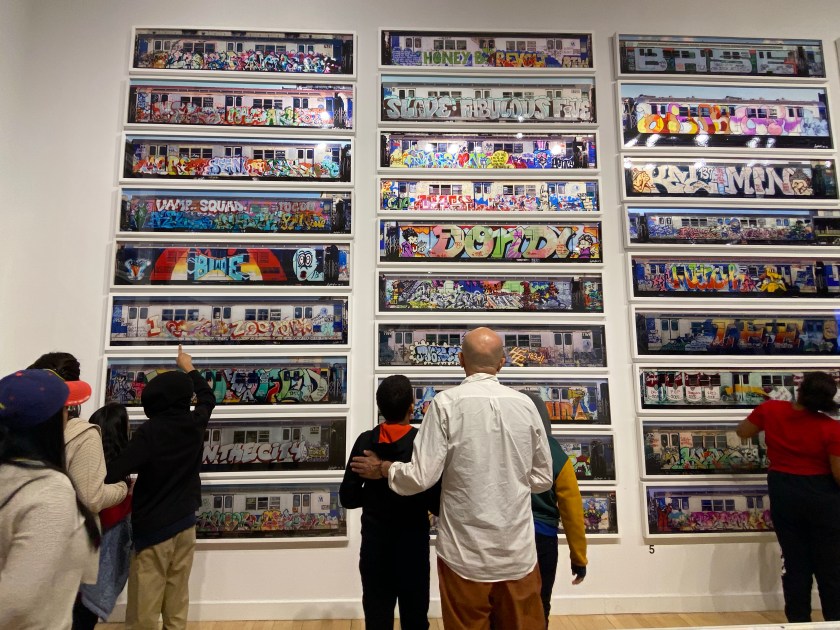
For our Bronx community project, I pored over photographs from the NY Public Library Digital Collections of our school neighborhood in the 40s, 60s, and 70s, finding intersections that we’d be able to place on the map and juxtapose next to photos of what stood there today. I geeked out over a three-part episode from The Bowery Boys about the history of the South Bronx. The Bronx Museum of the Arts had an exhibit with Henry Chalfant’s photographs of the graffitied trains from the 70s and 80s, so we booked a field trip. Natalie, Bryan, and I attended a talk at MCNY to learn about the Young Lords.
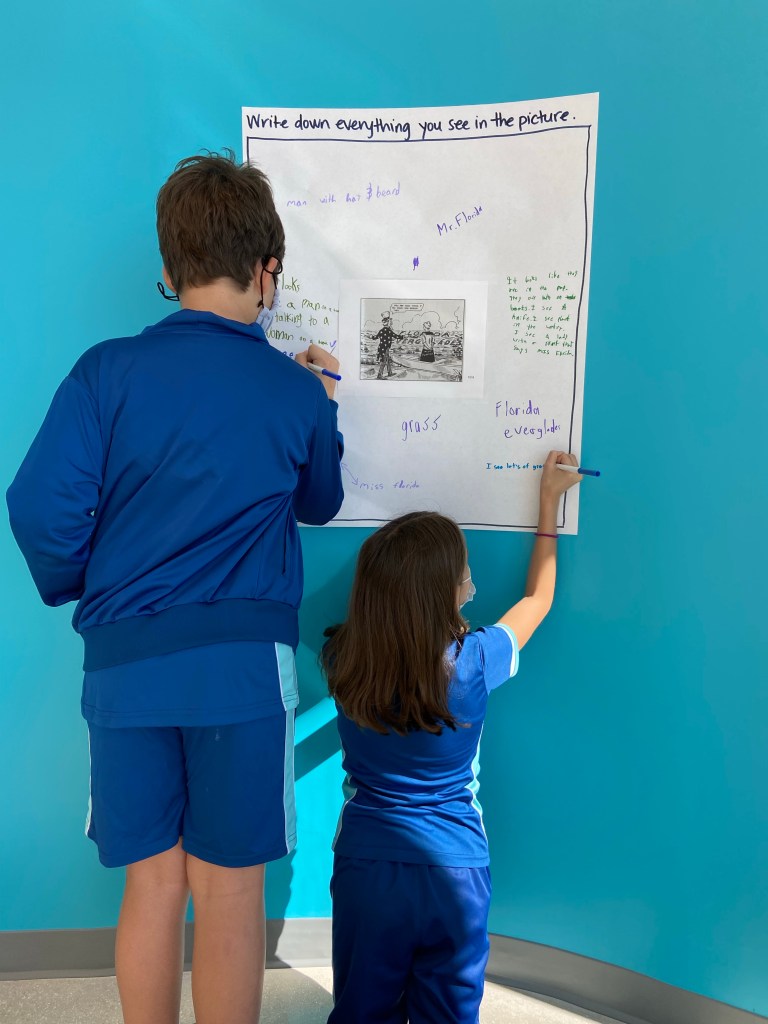
Here in Miami, I ordered a few books to learn more about the history of the Everglades: River of Grass by Marjory Stoneman Douglas and The Swamp by Michael Grunwald, as well as a bunch of picture books for interactive read aloud. I found blogs with old political cartoons and photos, some of which I used for our first provocations. I followed community and nonprofit organizations on Instagram and reached out to some of them for interviews and field trips. I also talked a lot with my coworkers who grew up in South Florida (shout out to Estelle and Josue).
The Beauty of Place-Based Learning: Discoveries for Both Insiders and Outsiders
I think one of my favorite aspects of place-based PBL is that both insiders, who’ve lived in the community forever, and outsiders, who’ve either recently moved there or just commute there from another neighborhood, end up learning so much about their community.
We learned about the resilience and strength of the mangrove forests, and how the Everglades has so many different ecosystems within it. We literally got our hands dirty in order to see this for ourselves.
5th Graders climb up a red mangrove’s roots in Key Biscayne
At the crossroads of Brickell, Little Havana, and The Roads, our school sits alongside I-95, where Xavier Cortada and his 800+ volunteers painted the Miami Mangrove Forest, which we all see every day as we come to work, but never knew the story behind.
We built relationships with organizations that are fighting for the survival of Miami’s ecosystem well into the future, for the benefit of plants, animals, and humans who call Miami home.
Every day that I live and teach here, I grow a deeper appreciation for this city. Through this project, I have gained more faith than before that it will continue to thrive. Watching the fifth graders present to the younger students about mangroves and why we should care about them showed me that they have too.
I’ve been trying to write this post about the importance of thought partners for the past week and a half, but I keep coming up against a wall. “Blog!” kept staring at me on my to-do list, and I kept pushing it to the next day, and the next. It was the first week back from break and I’ll just say I barely made it to Friday.
Today, though, as I was speaking to two of my favorite coworkers and now good friends, A&A, I was filled with a sense of gratitude. I’m so lucky that I get to work alongside these smart, capable, caring, and reliable women, I thought. Reflecting on my practice with them these past eight months has made me a better teacher, whether those reflective chats happen at lunch or after school, at 7:30 in the morning as we make copies, through voice notes sent over WhatsApp, or in an official coaching cycle meeting.
I remember the first time I met Ana, it was during one of her first Writer’s Workshop PDs with the staff. It was a Tuesday in May, and I was visiting Miami for my husband’s birthday and to help him move some furniture in. After a day of Zoom with my students back in the Bronx, I caught an Uber to KLA and was greeted warmly by Angie and Male. I poked my head into the 4th grade classroom to see my soon-to-be students and was pulled to a seat to watch their end-of-year show rehearsal. Then, while the last students dismissed, I made my way into the gym and sat down in one of just a few seats, placed in a U-shape in front of the projector. As Ana shared, I took fast and furious notes in my journal, filling up 3 or 4 pages. Estelle and Lizzie asked questions, showing genuine interest and enthusiasm, even though we know that most teachers in May are exhausted and would rather go home than sit in a Tuesday PD.
I went up to Ana after the meeting and introduced myself. She seemed excited that someone else knew about workshop. I laughed and tried to explain that I didn’t follow it exactly, had never been trained in it. Later that night I texted my friend Danielle, who was finishing up her Master’s at Teacher’s College, how Writer’s Workshop finally made sense to me — and that was just after one hour of hearing Ana explain it.
I met Allison in that same gym, though it was arranged quite differently. It was the first teacher work day in August — the first first day of school for me — and tables were everywhere, with 6-8 seats at each. I, in true Crehore fashion, arrived early, sweating from the Miami humidity that I wasn’t quite used to yet. I took a seat at Estelle’s table, where Ana soon joined, along with a couple of preschool teachers who I made small talk with.
Then there was Allison, pulling up a chair and introducing herself. We discovered that we shared a similar background, having both taught as auxiliares in Madrid for a couple of years. Her smile and contagious laugh settled my nerves, which had been buzzing under the surface since the morning. I finally felt at ease.
For the next two weeks, I lived in Ana and Allison’s classroom as much as I could. We shared ideas and thoughts, signed onto Zoom meetings together, and dothed ourselves Triple-AAA.
So yes, pandemic teaching is hard, and we’re still in the thick of it, unfortunately. The end of the year is only going to make it harder, as everyone starts to get a little loopy in the build up to summer break and graduation.
But today I am grateful for having this support system to get through it alongside.
Anyone who knows me knows that I am very organized. (Yes, I do tend to get cluttered. I’m working on it.) I especially value organization when planning Project Based Learning units, which, without some structure, can just seem like a bunch of floating ideas. My three favorite tools for planning PBL units are curriculum calendars, Dr. Gholdy Muhammad’s Culturally and Historically Responsive Literacy (CHRL) framework, and Thinking Maps.
Curriculum Maps
I’d used pacing calendars prior to Samara at my first school for math. Our math coach handed us a stapled pack of pages that outlined which math lessons we should be covering each day of the year in order to teach them all before the NY State tests. That’s not what I mean here when I refer to a curriculum map.
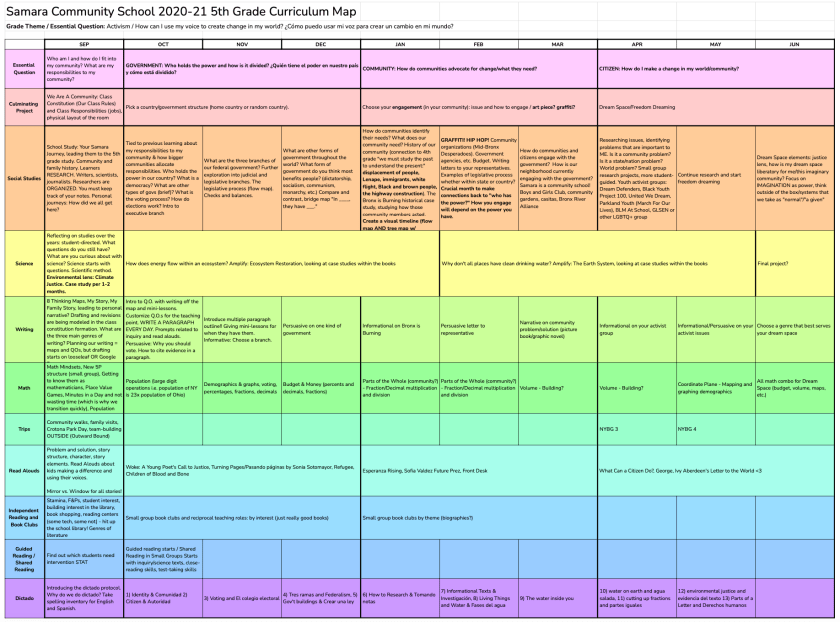
A curriculum map is an at-a-glance overview of your whole year — every month, every subject — so that you can see how all of the pieces of the puzzle fit together. At Samara, where each grade has a theme/essential question, we made sure to include essential questions for our 3 major PBL units, as well as field trips and culminating projects.
Our 5th Grade Curriculum Map for 2020-2021
Curriculum maps are extremely helpful. Not only can you see EVERYTHING, but you can also easily see how to integrate the various disciplines. For example, in the fall of 2020, our 5th grade PBL unit focused on government and the presidential elections. We saw a window here for teaching multi-digit operations as well as decimal fractions, since we’d be analyzing different infographics with population, demographics, voting percentages, budget, etc.
Culturally and Historically Responsive Literacy
If you’re a teacher and you haven’t heard of Dr. Gholdy Muhammad’s Cultivating Genius, do yourself a favor and buy the book RIGHT NOW. I won’t be able to do it justice in this short blog post. So I’m going to quote from Jennifer Gonzalez and the Cult of Pedagogy, as well as direct you there and to Dr. Muhammad’s website to learn more.
Muhammad believes we’re not reaching many of our students, especially Black students, because our curricula and standards are lacking. The emphasis in our current standards is mainly on skills—skills that can be measured easily on standardized tests—and not a whole lot else…
But there was a time in history when a more complete, more human form of ‘curriculum’ did exist, and it energized and inspired its students—all of them Black men and women—to read, write, speak, and publish with the kind of passion and dedication we would want all of our students to have about learning. This curriculum evolved within the Black literary societies of the 19th century…
These societies were the inspiration for Muhammad’s Historically Responsive Literacy framework, a four-layered pedagogical model that places skills on an equal plane with three other learning pursuits: identity, intellect, and criticality.
Though Cultivating Genius only outlines four learning pursuits, Dr. Muhammad has stated in various workshops and interviews that there is a fifth: joy.
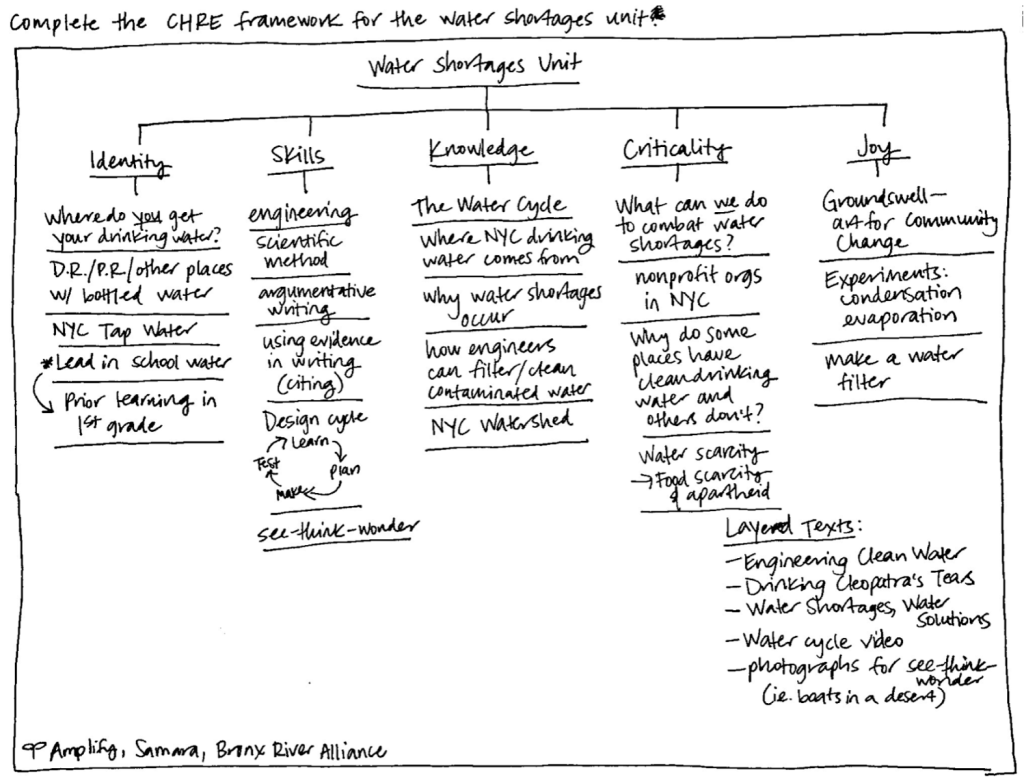
I love using Dr. Muhammad’s framework to guide my PBL planning because it ensures that the unit will connect to students’ lives, teach them the skills and knowledge they need to know in 5th grade, help them to think critically and question “power, equity, anti-racism, and other anti-oppressions,” and provide them with opportunities for joy. It also increases the rigor of any unit. I’ll show you exactly how I use the framework after I talk about Thinking Maps.
Thinking Maps®
In the spring of 2019, I was trained in Thinking Maps, “a set of 8 visual patterns that correlate to specific cognitive processes” (thinkingmaps.com). Unlike regular graphic organizers, of which there are thousands that are usually chosen with no real rhyme or reason (like a sequencing map in the shape of an S for a snake?), there are only eight Thinking Maps. Each Thinking Map is aligned to one specific thinking process: defining, classifying, describing, comparing, sequencing, cause and effect, whole to part relationships, and analogies.
For Samara, a dual language school with ICT classes, Thinking Maps were a no-brainer. And me? I totally drank the Kool-Aid. I still use Thinking Maps all the time in my personal life: for to do lists, grocery lists, packing lists, even when Alberto and I were planning our move to Miami! They are unbelievably useful, and honestly, they just make sense.
The way I use Thinking Maps for planning PBL units is as follows:
Brainstorm with a circle map. Get down ALL of the ideas I have. Ideally do this with a thought partner.
A circle map we made for an end-of-year/end-of-unit project
Categorize all of the ideas according to Dr. Gholdy Muhammad’s CHRL framework.
Backwards plan and sequence the unit: What needs to be taught first so that students arrive to the final project?
I can then input the sequence into my curriculum map and work on holding myself accountable as well as staying flexible for student choice and voice.
Putting it into Practice: Our Current Unit of Study
In December, I roped Josue, our tech teacher, into brainstorming for our ecosystems unit with me. We created a circle map that overflowed onto a second page.
Over winter break, holed up in NYC at my parents’ house during the omicron wave, I researched resources and field trips, adding to the map and bothering Josue with my constant texts. On the plane back to Miami, I organized the ideas into a tree map with the CHRL framework.
I revised and reworded the essential question until I finally got it right: How can we encourage our KLA community to take a more active role in caring for South Florida’s ecosystems?
Then I paced it out: How would I launch the unit with the students so that they could come to this question on their own? When would the field trips make the most sense? What would students need to learn about and build expertise in before starting to take action? How could I align math, reader’s workshop, and writer’s workshop units so that they supported the flow of the project?
Into the curriculum map the ideas went:
January – launch and start initial research on ecosystems; start informational writing unit
February – deeper investigation into ecosystems, including virtual and in-person field trips to the mangroves of Key Biscayne and the Everglades; final informational writing bend = quick-write brochure about the Everglades habitats and endangered species
March – begin conversations about taking action, interview eco-artists, urban designers, nonprofit employees, etc; start opinion writing unit
Since January, the unit has taken on a life of its own. The students really grabbed onto mangroves more than any other ecosystem. A request for an interview with eco-artist Xavier Cortada led to us participating in his Plan(T) project school-wide, bringing mangrove propagules to KLA. An interview with Anna, our atelierista, sparked criticality and gave seed to a community urban design culminating project that integrates math and art, which we’ll launch after spring break.
But having that organizational plan? It’s like a road map. You may end up taking an alternate route, but having the map in front of you helps you keep the final destination in mind.
When my husband and I decided to move to Miami, I was sure about one thing: whichever school I taught at would need to embrace inquiry, integrated studies, and project based learning. I was lucky to find KLA, which has allowed me the same creative freedom that Samara did in designing curriculum that is meaningful and relevant for my students.
The way I approach project based learning is heavily influenced by my time at Samara and the professional development I received while teaching there, as well as by what I’m seeing and learning at KLA with its Reggio-inspired model.
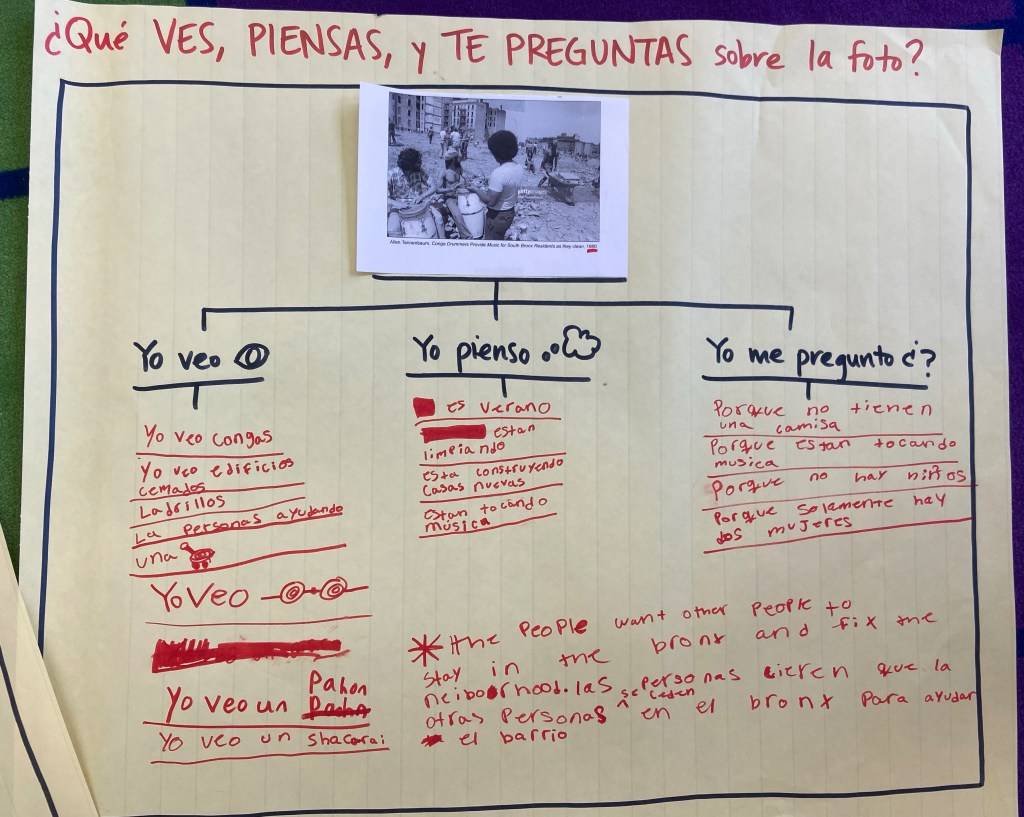
My first Samara 5th graders observe a photo of their Bronx neighborhood in the 1970s, when The Bronx was burning
A disclaimer: I am in no way an expert on project based learning. I do, however, think I have a knack for it. Planning projects is fun (if you’ve ever planned one with me, you know how excited I can get), and it’s probably the only part of planning that never truly feels like work, because I am learning so much in the process.
I know that I’ve learned the most about effective teaching through other teachers—talking to them, observing them, reading their blogs/social media. So my goal is to document and reflect on my planning process here in bite-sized blog posts, in case it helps anyone out there.
What is Project Based Learning?
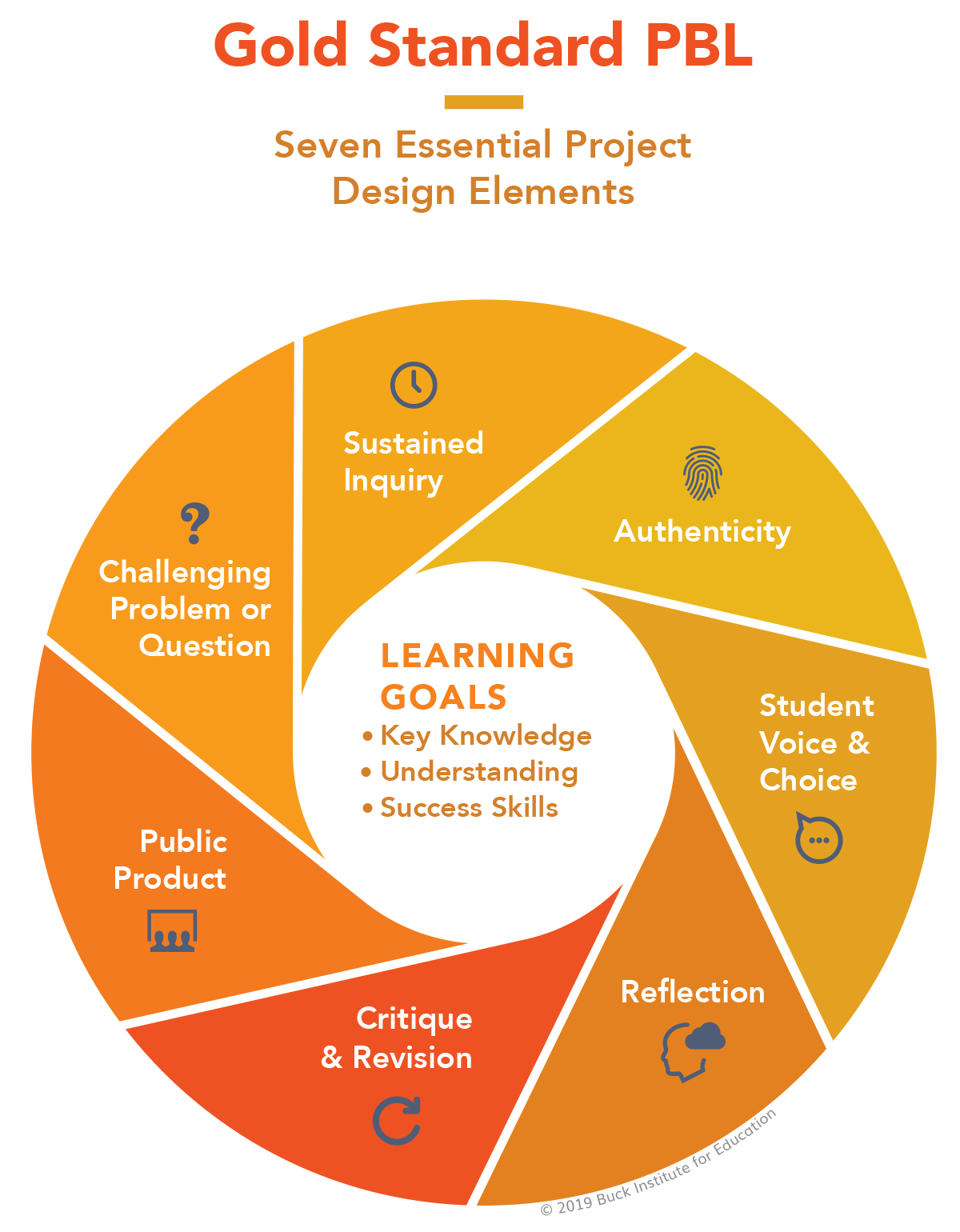
Before I launch into this blog series, it’s important that we ground ourselves in a definition for project based learning. PBLWorks, the leading provider of professional development for project based learning, defines project based learning as “a teaching method in which students learn by actively engaging in real-world and personally meaningful projects” (pblworks.org). That said, project based learning (PBL) is NOT simply “doing projects.” I particularly like this explanation from their website:
“We find it helpful to distinguish a ‘dessert project’ – a short, intellectually-light project served up after the teacher covers the content of a unit in the usual way – from a ‘main course’ project, in which the project is the unit. In Project Based Learning, the project is the vehicle for teaching the important knowledge and skills student need to learn. The project contains and frames curriculum and instruction.”
PBLWorks
Seven Essential Project Design Elements – PBLWorks
I was lucky enough to receive a full day of professional development from PBLWorks before leaving Samara, and I still have a lot to learn from them, particularly in terms of assessment and student reflection, critique, and revision. I already know these are my next steps as I look toward planning future PBL units. Onward.
Depth Over Breadth
One of the first things I learned at Samara about PBL is the idea of valuing depth over breadth; when you decide to do thematic units or projects, you simply have to give up the idea of being able to teach everything.
This can be a tricky concept to swallow.
But I have to teach all the things!
Take a look at any social studies or science scope and sequence and you’ll see what I mean. There is so much that states and cities and districts want you to teach in a single year for a single subject that it can be overwhelming, if not downright impossible. The teachers who do try to cover it all usually end up sacrificing depth in favor of breadth—students get a little sprinkling of everything, but don’t get a chance to linger and build their expertise. Not very effective.
With PBL, we want students to think critically, problem solve, collaborate, and communicate their newfound understanding in meaningful ways. This means we need to go deep.
Where to Begin
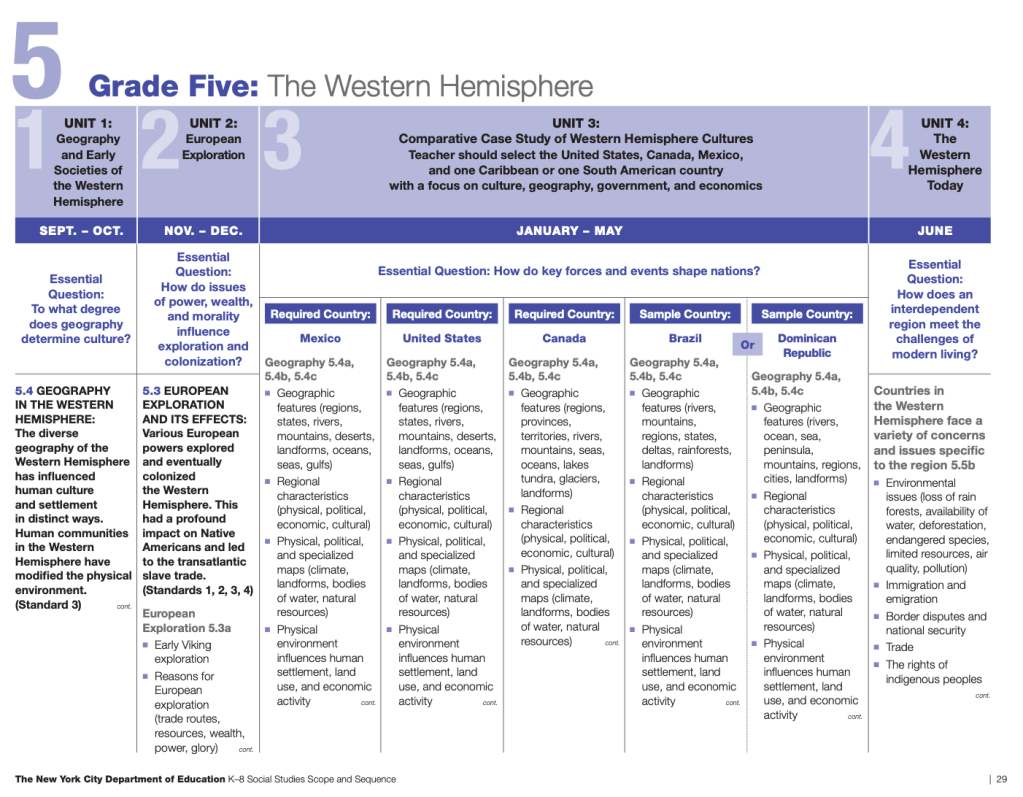
I like to begin by looking at the standards and the scope and sequence. NYC has a beautifully designed, easy to understand social studies scope and sequence. Florida? Not so much. Either way, get familiar with what your state wants students in your grade to learn. Focus on science and social studies, as these are the subject areas that often get “sprinkled” throughout the school day/year, pushed aside in favor of literacy and math, which are absolutely necessary in the primary grades.
Once you’ve gotten an idea of the standards, look inward:
What do you see in the scope and sequence that you are passionate about?
If you’re passionate about something, it will be contagious — others will get excited about it because you are.
Next, look at your students:
What do you see in the scope and sequence that they are or might be passionate about?
Get to know your kids really, really, really well. What questions have they already asked that connect to these topics? What are their interests, their passions, their strengths?
Finally, look at your community:
What issues in your neighborhood/town/city relate to the topics you and your students are passionate about?
I’ve found that project based learning is most effective and meaningful when it’s place-based too. What resources exist in your community to bring this learning to life?
Starting with a Seed
Here’s how I followed this for our current unit of study.
What do I see in the scope and sequence that I’m passionate about?
I am passionate about the environment and combatting the effects of climate change. I see this in the Florida State Standards SC.5.L.17 about Interdependence.
What do I see in the scope and sequence that my students are passionate about?
Many of my students love animals and wildlife. Some of them who moved here from another state have asked why our school doesn’t recycle. Most of them love being outside and are very active.
What issues in my neighborhood/town/city relate to the topics we are passionate about?
Miami is a city built on top of what was once part of the Everglades. Climate change is impacting Miami immensely because of sea level rise. Lots of flooding issues. There are many organizations working to combat pollution of Miami’s beaches. However, there’s a lack of easy/cheap recycling, and hardly any composting.
I had the seed of an idea for the unit. Now I just needed to start planning for it. To be continued.
An installation of mangrove propagules in our classroom window. We are currently participating in Xavier Cortada’s Plan(T) project as part of the community engagement portion of our project.
I’ve always struggled to follow a curriculum. My first year of teaching, my fellow teacher newbie and I visited our new school a week before we had to report to get some materials and start planning for the first month of school. Our math coach placed the teacher’s guide for our school’s math curriculum in front of us and began narrating how a typical lesson would go, her finger tapping at the top of each page as she went. It felt sterile, void of life, indifferent to the human children that would be learning from its pages. The next week, I remember giving it a go like she’d shown us, playing the video that went along with the lesson, only to shut it off as the cartoon character’s high-pitched voice made me (and my third graders) cringe.
“Enough of that,” I said, and the students breathed a sigh of relief. So began my journey into developing my own curriculum for my students.
I had an assistant principal that year who, though not entirely helpful for much else, did say something wise about curriculum guides during one grade-team meeting: “The teachers guides are like a script, but you are the actors. You make it come alive.”
Corny metaphor aside, I saw what she meant. We weren’t meant to teach from the guide. We weren’t meant to have them in our laps as we spoke to the children, glancing down to make sure we were saying everything “correctly.”
Fast forward six years later, and teachers guides for me are just that: guides. Supports. A jumping off point when you’re not sure where to begin. The real planning? That comes from my heart, from what I am passionate about, and from that year’s students’ strengths and interests and passions.
I’m a creator, and creating is part of why I love teaching so much. Even in the grades that I’ve taught more than once, I’ve rarely taught the same lesson or unit in the same way twice. With each year repeating a grade, what I actually gain is more confidence and expertise in the content, the landmark skills that I know my students need to learn in order to be successful in their future academic careers. Additionally, I’ve witnessed my growth as a teacher by seeing the shifts in which “subject area” I focus on developing professionally. My first three years, it was math. My fourth and fifth, integrated studies and themed, project-based learning units, with a hint of writing revolution (Judith Hochman). All intertwined heavily with multilingual language-learning, as I was teaching in dual language classrooms at the time.
This year, I’m finally focusing on writing, thanks to a colleague, mentor, and friend who is pushing me professionally and personally (ahem… this blog). I find myself once again looking at curriculum guides for Teacher’s College Writer’s Workshop units and setting them aside in favor of creating my own units based on what I see my students needing and wanting.
This winter’s informational writing unit was a big success, for me and for my fifth graders. I grew in helping students to set and achieve goals through one-on-one and small group conferencing. A final mini-bend allowed students to transfer their new knowledge to quick-writes about our science content: writing informational brochures on the new Chromebooks, which ended up incredible. And last week’s informational on-demand provided confirmation in the data: almost all of them jumped up half a year to a full year’s growth.
A ready-made curriculum is a map that promises to deliver your students to a certain destination. This year, I tried to follow one of those maps when I taught the realistic fiction unit, only to realize that the path wasn’t the right one for my students. So I continue to take the risk of scanning the map, situating myself in the terrain, and creating new paths, knowing that I have a pretty good sense of direction. And my fifth graders? They’ve reached the destination each time.
Ana suggested I start blogging about my experiences teaching, so here I am.
I’m Amy, a born and raised New Yorker-turned-Miamian. After 5 years teaching Spanish dual language in NYC public schools in both Washington Heights and The Boogie Down Bronx, I find myself now at an independent, Reggio-inspired school in Brickell. Quite the jump, bringing with it a ton of change.
That said, in a strange way, I’m in somewhat familiar territory: founding a new grade for the third time in my short teaching career. Founding a grade brings with it the expected fear and anxiety, but also unforeseen joy and excitement. Through this blog, I hope to document this rollercoaster ride and reflect on what’s gone well and what could go better.
For, after all, founding a grade is in its way a shitty first draft, as the title states. There will be much to add and cut and revise for next year. I hope to give myself grace, quiet the perfectionist within me. You’ve got to write the whole thing before you can fix her up!
So here’s to it, and to connecting with other educators along the way.








 Writing With Abandon