Writing With Abandon

Reflections and ramblings about life as an educator, writer, reader, knitter, and over-thinker. Trying to do the writing only I can do.

Tag: miami schools

  • The First Writer’s Workshop

    It’s 5:30am and I’ve already been up for an hour. I’ve been struggling with morning insomnia for a few months now — waking up around 4 or 5 to pee, and unable to quiet my brain enough to fall back asleep. I have a notebook beside my bed to help me dump these thoughts, the goal being to train my brain to deal with them later, but tomorrow is moving day and so I’m too excited to settle back down.

    Besides, it’s the perfect time to get my slice of life out of the way. And I do have a goal for my Tuesday slices, now that the school year has started — I’d like to document a year in the life of a 5th grade teacher and her class and the learning we all do. So I thought I’d begin with the first Writer’s Workshop.

    ***

    This year is a little different. It’s the first year at KLA that I don’t have Ana in the classroom across from mine or down the long hallway, and it’s not because she’s on maternity leave or has moved away. Ana has gotten the job we’ve all been hoping for (and more!): instructional coordinator. This means she is more available to do coaching work with teachers, coordinate curriculum for the school, help streamline and align all-school practices, and so much more. This spring and summer, she also wrote a whole new WW launching unit for us: The First 20 Days of Writer’s Workshop, a beautiful unit that emphasizes talk, encourages teachers to join in the writing, and keeps writers in their notebooks to help them develop a strong repertoire of strategies for generating ideas of what to write about.

    To be honest, my head hasn’t been in the right place since starting school, what with everything that’s been going on (see my last post), but I knew I needed to start this year off right with a first Writer’s Workshop lesson that would hook my writers. That need became even more apparent when, during our morning meeting share, students expressed their feelings (good or bad) about writing — some saw it as something to enjoy, when they got to write made up stories or jot down their feelings to destress, while others cited it as being boring, hard, or tedious, unless they were passionate about the topic.

    I knew this first lesson would be important in convincing my reluctant writers that maybe, just maybe, there could be something to enjoy about writing this year. (And I have verbal — and written — proof from previous years that I’ve been able to do this. Many students who previously didn’t like writing either fell in love with it or found the utility in it.)

    So, as they gathered on the rug in rows for the first mini-lesson, I took a breath, told them I needed a moment to put on my writing teacher’s hat, and then leaned in close, as if letting them in on a secret: “Good morning, writers.”

    Envisioning language, a suspenseful story, big eyes and smiles, audible surprise — I wish I could have filmed the lesson from my perspective. It was a beautiful example of engagement, when every single kid is there with you, one of the utmost highs of teaching.

    And then, the planned conversations for oral rehearsal — one partner talking, the other asking follow-up questions. By the time I sent them off to write, there was no question that the notebooks would be filled. When the timer beeped, you could feel that they would have kept going.

    But it’s the first six weeks of school. The first 20 days of writing. And so we go slow to go fast.

    I’m ready for day 2.
  • Friday Haikus

    HOW-TO HAIKU

    Taught kids to haiku

    They tried traditional ones

    And silly ones too

    *

    FUNNY KID

    Reluctant writer

    Manages to write the best,

    Funniest haikus

    *

    SPRING BREAK

    It’s finally break

    School is out — Quick! Run away!

    Ready to relax

    *

    SOCIAL MEDIA

    Deleted TikTok

    It is a total time suck

    Now screen time is low.

    *

    HYDRATE

    Remember to drink

    It’s important to hydrate

    Gotta love water

    Day 17 of 31
  • A Connection

    I have a student who tends to get sick a lot. Sometimes it’s his immune system, and sometimes it’s psychosomatic (like when I explained to the children a couple weeks ago that I was experiencing vertigo, and after recess he told me, “I think I’m having what you had!” with a hand to his head).

    Today after PE, as we sat down for math, he told me he was feeling nauseous, and I could see how it was making him nervous. Thinking it was a combination of thirst from exerting himself in PE and hunger (lunch was 45 minutes away), I told him to drink some water, try going to the bathroom, and wait to see if he felt better after eating something.

    On the lunch line, though, I could feel his anxiety radiating from him. I suddenly recognized myself in his fear — this weekend, overwhelmed with my own health crisis, I broke down to my therapist. Not only was I run down from the health issue itself, but I was exhausted by the anxiety I was having over it, losing actual sleep and making myself sicker with worry.

    So I leaned into that.

    As he waited for his food, I rubbed his back and told him how when I get sick, I feel just like him. I told him that what helped me was to talk back to my anxiety, to remind myself that yes, I didn’t feel well, but I was going to get past this. This wasn’t forever. I would feel unwell and then I would get better.

    “Tell your brain, ‘I’m going to be okay. I’m safe,’” I told him.

    I felt him sigh under my hand, the tension releasing.

    “Do you feel like you can eat?” I asked.

    “Yes,” he nodded, and made sure to get some pork in addition to the rice I had suggested.

    He still felt sick afterward, and I called his mom to pick him up, but I hope I helped make that fear go away, at least.

    Day 16 of 31
  • An Ode to Public Libraries

    I grew up just a couple blocks away from the St. Agnes Public Library in New York City. I remember my first library card, and all the amazing books I borrowed from there. Scratching mystery crust off of pages, but turning them all the same, eager to finish new stories, experience new worlds. From middle grade books to the dramatic young adult series I read (hello Sarah Dessen and Jodi Picoult!), I devoured them, borrowing stacks at a time.

    When I lived in Madrid, I visited the Pedro Salinas library, found their tiny English fiction section, borrowing British editions of literary novels like Zadie Smith’s On Beauty.

    Back to New York, I lived and worked in Washington Heights. I loved the children’s section in the library closest to my apartment, and took my third graders to the Fort Washington Library for a magical field trip.

    A few years later we lived on East End and 78th, and I had the Webster Library just steps from my front door. I adored the used bookstore in its basement.

    When COVID hit, I couldn’t take books out for a while, so I borrowed them from the NYPL and the Brooklyn Public Library on my Kindle. I continue to borrow books on my Kindle constantly. (The airplane mode trick is the best, if you don’t know it yet.)

    The first week I moved to Miami, I set out walking under the blazing July sun to visit the main branch of the Miami Dade Public Library. I sent my parents a selfie with the three books I found and borrowed that same day.

    Today I returned to that branch with my class. Though they weren’t initially excited, the anticipation grew. Parents emailing us that their children were begging them to get library cards in time, and would the e-card work to take out physical books, otherwise their daughter would “kill them”? Children bouncing on line before going in, as though we were going to Six Flags. And finally, the visit — in awe of all the information the library had to offer, and each of them finding a small (or large!) stack of books to borrow.

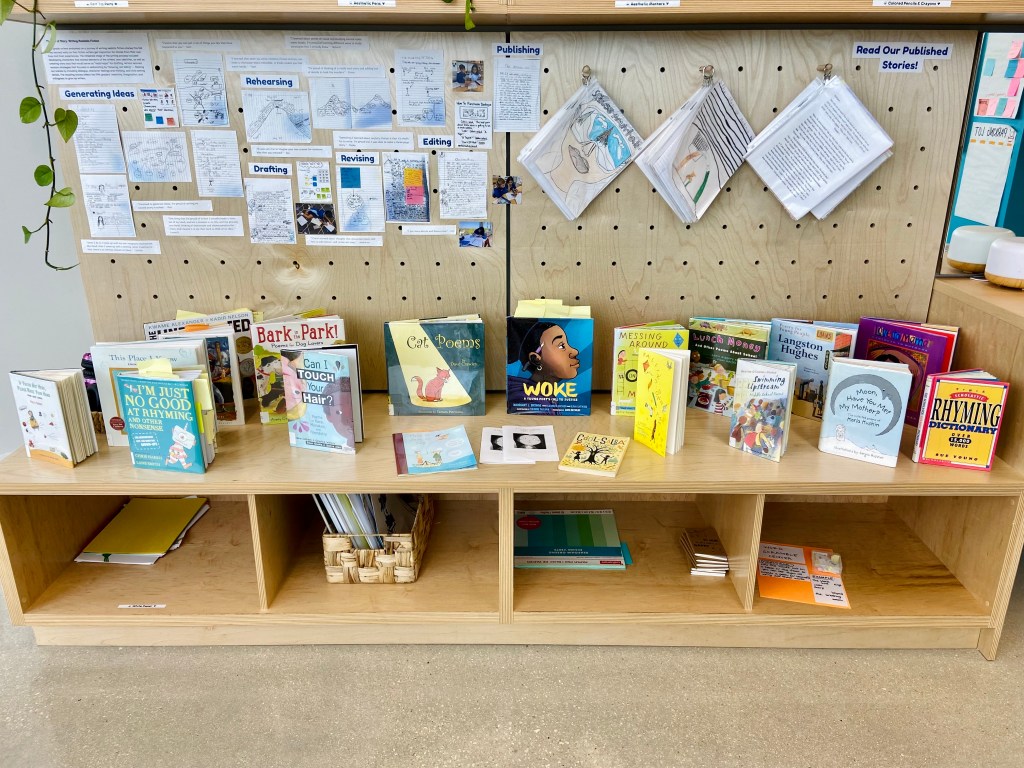
    All but 3 of these poetry mentor texts are from the public library.
    Day 15 of 31
  • Notes from an “Ask the Expert” Session

    Every month or so, on professional development Tuesdays, we have an “Ask the Expert” session with Lina Acosta Sandaal, a psychotherapist, child & adolescent development expert, and creator of Stop Parenting Alone. She is amazing and I always feel that I learn so much from a session with her.

    Here are some notes I took from today’s session that really stuck with me, and which I want to keep in mind:

    • We all have a confirmation bias that makes us see what we want/expect to see. Especially at this point in the year, we are struggling and are allowing our confirmation bias to take over. It’s automatic. So we have to take an extra step to reset every day until the end of the year.
    • Our brains are the best virtual reality equipment ever.
    • Guilt is a horrible feeling to feel, but it shows you have love and caring and compassion within you.
    • If you model resetting, you give kids the opportunity to reset.
    • Remember, it’s not messing up the day, it’s just messing up a moment.
    • Two ways to calm your body and your nervous system when you’re especially overstimulated or stressed:
      • ONE – Find your feet. Find 3 tight spots to loosen. Take a breath. Speak.
      • TWO – Find your feet. Expand your eyesight — widen out.
    • Three musts of caregiving: consistency, routine, teamwork amongst caregivers.
    • When we give kids a crutch, we need to give them a crutch with a plan. “That is there because we are working towards __.”
    • Around age 8, children move from caregiver-motivated to self– and peermotivated. This is why it’s especially important in the early years to motivate with responsibility, integrity, and perseverancenot pleasure.
    • After a big event or project culmination, kids will disengage. Plan accordingly: make time to process, reassess, and get excited about what’s next.
  • An Excerpt

    For today’s slice (day 9! wow!), an excerpt from my writer’s notebook entry yesterday.

    ***

    The sun dapples differently in the morning, the humidity still thick. The brown vines hang and sway from the branches of the trees, almost like they’re dancing in the wind. I can hear birds chirping and roosters clucking. Car engines as they drop children off at school.

    What if you could mute the sounds one at a time?

    Take away the white noise of the whooshing air on the highway. Take away the rumbling car engines. Take away the whistles from the rooftop.

    Leave the air rustling the leaves on their branches. Leave the birds tweeting in the trees. Leave the rustle of pen and paper, children’s voices.

    Blankets of pollen coat the benches, allergy culprits. Like fairy dust, causing sneezing and watery eyes.

    M found a worm, inching along his leg. We gave him a post-it pack home.

    “He has good abs,” M said. “I’m gonna call him squiggly.”

  • In My Feels: Anticipation

    All. The. Things.

    At the launch of every new writing unit, I feel a wave of anticipation that teeters dangerously between excitement and overwhelm.

    Excitement because it’s a new genre, and there are so many great tools and resources, and I have some new systems I want to put in place, and this time I swear I’ll be more intentional with picking the mentor texts and modeling in my own writer’s notebook.

    Overwhelm because there are TOO MANY great tools and resources! And how will I teach all the new systems and still give writers time to write? And how will I get these on-demands graded in time? And, oh god, there are so many things to teach them, where do I even begin?

    So I’m taking a break from the grading to write this post and remind myself to BREATHE.

    To just take it “bird by bird,” as Anne Lamott says. The unit will pick up speed as the writers step into it, and I will know how to sift through the tools and use what I need once I see what they’re producing.

    I am leaning towards excitement as I gear up for tomorrow, for two main reasons.

    First, Consuelo and I have decided to split the class in half for reader’s and writer’s workshop, aligned with their book clubs and their writing partners. This way we can take advantage of both instructors and get a 12:1 student:teacher ratio. We’ll also have more time and freedom to conference with students, which I’m really excited about. After attending the TCRWP’s Virtual Saturday Reunion, as well as Ana’s last WW meeting on the teacher work day, I’ve got so many ideas about how to make small groups work better for both me and the kids. That’s a big goal for me as a teacher this unit.

    Additionally, as I was preparing a “This Unit’s Mini-Lessons” anchor chart, an idea Ana and I had for student accountability, Consuelo gave me the idea to make small cards to give to the students for each teaching point. That way, it could live on the anchor chart AND in the students’ notebook for reference.

    Here are how the first three lessons’ cards turned out. I’m looking forward to seeing how this helps cement the teaching point for each writer!

    It’s important for the card to include a visual, and I also added in which stage of the writing process it applies to. I’m hoping this helps empower students when we confer!
  • Arc of Story: Week 2/3 Reflection

    My weekly reflection got postponed a bit from our days off for Hurricane Ian. It didn’t end up hitting Miami too badly (thankfully), so it mostly gave us teachers and the students a mini vacation to rest and recuperate. Which was much needed, especially as I was nursing a cold at the time.

    So sessions 7 and 8 were pushed to last week, which was completed with two mini-lessons on leads and setting. I had one successful and one not-so-successful small group, and a bunch of successful conferences.

    My plan this week is to finish conferencing on Monday and Tuesday with the students I didn’t get to last week, and then offer a couple small group sessions on Wednesday and Thursday where students can “sign-up” to get support with revision strategies.

    Next week, students will be editing and publishing, and I’ve offered typing as an option for their final drafts. I think for small groups/conferencing, I’ll do another “sign-up” but this time with editing conventions (like, punctuating dialogue correctly, or reading your piece out loud to catch run-on sentences).

    The week after that, we’ll finish up with our intimate class celebration, a more public celebration, and our narrative on-demand to see the growth from the beginning of the year.

    This is a short blog post, but it’s been a busy weekend. I hope to have a more thorough post by the end of the unit!

  • Arc of Story: Week 1 Reflection

    It’s Saturday and I’ve just finished planning the lessons for the second week of our realistic fiction unit and creating some tools to help my writers.

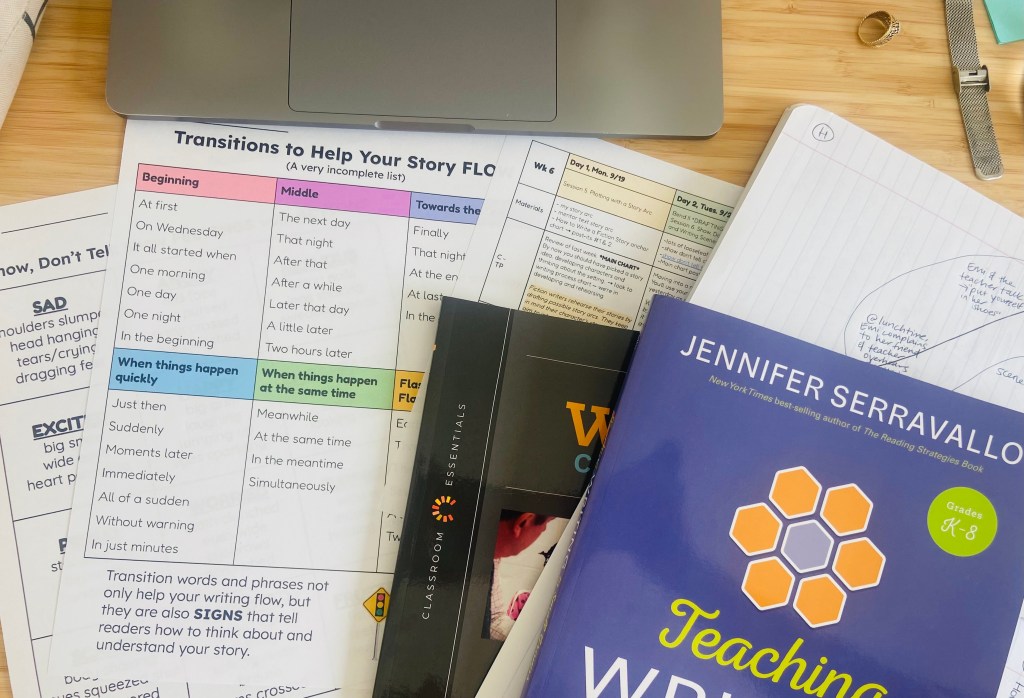
    Tools, plans, a story arc in my writer’s notebook, and my two handy professional texts.

    Mini-Lesson Breakdown

    This is the week where I’m going to attempt to really tackle each of my goals in mini-lessons:

    • Session 5 – Plotting with a Story Arc (I’ll be emphasizing the importance of just a few scenes, and how the problem can still intensify in such a short time period)
    • Session 6 – Show, Don’t Tell – Planning and Writing Scenes (I’ll introduce a show, don’t tell chart that includes examples of telling vs showing as well as dialogue; I’ll also provide students with a tool that Ana made to show feelings by using actions)
    • Session 7 – Feeling and Drafting the Heart of Your Story (This lesson is all about losing yourself in your story while you draft. Last year we did some envisioning, enacting, and drafting, but this year I’ll try having them ask themselves what the heart of the story is before/while they envision and embody their characters)
    • Session 8 – Using Transitions to Give Your Writing a Flow (While the first 3 sessions of this week are adapted from the TC unit, this lesson I created based on the needs of my students. We’ll take a look at the narrative checklist and then I’ll give writers a transitions tool to keep in their folders. They’ll re-read one part of their draft during the active engagement and look for where they might need transitions)

    “How’s it going?”

    One thing I’m proud of myself for this last week is that I checked the writers notebooks every day, keeping track of where students are in terms of trying out the mini-lessons, doing writing at home, etc. This helped me to schedule some small group sessions, which was super necessary, because I realized that with 23 students, and realistically only 25 minutes of independent writing each day (I know, it’s short — our day is tight), there’s no way I can conference with every writer every week.

    I also purchased Jennifer Serravallo’s Teaching Writing in Small Groups to complement my professional reading with the Carl Anderson book. I’m really excited about the Skill Progressions that Jennifer has outlined, because they’re a really easy tool to know what to teach next based on a particular student or group’s goal.

    I still have lots of room to grow in small group instruction, but at least for right now I can say:

    1. I know what my students are writing and where they’re at in the writing process.
    2. I met with all students last week (except one who was absent for two days), either in a conference or a small group. Hooray!

    Now I just need to assign goals to each student and make a plan for this week’s small groups! But first, I’m going to take a break.

  • Second Chances: Planning for “The Arc of Story” (Again)

    It’s September and we’re about to head into the 5th week of school. Routines are falling into place, the students are beginning to feel more comfortable with one another and with us teachers, and the amount of work we have to do goes back and forth between feeling manageable and never-ending, all at the same time.

    I feel lucky to be teaching 5th grade for the fourth year in a row, with a new crop of students in front of me, a whole extra year of teaching 5th graders like them behind me, and an amazing co-teacher by my side. Each year with the same grade, I get to reflect, revise, and take another stab at teaching that subject/topic/unit that I didn’t get right the first time.

    Take, for example, our next writing unit. It’s a unit that I taught last year — The Arc of Story, Realistic Fiction — one which… didn’t go as intended. It was my first time planning and teaching a published Writer’s Workshop unit, and there were MANY things that I ended up wishing I’d done differently. I had some wins (learning how to craft teaching points & active engagement for the mini-lessons), but I mostly focused, as I tend to do, on the shortcomings (I barely conferred, and most students wrote 15+ page stories that weren’t focused and that they didn’t have time to revise).

    I’m energized by the chance to reteach this unit. For one thing, Ana’s going to be teaching it to 4th grade as well, which means we’ll get to put our heads together to brainstorm and rework lessons as we go. For another, I am coming at the unit with more confidence as a writing teacher and a clearer idea of how I can make the unit successful for my students and for me.

    Goals for the Unit

    The pitfalls from the last unit were clear, and the data from this group’s on-demand narratives supports them. So, I’ll be aiming to teach towards the following goals:

    • Focused short story arcs — 2-4 scenes, clear problem, clear resolution
    • Transition words
    • Show, Don’t Tell — specifically through (properly punctuated) dialogue and vivid description of setting and character

    Game Plan

    My game plan for tackling these goals includes:

    • Choosing mentor texts that clearly show off a command of the aforementioned skills, and referring to them consistently throughout the unit (both in mini-lessons and conferences). Last year, I used two picture books, but they were a little too long. I want the fifth graders to be able to see structure and scenes easily, and so some simple short stories are what’s needed. The two I’m going with are “Min Jee’s Lunch” by Elizabeth Kleinrock and “Eleven” by Sandra Cisneros.
    • Writing my teacher mentor piece ahead of time and ensuring that it also demonstrates and reflects the type of writing I want my students to be able to produce. Last year I tried making my piece follow the same structure as the example in the teacher’s guide. This year, I’m going off of my own seed ideas and thinking about the students I have in our classroom. Who are they? What will they relate to? How can I make sure that my piece is short and focused, just like I want theirs to be?
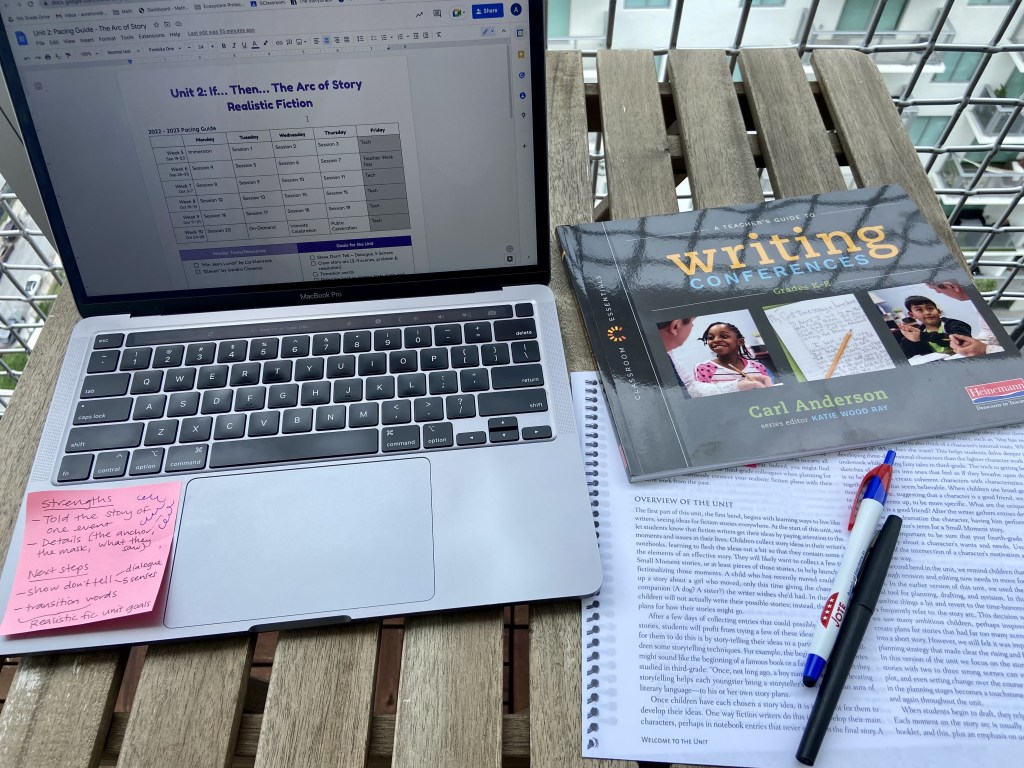
    • Creating a schedule for conferring with students one-on-one and in small groups so that I can keep track of what they’re writing and give them feedback before it’s too late. I didn’t start conferring with students until the third unit of writing last year, because I was still getting the hang of planning the mini-lessons. My students would have benefitted greatly from me reading their writing and meeting with them about it more regularly. (This is partly why some students wrote such long pieces — I didn’t catch them until it was too late.) I bought the new A Teacher’s Guide to Writing Conferences by the one and only Carl Anderson and am already digging into it. It’s a fantastic resource with tons of digital resources and videos of Carl in action.

    Staying Accountable

    I’ll try to hold myself accountable by checking in on the blog each week. Let’s see how it goes!

    Now, back to planning.