Last summer, I recommitted to knitting. Ever since moving to Miami four years ago, the seasonal desire to make sweaters and other accessories disappeared, given that every day here is practically warm enough to wear a t-shirt and shorts.
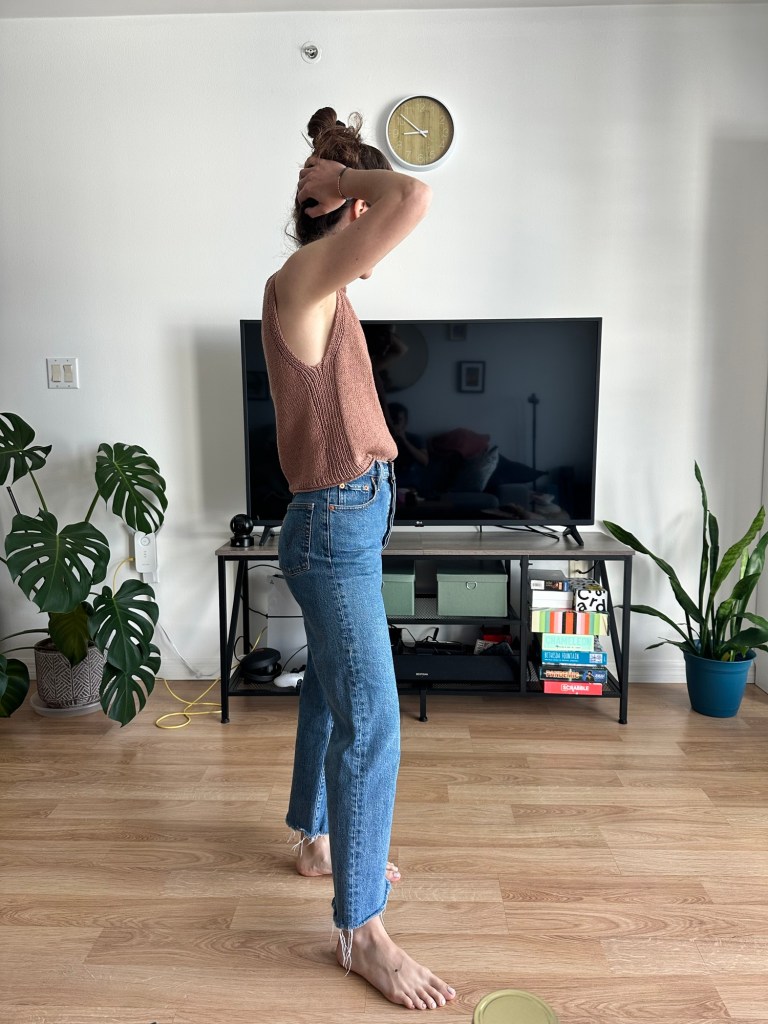
But after making a tank top and finishing a frogged sweater, I have kept up with knitting! I made Ana’s daughter a bear bonnet; I made my niece and myself matching cardigans; and yesterday I finished a linen-cotton tank, just in time for my summer travels.
Me posing in my new tank top
I loved working with the yarn — Sandnes Garn Line, a linen-cotton blend — as it’s light, airy, and drapes beautifully. I did not love weaving in the ends (plant fibers are not as “grippy” as wool fibers, so I had to split and branch out the ends, which took 5x as long).
I just wet blocked it and I can’t wait to wear it this summer and any other day!
In November, I started a knitting club on Mondays after school. Vero had been asking me since my first year at KLA, but I couldn’t bring myself to add something else to my to do list. At the time, my commute was also a lot farther.
But this year, it felt like the right time. We set it up so that classes would begin in November and sent out the class details on a cute Canva flyer. I squealed as she told me 5 of my students had signed up.
The first class was a doozy.
“I don’t know if this is going to go so well,” I told Patrick that night.
I had found all of these beginner how-to videos on YouTube that I thought were pretty easy. I knew to start with the basics: slip knot, cast on, knit stitch. I taught them the vocabulary they would need. I was ready to help them with the cast on like my mom did when I was first starting out, and even pivoted mid-class to show them an easier type of cast on.
“But they struggled to even make a slip knot!”
Luckily, the girls practiced that week at home, and by the second class, a few had mastered each of the new skills, and were helping the others to figure it out. Each week I watched their skills grow, the pride they took in their projects.
One student’s chunky scarf!
We’re in the fifth month of class, and now we have 8 knitting club members: 7 fifth graders and one of their sisters, who is in third.
It’s a funny dynamic each week.
“I don’t feel like knitting today,” E stated on our way to the classroom this past Monday.
So she and other E decided to have a dance/karaoke party to music from Descendants.
Three others sat at my table knitting along with me as I worked on my Eva cardigan by PetiteKnit. The rest sat at a different table, whispering about something as they knit up their squares, headbands, and scarves.
“It’s like a bunch of old ladies getting together and knitting,” I’ve described it to others. “Half of them don’t even want to learn new stitches anymore. They just want to knit and gossip.”
“What happens in knitting club stays in knitting club,” A mentioned one time. She cracks me up.
This month, we’re working on a journalism unit in writer’s workshop and creating a KLA News Magazine. One of my students is writing about the knitting club and interviewed me to get perspective for her article.
“Have you ever considered making a YouTube channel that teaches kids how to knit?” She asked me towards the end of the interview.
“I haven’t,” I replied, a smile coming to my lips as I remembered those first videos that confused the heck out of them. “But I am now!”
Last Wednesday, I visited Julie upstate. We’re hoping to make it an annual thing. Her house is one of the most beautiful homes I know — filled with colorful, eclectic artwork, yet simple, modern, open, and bright. Their deck looks out onto their huge field, where the two German Shepherds enjoy running. It’s the perfect knitting/reading/tea-sipping spot in the mornings and early evenings, and their pool invites you in for the hotter hours of the day.
The morning view.
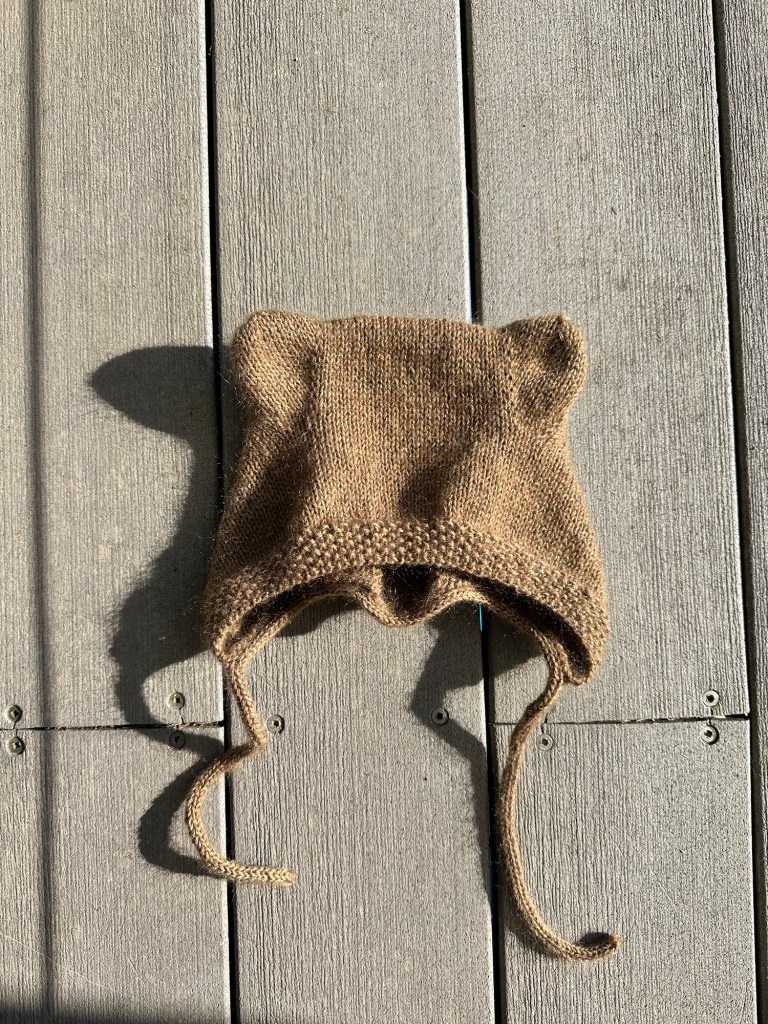
Of course I brought a knitting project, and Julie had hers. I finished the baby bear bonnet for Elena, something I’d been meaning to knit for months (sorry, Ana!). I love baby knits because they knit up so quickly! And this one is just so cute.
As I was knitting, though, I stumbled a few times — there were a couple of abbreviations that weren’t in the pattern’s glossary, a few instructions that were unclear. I was very attuned to it because my first night there, Julie and I had watched a podcast where the designers of this pattern explain how, when they began translating their patterns from Danish to English, a knitter gave them some feedback about how their American customers would need far more information than their Danish customers ever would! So it was funny that, even as an experienced knitter, I found the pattern wanting.
“Just do what the pattern says,” Julie told me, repeating the words her knitting teacher says whenever she gets stuck at a particular part.
So that’s what I did, asking her advice whenever I stumbled across another part. By Friday morning, the bonnet was complete!
On Sunday morning, back in my bed at my parents’ apartment, I was struck again with some mid-morning insomnia, and started scrolling through knitting patterns on PetiteKnit’s website to distract myself, thinking about what I will knit for my niece this fall, and my best friend’s baby due in early September.
As I fell into a “scroll hole” on her website, I came across her About Me page. There, she explains how studying medicine for 10 years impacted her work as a knitwear designer: “The scientific method of writing an article is in many ways the same as that of writing a pattern. My supervisor at university told me that a methodology section should be written so that anyone else would be able to do the same. The level of information should neither be too high so as to interfere with the meaning, or too low so as not to be adequate. In many ways writing a pattern is exactly the same. I write down each step in a way that anyone with a knowledge of the techniques should be able to arrive at the same result.”
I couldn’t help connecting her philosophy of pattern-writing to teaching, a career in which we are constantly writing patterns (our lesson plans/projections) and giving instructions.
I started to ask myself: How clear are we making the instructions that we give students? As a former dual language teacher, I often think about instructions, both verbal and written — it’s important to use simple language, give clear and concise steps, provide visuals. I am often hyper-aware of when I and other teachers falter here. It’s necessary to pre-plan so you can really think about the task and any materials students may need. But it doesn’t always pan out that way!
My insomnia brain started ruminating further.
Okay, clear instructions, yes, but what should we be giving these clear instructions about? What tasks should we leave up to the students? I started thinking about interactive modeling with Responsive Classroom and the start of the school year. The routines that we teachers decide on and the ones we co-create with the students.
And what should students themselves be able to write instructions for? Routines? After completing a project or solving a complicated math problem, shouldn’t students be able to explain what they did in a clear way? And if they can’t, why not? Is it something related to them not exactly understanding what it is they did, or is it more about the act of writing instructions (recipes, patterns) that they need more work on? We all have those students who, when explaining what they did, give you a simple, vague sentence, and then those students who explain what they did with far too much detail!
I don’t exactly have the answers to my many questions, but I found it interesting following the thread from knitting patterns to classroom instructions.
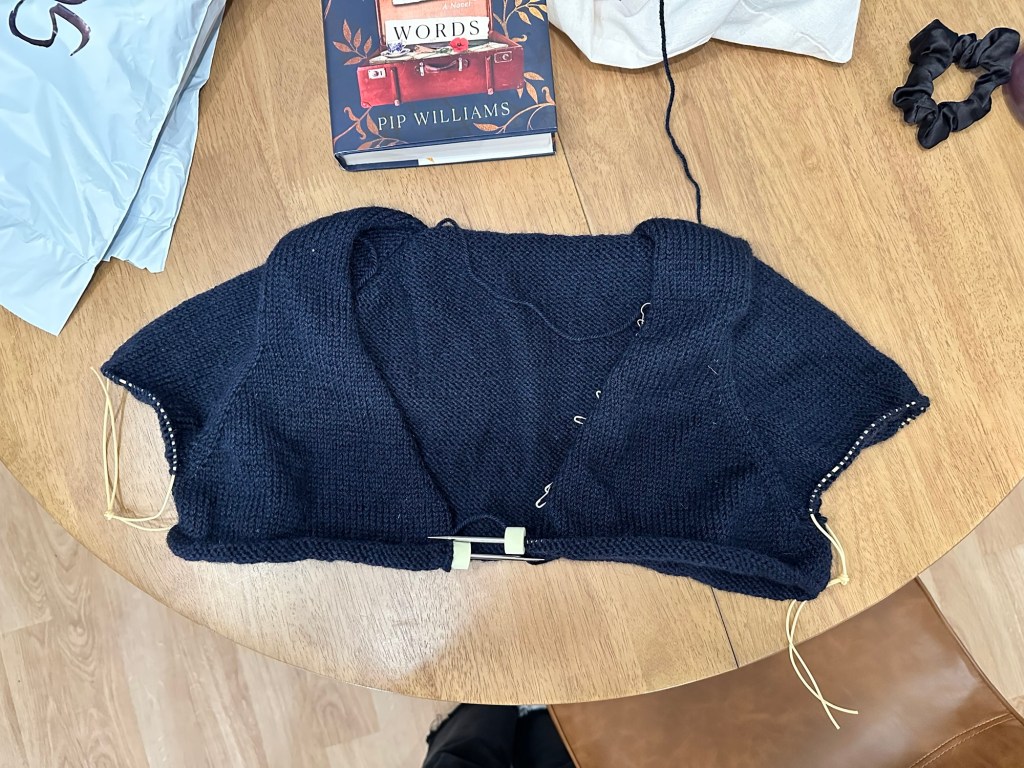
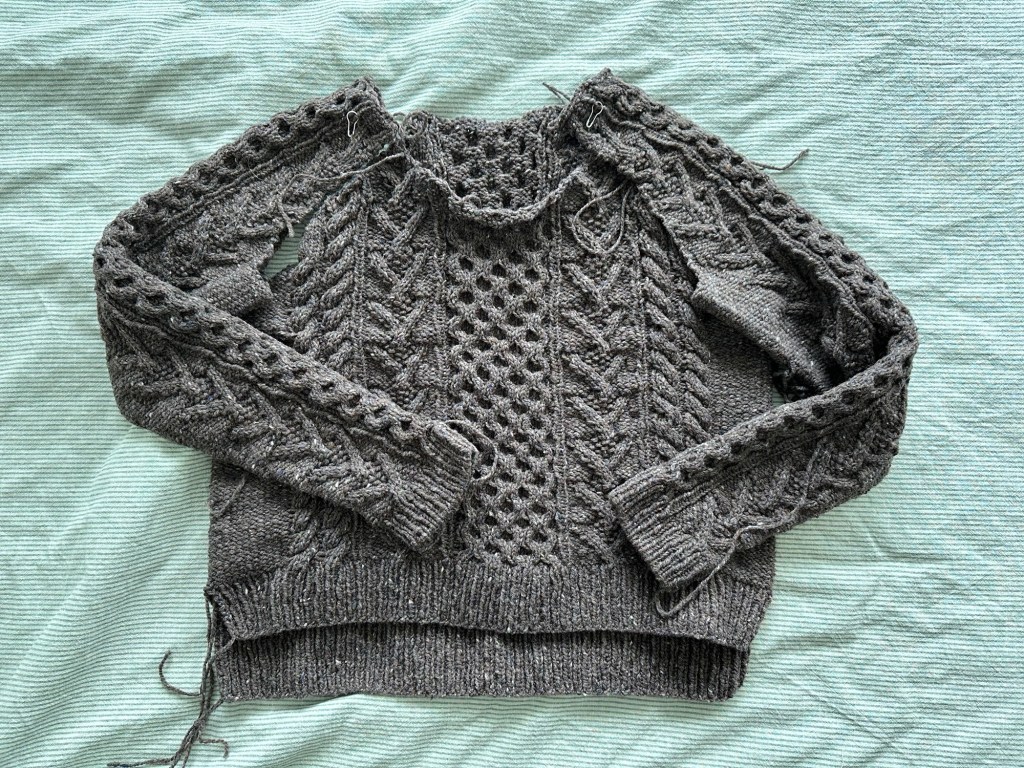
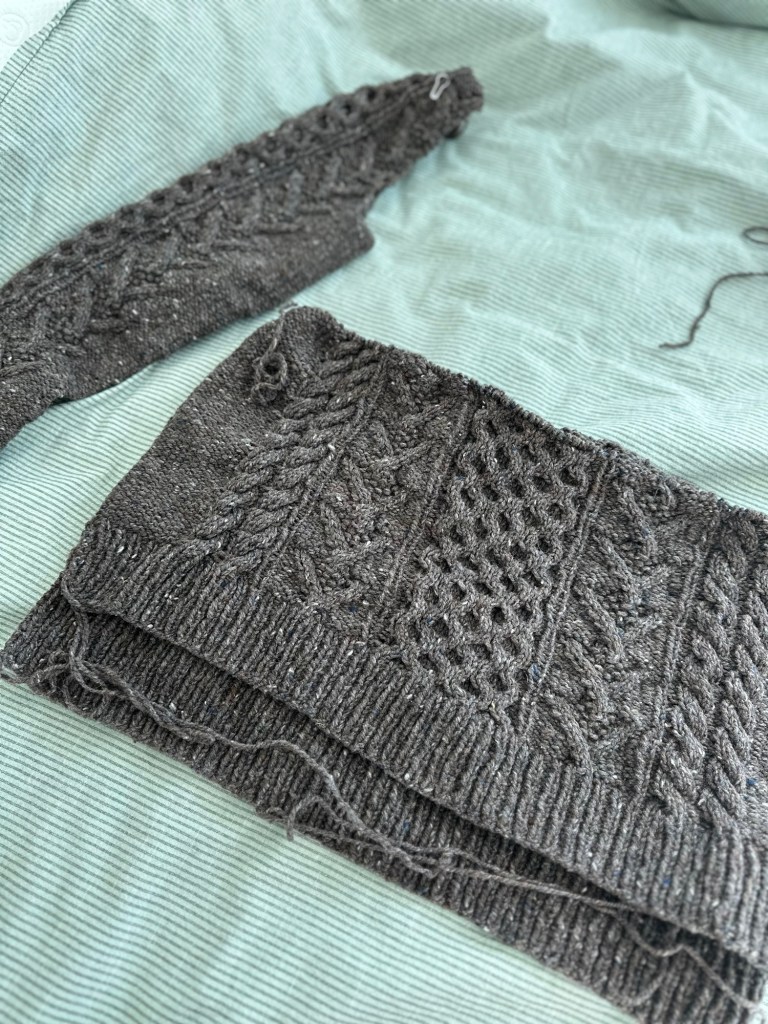
Where I left off on the Bronwyn sweater before my trip — blocking, seaming, and the collar are left. The Bronwyn sweater’s pattern is the opposite of PetiteKnit’s philosophy: 20-odd pages due to multiple sizes, making just the act of opening the PDF overwhelming!
Last week, I “unfrogged” a piece of knitting. (In knitting, when you “frog” something, it means you set it aside for an indeterminate amount of time, aka, you abandon it for a little while, or for a long while, or forever!)
It was the June Top, a silk tank top by PetiteKnit, a knitwear designer known for her simple, classic, and easy-to-follow designs. I bought the pattern and the yarn for it last summer when I was visiting Julie upstate, and started it when I got home with the intention of marling the yarn, but didn’t like how it was turning out. So it stayed in its project bag in a basket, untouched for months. This spring, after Julie and Chris came down for a visit and she asked what was on my needles (nothing), I decided to unravel it and turn it into a striped tank top, but I didn’t get very far before frogging it again.
Summer break seemed like the perfect time to get my hands back on a project, though. There’s something about the long vacation that leaves my anxiety tingling through my fingers. A restlessness, you could call it. I’ve gotten better about biting my nails, but not completely — my left thumbnail has beared the brunt of it (sorry, buddy). Knitting has always helped me with that urge to fidget or to bite, and that was initially why I pulled the project bag out of its spot under the coffee table and got back to work.
Soon, though, the joy of knitting re-emerged and took hold. There’s an almost addictive energy that forms as I physically sculpt a new garment. I once more felt grateful for my hands and fingers and the skill that I have honed since my mother and my grandmother taught me to knit as a young girl.
The tank top started taking shape.
Knit bottom up, in the round.
Once I had two stripes of each color, I was on a roll. I decided on the length (2 inches shorter than what the pattern called for, as I tend to wear cropped shirts and high rise pants) and separated for the front and back.
The front straps complete.
When a pattern is simple stockinette stitch, I’m able to knit without looking, and watch TV shows or movies as I do it. But once a pattern calls for more attention — short rows, bind offs, lace, or cables — I have to keep my eyes on it.
So this time, I decided to borrow an audiobook from the library to accompany me through the many hours of knitting I still had left to finish the top: The Maidens by Alex Michaelides.
The thriller ended up being the perfect companion to my knitting. I hung on every word, listening even when I showered and ate a solo meal. The voice actor who read it was excellent, and I felt as my students must feel during read aloud. I kept telling P how I couldn’t wait to get back home so I could listen and find out what would happen next!
And of course, I finished my June Top in no time:
Necessary mirror selfie after finishing and wet blocking.
I realized that I could combine two of my great loves: knitting and reading. And this realization gave me the boost I needed to pick up another project I’ve had frogged for a while: the Bronwyn pullover, a cable-knit beauty. Perhaps I’ll get her done before my trip to Maine.
I started this project in the winter of 2020! Let’s see if I can finish it in the next few weeks.
Which leaves me to search for my next audiobook companion. Are any of you audiobook listeners? Do you have any audiobooks that you’d recommend (ideally fiction, though I have loved listening to some nonfiction read by the author)? Or, have you read a book recently that you couldn’t put down and think would read well in audiobook format?







 Writing With Abandon