I’m Amy. A born and raised New Yorker, currently living in Miami. Here to reflect on my experiences as an educator and learner, working things out as I write.
One more month until I take my final look around a ready-for-summer-kind-of-clean classroom.
Four more weeks until I gather my books to bring home.
Three weeks and one day until I say goodbye to our students, wishing them the best of luck in middle school.
Two weeks and three days until our fifth graders graduate. We’ve got to get cracking on their speech.
One week and one day before our school’s celebration of learning, the evening where we’ll be presenting our findings after the 21-day digital detox. I’m about halfway through editing the video.
Three more days until report card grades and comments are due. Grades are mostly in. Comments? 🙃
One more hour until we head to the car and drive to work.
Each day has been a trudge lately.
Some glimmers, but mostly a trudge.
I find myself watching the clock until 3:10 when I can take them downstairs for dismissal. Checking the calendar to see how many more days.
I wish it were different, but this is my reality lately:
One foot in.
One foot out.
Impatiently waiting one more month until both feet can be together, and take me somewhere new.
This morning I was really excited to wear the new cardigan that I had just finished knitting over the weekend. I got dressed, took a few quick photos that I sent to my mom and Julie, and filmed an “after” video for the before/after blocking reel I wanted to make and show to my knitting club girls.
In morning meeting, my fellow knitters were all compliments: “We love it!” “Is it itchy?” “Oh my god it looks so pretty!”
It was a bit itchy, but no mind. It was the perfect coziness for our classroom’s powerful AC.
Fast forward to 10:53am on the rooftop. Recess was almost over. Kim and I were sitting on the turf in the shade. Well, she was squatting. My computer was in my lap and I was focused on what I was doing, until it started to drizzle a bit, the tiny droplets landing on the screen.
I shifted my weight and felt something wet underneath me. That’s when I remembered why Kim was squatting — she’d made a quick remark about the turf being wet, but I must not have felt it with my thicker jeans. Until now.
I shot up.
I arched my back to look, touched the dark line at the back of my thigh. Yup. Wet.
Cold, wet denim.
“Ms. Amy, it’s not raining!” M shouted at me as I began walking off the field. The rain started coming down a bit harder, but still light enough that, were my pants not soaking wet, I would have let them keep playing. But they were wet. Wet wet. The kind of wet where someone can see an outline of your butt and will most certainly assume you’ve peed your pants.
“Nope, we’re going downstairs!” I shouted back.
“But what about recess?” H whined.
“You can have 5 minutes to chat, but then we’re doing math!” I said as I continued rushing out.
The girls followed, confused. I turned my back to them and pointed: “My butt is soaked!”
“Oh, Ms. Amy,” E said playfully, shaking her head as she ran alongside me, ever the teacher’s assistant.
“Do you have a change of clothes?” M asked, always the most concerned.
“I only have extra t-shirts!” I said as we raced down the stairs.
When we got into the classroom, I grabbed my flannel and tied it around my waist. I remembered the coaches had some samples of new uniforms for next year that had been sitting on their desk.
I texted Patrick: “Do you have any change of pants or shorts up there?” while running back upstairs.
He was reading my text as I arrived.
“I think Rosie may have gotten rid,” he frowned, opening his office door. Sure enough, the pile of uniform samples was nowhere to be seen.
I ran back out.
“Rosie! Where did you put those uniform samples?”
She gave me a sheepish look. “Err, I donated them to Cuba.”
“Ah, okay, no worries!” I said, hitting the elevator call button. I remembered last year when a student had gotten her period for the first time and needed a change of bottoms, the lobby had provided her with a pair of shorts. She was my size — surely they’d have something that would work downstairs.
I got to the lobby and saw Nayelis, Ashley, and Cooper at the desk.
“Hi Nayelis! Hi Ashley! I need a favor…” I began, explaining the situation. “Do you have any extra shorts or pants that might fit me?”
“You sure you didn’t have an accident?” Cooper joked. He loves to pull pranks, ever since April Fools.
“Let me see if we have something,” Ashley said, then disappeared into the car tunnel.
While I waited, Nayelis showed me a couple phone cases she was considering. Between the pink and black one, I voted for black. Classic.
Ashley came back, a pair of joggers in her hands.
“You’re a lifesaver!” I said, grabbing them from her. Size 16, but I’m pretty small, so they would have to do. I ran to the bathroom, shrugged off the cold and wet jeans, and pulled on the joggers. A perfect fit.
I tied my shoes, threw on my sweater, and headed back to class.
The rest of the day, my colleagues stopped me and asked for the story. Ana particularly found it humorous.
When I texted her about how I hadn’t sliced today, and was in between writing about AI or the two pope movies I’d watched last week, she sent me a voice note: “Why aren’t you slicing about the pants? In my head, when I saw you walk with those, I thought, this is a typical slice of life.”
So there you have it. It was not the outfit I was planning to wear, but it was super comfortable.
Do you remember that first writer’s workshop session?
It was just after 2pm on a weekday in August. You had a class of just 13 students, no co-teacher, squeezed onto the rug of that tiny room. Everyone was wearing masks, including you — yours was fabric, a light blueish-green with stripes that your dad’s bandmate’s wife had made. You could feel your breath warming as you spoke; you yanked the mask down slightly to be heard over the loud air conditioner, looked down at your lesson plan:
Session 1. We Are Writers
You hugged your notebook to your chest, which you had just decorated the weekend before at a friend’s house. You cut out patterns and letters from magazines. Your name — A-M-Y — on the front, your two words — JOY and CONNECTION — on the back, a quote from Jason Reynolds — “Writing is like any other sort of sport. In order for you to get better at it, you have to exercise the muscle.” — collaged between images that spoke to you, photos of family and friends. Under your chair, behind your legs, 13 fresh composition notebooks sat in a bin, waiting to be handed out.
“Good afternoon, writers,” you started, feeling the hum of those words take flight and dip into the ears and minds of the students before you. “This year, we will write for many purposes and audiences. We will embark on this writing journey together.”
Ana’s lesson plan said: “(Make a big fuss handing out NBs.)”
So, of course, ever the good student, you did, handing each notebook to a pair of reaching hands as you told them that next week, they’d have the opportunity to decorate their notebooks with photos, drawings, quotes, and more.
You settled back into your chair, leaned forward ever so slightly.
“Today I want to teach you that the only thing writers need is a pen, paper, and a beating heart. We write about what we know, what we see, what happens to us or others. Everything we experience can become a story if we capture it in our notebooks.”
Could you have known then that you were giving them the tools they’d need to write their own slices of life?
Could you have known then that this lesson is timeless, that “today and every day,” you really can “see every idea that pops in your head as a possibility for a story”?
Could you have known then that Ana would become much more than a mentor, a writing partner, a friend?
Could you have known then that you would have so many more magical moments with those students, and the next group, and the next, and the next?
The half groups in 2022, in the bright windowed corner room. The writing conferences where a student’s pen started racing across the page before you stepped away. The independent writing time when you were writing too, and it was so silent you could hear a pin drop because you’d forgotten to put on the music, but it didn’t matter because everyone was in flow.
Could you ever have known then that by teaching kids to believe themselves to be writers, you’d be helping the writer in you find her way out onto the page again?
Could you have known then that you were speaking as much to yourself, the dormant writer, as you were to them, the writers-to-be?
I know now, so I write to the you of then:
Writer’s workshop will, without a doubt, change your life.
As part of my commitment to be as device-free as possible while my 5th graders do their 21-day digital detox challenge, I am charging my phone outside of the bedroom, trying one phone-free weekend day, and aiming to take daily walks with just my keys and Phoebe.
I find myself much more aware of my surroundings and relaxed on these phone-free walks — I can feel the breeze of the perfect Miami spring weather as it lifts the peach fuzz on my arms; I can hear the faint music from a boat out on the water; I smile more at the people who I pass. Sometimes I see dolphins in the water, like we did on Sunday as we walked around Brickell Key. With no phone, I can’t take a photo or a video, so I am forced to just absorb it, be with it, in the moment. And I love being this present.
Today, though, there were oh so many things I wished I could text you on my walk. You wouldn’t have responded; you are teaching a private soccer lesson until 6. But if I’d had my phone today, this is more or less what your WhatsApp notifications would have looked like:
4:57pm: Omg you would not believe it. I got into the elevator with Phoebe and there was a couple in there, and she, of course, started getting all the cuddles from the guy. But then — HE PICKED HER UP. Like, just grabbed her up off the ground and nuzzled her! WTF?! Who does that??
5:01pm: Omg Phoebe just sprinted across the grass after this golden retriever, acting like she wanted to play, but then the dog’s owner let go of the leash and he was chasing her, and she was squealing and running SO far! And when she finally came back, and I went to grab her harness, she squealed at ME! 😭😩😩
5:05pm: Okay now she has fake-squatted for a poop twice. 🙄 Leaving this grass and continuing on my walk.
5:07pm: Fake-squat #3! This dope!!!!
5:10pm: And just when you thought she couldn’t fake you out anymore, she does it AGAIN. This time, she peed.
5:14pm: Literally this dog is so crazy. She just squatted for a 5th time!!!
5:16pm: Okay, guess 6th time’s the charm! 💩 success! 💪💪
5:19pm: Some guys are sharing a joint and one of them is literally using his parked, open convertible as a speaker for their music. Miami is weird.
5:28pm: Just picked up a cool historical fiction book at the little free library! 🤓
But I didn’t have my phone, so I couldn’t text you all of that. Instead, I just laughed to myself each time Phoebe fake-squatted, let my mind wander, and drafted this slice in my head.
Inspired by Molly’s Wordle poems, I thought I’d try one after my 5-guess game yesterday. Generally I get a bit nervous if I still haven’t guessed the word by guess #5, but I was too distracted by the way the words came together. I think this poem wrote itself:
The Trek She was going on a quest— She didn’t yet know her destination. Tightening the straps of her pack, She stood stock-still on the precipice, Gazing out at the path before her.
As a middle schooler, I wrote stories about fictional characters, manifesting events that I hoped would unfold in my life (I remember one specifically about a girl who goes to a lake in the summer with friends, her crush telling her he liked her, them sharing a kiss on a boat one afternoon). I wrote fiction because I didn’t know how to write about my life other than writing in my diary. I had file after file of stories on my eMac computer, most lacking endings.
In high school, a few of my teachers had us write stories in the style of an author, which was my favorite way to show my understanding of a novel (like writing a “grotesque” a la Winesburg, Ohio by Sherwood Anderson, or writing in the style of Virginia Woolf in Mrs. Dalloway, the sentences verging on run-ons, lyrical and open). One teacher had us write page 200-something of our life memoir. I wrote about taking the crosstown bus to see my sister and meet my niece/nephew for the first time.
My friends and I became obsessed with freewriting after our teacher, Annie Thoms, had us get in the habit at the beginning of her writing workshop each day: set the timer, 10 minutes, only one rule — Don’t. Stop. Writing. Gemma would message me prompts on iChat in the evenings, a spattering of seemingly disconnected words — rose, schoolbus, blood, feather, bag of chips — and I would give her one in return — water bottle, field, purse, knife, lamp. We’d set our timers and see what would come out.
In college, I went to school for creative writing and literature, thinking I’d write the Next Great American Novel. What I found was that I was much more interested in writing creative nonfiction than anything else. In my fiction classes, I’d end up writing memoirs thinly disguised as stories, and I wouldn’t get away with it.
“The craft is good,” my fiction professor would tell me when it was my turn for feedback, “but it doesn’t read as fiction.”
I was lucky to take a class with professor and writer Kirsten Lunstrum, who encouraged my genre-bending and personal narrative writing. The first personal essay I wrote for her seemed to climb its way out of me, my fingers racing across the keyboard as I hurried to catch it all. I later took an independent study with her where I practiced more memoir writing and dipped my toes into fiction in a safe, brave space. But she left before my senior year, and I never got the mentorship — nor had the confidence — I felt I needed to finish with a strong creative writing project. I set aside my 30-page personal essay about me, my sister, and my mom, and focused on my literature thesis. I dropped the final required creative writing seminar and graduated without the double major.
I carry a lot of shame around that decision.
What was wrong with me that I couldn’t write actual fiction? What was wrong with the other creative writing professors that they couldn’t see the value in memoir?
I didn’t feel “good enough,” whatever that meant. And I stopped writing, for a long time. I’d come back to it in spurts, as the files on my computer prove to me:
STARTING MAY 2013
Starting oct 2017
One file from 2019 in a folder titled simply: “ramblings”
Three files in a folder titled “2020 Writings”
But mostly, I let it slip away until I started teaching writer’s workshop in August 2021.
Two weekends ago, Ana and I met up to record a few podcast episodes and go on our first writing date for a while at Books and Books. We ate delicious sandwiches, I purchased some books and a new notebook, and then we set out to write. I opened up my laptop to the fictional story I had started a few days earlier (my “novel,” I was calling it — no name, no real direction, just a feeling). I typed a few sentences and then felt it creeping up: the imposter syndrome. The “not good enough.” The you-don’t-even-know-how-to-write-a-short-story-so-why-would-you-try-a-novel? The if-you-can’t-write-a-fictional-story-are-you-even-a-writer-at-all?
“I’m just going to read,” I told Ana, my cheeks flushed. Her fingers were racing across the keyboard, clacking away as she typed at a story that had materialized in her mind, big magic blooming.
I opened up Refuse to Be Done by Matt Bell, finding comfort in his encouraging words: “Start writing, and the draft will come.”
Later, I found discomfort in a podcast episode Ana sent me — a man telling his listeners that before you write it, your novel needs to have an elevator pitch, otherwise it’s probably not a very good one. He had some good advice, but most of it was lost in a sea of other advice that made me feel very, very small.
“I don’t have an elevator pitch,” I told her. “I don’t know what my novel is about.”
I didn’t write for a week.
Then, a few days ago, I opened up the other book I’d purchased: Body Work: The Radical Power of Personal Narrative by Melissa Febos, a writer who had taught at my college the year before I arrived. My friend Bob always told me I would have loved her classes.
And her words lit something up in me.
“But my own story wouldn’t leave me alone,” she writes in the first chapter. “It called to me the way I have since come to recognize is the call of my best stories, the ones that most need to be told. So I wrote it” (Body Work 7).
I could feel again the sensation of that first story I wrote for Kirsten’s class, how it nagged at me until I got it out, how it flew out of me effortlessly. I know writing does not always come that easily — trust me, I do.
But I also know what it feels like to have a story that won’t leave me alone. And for me, that’s never been fiction.
how many fungus gnats will be on the yellow sticky traps today
why the copy machine on the 4th floor struggles so hard to print on card stock
my lack of a plan for dinner tonight and how I’d better figure something out before Emily comes over
why Phoebe insists on barking every time someone is in the hallway
why my upstairs neighbor insists on playing his DJ music so loudly that it vibrates our ceiling and makes me feel like I’m “in da clurb”
the overnight trip on Thursday and Friday
making sure I’m fully packed for the overnight trip on Thursday and Friday
feeling untethered
but holding onto faith
the students of mine who want to try a month without their phones or tablets
the fact that I don’t know if I could survive a month without my phone or tablet
the fact that it’s not that I don’t know if Icould, it’s that our society is designed in such a way that if I went a month without my phone, I’d probably run into some trouble
the vlogs that my students recorded this afternoon
“What is UP, y’all?”
“Hey guys, welcome back to my channel.”
as though they’d been doing it forever
our podcast and how we managed to record another episode in less than 10 minutes
(“I couldn’t do this with anyone else,” Ana said, and I agreed)
what the F is going on in Yellowjackets and how I just want to rot into the couch and binge watch it
how I can’t just rot into the couch and binge watch it yet because I need to finish this slice and figure out dinner before Emily gets here
the fact that I don’t know how to end a list poem
but the other fact that this ending will have to do
My writing partner’s laugh bursts out of her like a fizzy soda. When she’s really cracking up, she’ll grab your thigh and give you a look through teary eyes as the laughter bubbles up.
“I have the idea for our first episode!!!” she texts me at 12:45pm on Sunday. “Let’s talk about James Clear’s tips for starting and keeping a writing habit.”
She shares a document with the tips already outlined.
My writing partner is always prepared.
I scroll down to the second page and see the list of episode ideas we wrote down on another Sunday: October 1st, 2023. I went over that night for dinner, wine, a reader’s workshop planning session (no judging), and to discuss our dreams of a podcast.
It kind of started as a joke, but my writing partner bought microphones the first time the idea came up. See? I told you she’s always prepared.
We never met again to record anything, except the Thursday before spring break. We gathered in my classroom to give a mini-lesson on generating slice ideas with our colleagues who were participating in the SOL challenge. Those who weren’t able to make it begged us to record, so my writing partner started a voice memo, recorded the 17-minute conversation, and sent it to the WhatsApp group afterwards.
“I felt like I was listening to a podcast,” one of the teachers wrote.
And so the spark was rekindled.
“Are we starting tomorrow??” I text my writing partner back at 2:17pm.
“Let’s do it!!!” she replies.
At 8:47pm she asks what I have planned while my students are in PE.
I tell her nothing, but that it is our only break that day, so I’m not sure where my head will be or what unexpected to-do’s will pop up.
But by the time 2 o’clock rolls around on Monday, I have nothing to prep and no desire to sit in my classroom, where I’ve been all day.
“I’m going to see if Ana’s in her office,” I tell Kim, and I head off in search of my writing partner.
I find her with Male, discussing schedules for next year.
“So? Are we doing it?”
“Well, I might have a meeting with Sophie at 2 because we never confirmed, but let me go check with her,” she says, heading off towards the first grade classroom.
Male and I share stories of our break, talk triathlons and mile-long ocean swims, the new physical therapy I’m beginning to help tackle the recurring aches in my neck and shoulders.
My writing partner swings the door open: “She doesn’t need to meet, let’s do it!”
Male laughs as we head into my writing partner’s office just next door.
My writing partner opens her computer to the list she shared with me the day before: “I figure we’ll just sort of read each one, and discuss a bit.”
“I’ll set a timer,” I say, pulling my phone out of my pocket. “Ten minutes?”
I turn to my writing partner. Her cheeks are red.
“Are you nervous?” I ask.
“A little,” she admits, giggling as she swipes through her phone to get to the voice memos app.
We both laugh.
“No laughing!”
My writing partner’s finger is poised over the record button. My thumb hovers over the start timer button.
We breathe in, and breathe out.
Click.
“Okay, so—” my writing partner begins, before we both let out the inevitable laugh. “We’re gonna try not to laugh or giggle too much.”
And then she just launches in.
Because my writing partner knows how to lead a damn good mini-lesson.
And then I join in, because my writing partner makes it so easy.
And we laugh, but at the right times.
The conversation flows. We go through the points. We discuss.
And then the timer goes off, and our first official podcast episode is complete.
With a squeal, we send it to our SOL group chat, and then laugh and hug each other.
How lucky I am to have a writing partner like her.
The photo Male snapped of us after recording our first podcast episode.
Two and a half years ago, I went to Israel on taglit — birthright — as a 31-year-old.
In case you don’t know, birthright is a free trip that many young Jewish people take to Israel. Taglit means “discovery,” and the program’s purpose is to help Jewish young adults aged 18-26 connect with their heritage and culture. Given the age range, it’s also often viewed by some of us in the Jewish community as an opportunity to party, which is one of the reasons I didn’t go at that age. Another was that I didn’t feel comfortable with the idea that I was allowed a free trip to Israel while Palestinian people were being denied their birthright, nor did I feel safe traveling into such a “heated” area. I won’t go further into the very complex politics, but when my best friend moved to Israel in 2018, and later met the love of her life, I knew I needed to visit her. Birthright had recently added trips for ages 27-32, so would allow me to do so on a budget, as I could get over there for free, and extend my stay for the price of a return flight. The original plan was for me to go in summer 2020, but then, you know, covid.
So it was that in July 2022, I found myself on a coach bus with 30 other Americans and 5 Israelis, driving through the desert south of Jerusalem.
Our bus group joked that it was “geriatric birthright” — full of the 27- to 32-year-olds that had passed on going in our college years or mid-20s. Most of us were well into our “adulthood,” with jobs and partners, some of us with children. So there wasn’t really a chance that any of us would hook up with an Israeli soldier or make aliyah (immigrate to Israel). A good third of the group were religious, another third were not religious but had a strong cultural Jewish identity, and the rest of us were sort of just along for the ride.
The day’s plan was to get to the Bedouin tents, where we’d eat dinner and sleep for just a few hours, then wake up while it was still dark and drive to Masada National Park to see the sunrise. After that, we’d head to the Dead Sea, and then it was on to Jerusalem, where we’d spend Shabbat.
I was interested in getting bat mitzvah-ed while we were there, which was something many half-Jewish people like me did on birthright. My sister had done it when she went after college, so I was interested too, more as a novelty than anything.
I made my way down the aisle to the front of the bus and tapped one of our trip leaders, Josh, on the shoulder.
“What’s up?” He asked, turning from the window.
“I’m interested in getting bat mitzvahed,” I said.
“Becoming bat mitzvah,” he corrected me. “But that’s great! Hold on a sec.” He stood up facing the back of the bus. “Is anyone else interested in becoming a bat or bar mitzvah while we’re in Jerusalem? If so, come see me now.”
I watched the faces look at Josh, look at me, and look at each other. A few didn’t look at all. After a beat, two others, a girl named Maridon from Salt Lake City and a guy named Jordan from the DC area, walked down the aisle towards us and sat down in the surrounding seats. Maridon had recently converted to Judaism and was quite religious, so this wasn’t just novelty for her. Jordan was half-Jewish like me.
“There’s no such thing as half-Jewish,” I remember Josh telling me, either during that conversation or during another.
“Okay,” Josh said as soon as we were all settled. “So this is how it works: I’ll give you each a line from the Torah that you’ll need to recite in Hebrew during the ceremony. I’ll give you the Hebrew, the English translation, and the Hebrew transliteration so you can practice beforehand. Other than that, you’ll need a Hebrew name.”
Maridon already had hers picked out.
Jordan’s name already had Hebrew origins.
Mine? Not so much.
“Do you have any Hebrew names in your family?” Josh asked.
“I don’t think so,” I told him, thinking about how my Ashkenazi Jewish family, originally from Russia and Romania, tended to use Yiddish words more than Hebrew. I’d only just learned a couple days before that a kippah was the same thing as a yarmulke.
“Which of your parents is Jewish?”
“My mom.”
“What’s her name?”
“Carol Jo.”
He frowned. “Okay, what about her parents?”
“Harold and Eleanor.”
The frown grew deeper.
“Do you have any aunts?”
“Rae and Billie.”
Annnnd deeper.
“Well, you can choose the name of a person from Bible whose story resonates with you,” he suggested. As an agnostic, that wouldn’t work for me. “Or, you can find a Hebrew name that you like the meaning of.” That sounded more like it.
I headed back to my seat near Daniella, Rachel, and Mai, one of the Israelis with us.
“Guys, help me figure out a Hebrew name!” I pleaded. “I want it to have a meaning.”
“What does your name mean?” Mai inquired.
“Amy means beloved.”
“That would be Ahava,” she told me.
“Like the brand?” I asked, thinking of the company that makes lotions and scrubs with Dead Sea salts.
“Yeah, I see your point,” Mai laughed. “I see you with a cool Hebrew name, something a bit more modern, you know?” She thought for a moment. “What about Gal, like Gal Gadot? It means ocean wave.”
“I like the meaning, but I kind of want it to start with an A, like Amy.”
“Hmm,” she pondered again. “Wait! What about Adva? It means little wave, like a ripple. And it’s really modern, not too common.”
Adva. I turned the word around in my head, tasted it on my tongue. The meaning tugged on my heart, making me think of my career as a teacher, the hundreds of students I’ve had the joy of connecting with.
“I love it.”
***
Two days ago I sat meditating during therapy, the pulses buzzing in my hands and ears, trying to connect deep within, where the strength of my sensitivity lies.
My mind cleared, and I saw myself as a pebble in the water, concentric circles rippling out from me to the students, friends, and family in my life, who each had their own circles too.
I smiled to myself, remembering that I am Amy, but I am Adva, too.
A small wave, a ripple, radiating ever outwards.
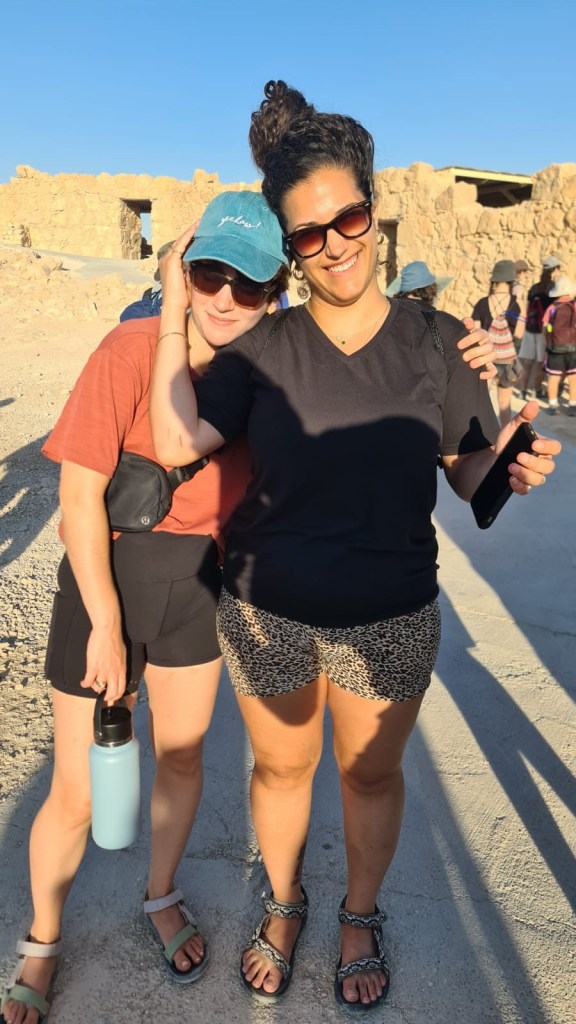
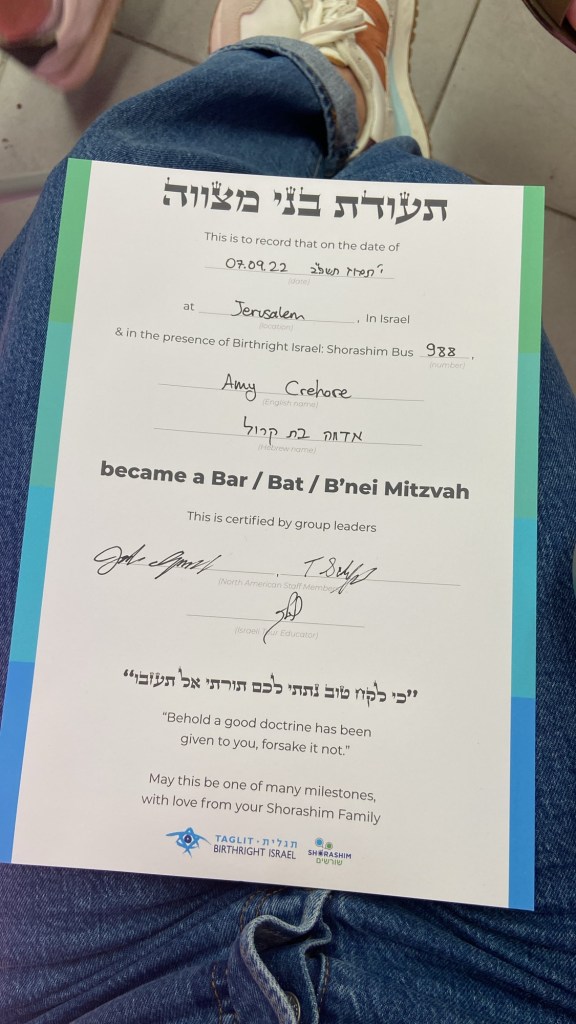
Me at MasadaMe and MaiMy bat mitzvah certificate, with my Hebrew name
The 2025 Slice of Life teachers comes towards its end, and I’m thinking about how to maintain this writing practice. I did pretty well last year, slicing almost every Tuesday until the fall.
Ana and I are texting about how we can get in the habit of writing more. We have been dreaming up our podcast for a couple years already. We might start with a Monday mini-lesson that explores slicing craft moves to encourage our colleagues to keep at it. Short. 10 minutes or less. Just like the mini-lessons we plan for our students.
I tell her how excited I am for the time that will open up for me after the school year ends. Can I make it a habit to write every day? Creatively write? Not just journal or blog, but really write?
I dream of writing a middle grade novel.
Maybe if I write that dream here, text it to Ana, publish it to my blog, it will light a fire underneath me to take the steps to get there. Maybe.
I dream of writing a middle grade novel that could lend itself to the joys of read aloud or book clubs. That kids see and hear themselves in.
Whew. Big dreams.
“Fiction intimidates me so much,” I text Ana. “Especially long form.”
“Liz would say, ‘set a date with writing and stick to it,’” she replies. “Avoid seeing the length, just start somewhere.”
She then suggests I get a new notebook solely for that idea that I “can’t get my hands off of.” (You don’t need to tell me twice to get a new notebook, my stationery-loving heart sings!)
She then reminds me of the writing advice I took notes on from Kelly Yang.
See, a few weeks ago, the social scientists group watched a video from Kelly Yang for schools about her newest book, Finally Heard, which some of them are reading in their book club (I originally thought of it for read aloud, but decided against it). In the video, Kelly Yang shares some of the brain science behind what makes our devices and these apps so fun and addictive, and she does so in an engaging and hilarious way. At the end, she spends 5 minutes sharing her tips for writing.
“Do we want to keep watching?” I asked the group.
A few mumbled no, but others nodded eagerly.
“Wait, I want to see,” E said. She was accepted to an arts middle school for creative writing.
I pressed play, pen at the ready to take notes. As I listened and jotted, I realized Kelly wasn’t just sharing tips for writing in general, she was sharing tips for writing a story. A long form story.
One of my favorite pieces of her advice is how she always writes an outline, but likes to see it as a “trail map.” When you go hiking, you might take the trail suggested, or you might find another way—maybe an easier way, or a more direct way, or a more interesting way. But you at least have that map there to guide you, in case you get lost.
“Did she say she starts with a character?” Ana asks.
I text her the picture of my notes along with the word: “Emotion!”
“Does it ring a bell for you?”
It does.
We end our conversation by setting a writing date for next Saturday, at a cute bookstore café.



 Writing With Abandon