Writing With Abandon

Reflections and ramblings about life as an educator, writer, reader, knitter, and over-thinker. Trying to do the writing only I can do.

Category: Uncategorized

  • Unfrogging

    Unfrogging

    Last week, I “unfrogged” a piece of knitting. (In knitting, when you “frog” something, it means you set it aside for an indeterminate amount of time, aka, you abandon it for a little while, or for a long while, or forever!)

    It was the June Top, a silk tank top by PetiteKnit, a knitwear designer known for her simple, classic, and easy-to-follow designs. I bought the pattern and the yarn for it last summer when I was visiting Julie upstate, and started it when I got home with the intention of marling the yarn, but didn’t like how it was turning out. So it stayed in its project bag in a basket, untouched for months. This spring, after Julie and Chris came down for a visit and she asked what was on my needles (nothing), I decided to unravel it and turn it into a striped tank top, but I didn’t get very far before frogging it again.

    Summer break seemed like the perfect time to get my hands back on a project, though. There’s something about the long vacation that leaves my anxiety tingling through my fingers. A restlessness, you could call it. I’ve gotten better about biting my nails, but not completely — my left thumbnail has beared the brunt of it (sorry, buddy). Knitting has always helped me with that urge to fidget or to bite, and that was initially why I pulled the project bag out of its spot under the coffee table and got back to work.

    Soon, though, the joy of knitting re-emerged and took hold. There’s an almost addictive energy that forms as I physically sculpt a new garment. I once more felt grateful for my hands and fingers and the skill that I have honed since my mother and my grandmother taught me to knit as a young girl.

    The tank top started taking shape.

    Knit bottom up, in the round.

    Once I had two stripes of each color, I was on a roll. I decided on the length (2 inches shorter than what the pattern called for, as I tend to wear cropped shirts and high rise pants) and separated for the front and back.

    The front straps complete.

    When a pattern is simple stockinette stitch, I’m able to knit without looking, and watch TV shows or movies as I do it. But once a pattern calls for more attention — short rows, bind offs, lace, or cables — I have to keep my eyes on it.

    So this time, I decided to borrow an audiobook from the library to accompany me through the many hours of knitting I still had left to finish the top: The Maidens by Alex Michaelides.

    The thriller ended up being the perfect companion to my knitting. I hung on every word, listening even when I showered and ate a solo meal. The voice actor who read it was excellent, and I felt as my students must feel during read aloud. I kept telling P how I couldn’t wait to get back home so I could listen and find out what would happen next!

    And of course, I finished my June Top in no time:

    Necessary mirror selfie after finishing and wet blocking.

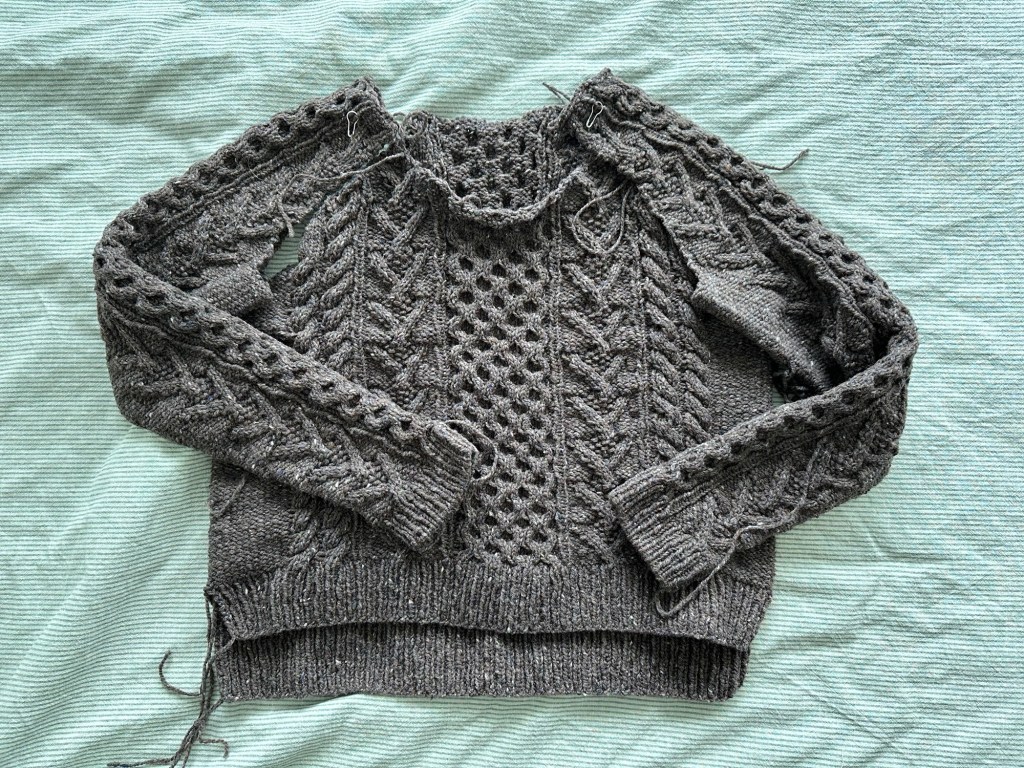
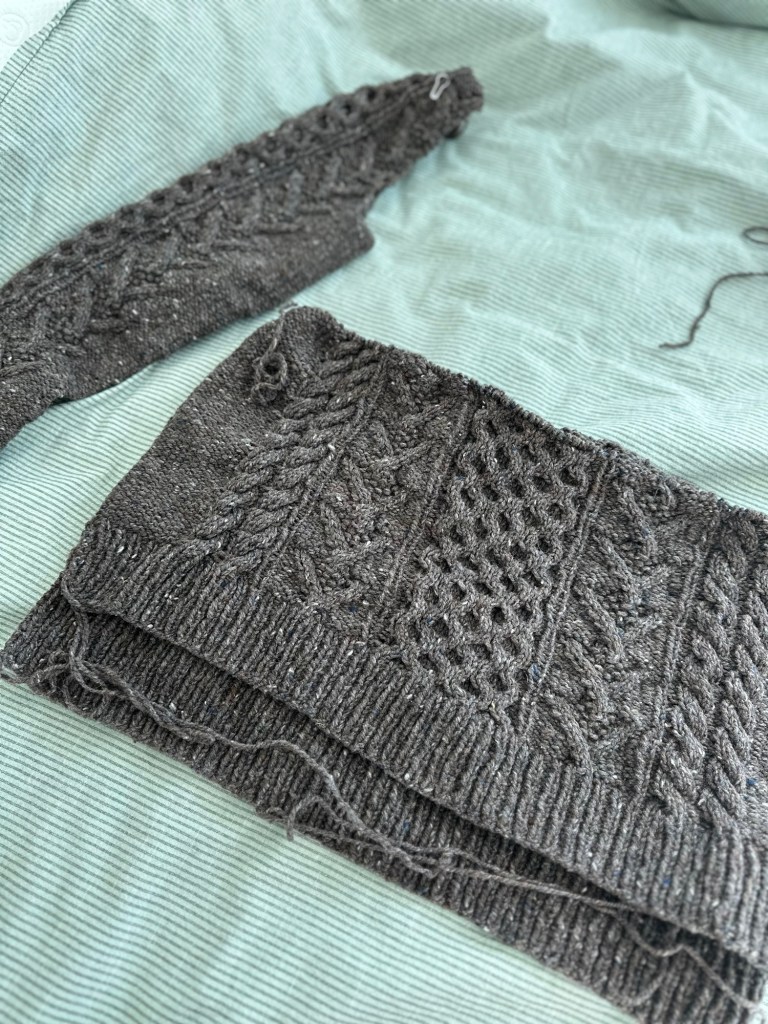
    I realized that I could combine two of my great loves: knitting and reading. And this realization gave me the boost I needed to pick up another project I’ve had frogged for a while: the Bronwyn pullover, a cable-knit beauty. Perhaps I’ll get her done before my trip to Maine.

    I started this project in the winter of 2020! Let’s see if I can finish it in the next few weeks.

    Which leaves me to search for my next audiobook companion. Are any of you audiobook listeners? Do you have any audiobooks that you’d recommend (ideally fiction, though I have loved listening to some nonfiction read by the author)? Or, have you read a book recently that you couldn’t put down and think would read well in audiobook format?

  • Short Scene at the Airport

    “Is she for real?” A guy behind me asks in disbelief to his friend.

    A teenaged girl has just let her two rolling suitcases go flying down the escalators at LaGuardia Airport.

    All of us look up at the sound of the plastic rubbing against the moving stairs at whip-fast speed, a loud “ZZZZZIP!” echoing through the terminal.

    A flight crew member gets there in time to stop the suitcases from flying further on the tile floor and hitting anyone. The girl runs down after them, her hands covering her nose and mouth in shame. Her mom and, I assume, sister, look down from further up the escalator.

    She’s very lucky no one was ahead of her. It’s still unclear if she purposefully tried to slide them down or if it was an accident.

    Phoebe remained unfazed
  • Full Circle

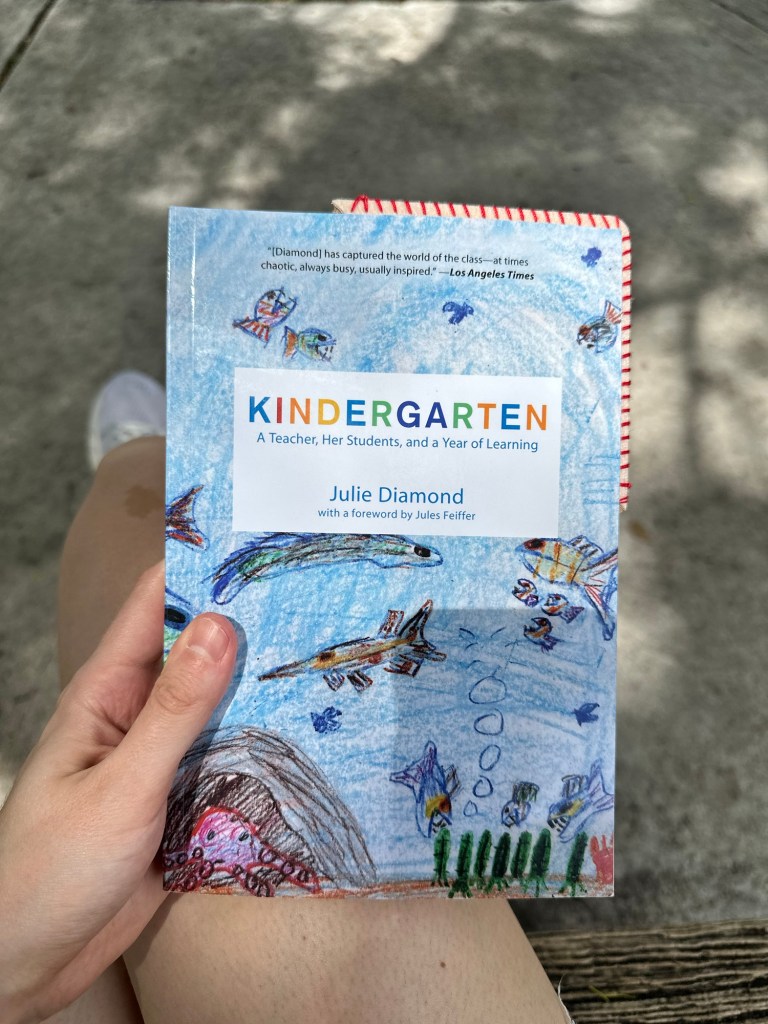
    In May, a post on the TWT blog caught my eye, as it started by quoting a teacher, Julie Diamond, from her book, Kindergarten: A Teacher, Her Students, and a Year of Learning.

    Wait a second, I thought. Julie Diamond? Could it be that Julie Diamond?

    Sure enough, when I googled the book and the author, up popped my own kindergarten teacher from decades ago, with her short, gray, cropped hair. I immediately ordered the book from Amazon and patiently awaited its arrival.

    On Wednesday, I went to a dog park with Phoebe while P taught a private soccer session, and began reading.

    The gorgeous cover with Estelle’s bookmark gift peeking out.

    I couldn’t put it down. I read, wishing I’d brought a pencil to underline and take notes in the margins. I reluctantly dog-eared the pages, swearing I’d unfold them as soon as I got home and write the notes I’d been meaning to (which I did).

    In a serendipitous way, I discovered, through reading Julie’s words, that my first elementary school teacher had a teaching philosophy truly aligned with my own. Progressive, project-based, child-centered, Reggio-inspired.

    How much of my educational career, both as a student and now as a teacher, can I attribute to that first year of my schooling at PS 87 under her tutelage?

    As Julie explains how she (and you, the teacher-reader can) truly listens to children and lets them guide their own learning, providing practical advice for setting up and running a classroom, I find myself affirmed, inspired, and impassioned. I am a sponge, soaking up as much teaching as she has left to share with me, some 28 years later.

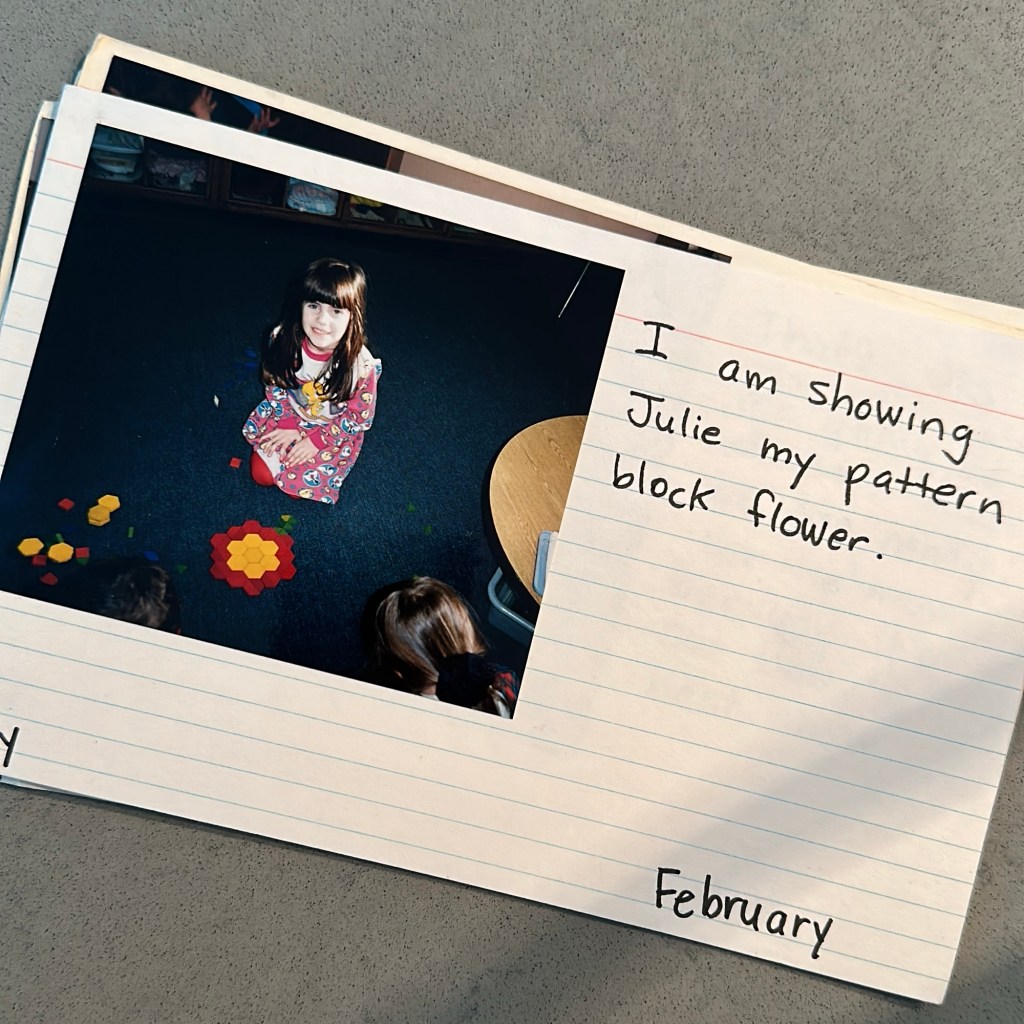
    Kindergarten me

    I feel more excited about heading back to work in August than I have been in years, and I’m curious about setting an intention to write about the upcoming school year: “a teacher, her students, and a year of learning.” What a beautiful idea.

    Perhaps the SOL community is a good starting place to hold me accountable.

  • Anxious Children

    In my last eight years of teaching, I’ve seen more and more children with anxiety: about tests, about friendships, about anything. This has been heartbreaking, as I understand what it feels like—I struggle with significant anxiety myself—and I hate to think about my students going through that so young.

    For a long time now, I haven’t thought that I had anxiety at a young age. Surely not. I certainly didn’t know the term. Maybe I’d heard someone say they were feeling “anxious” about something, but more likely it was “nervous” or “stressed” (and even that came later, and was much of what I thought anxiety was for a while).

    But this afternoon, I saw Inside Out 2, and now I’m not so sure. Perhaps I did have anxiety all along. (Warning: Potential spoilers ahead, so if you’re hoping to see the movie without knowing much about it, I’d recommend you stop here!)

    “My job is to keep her safe from things she can’t see,” the character of Anxiety says when she meets Riley’s other emotions. Anxiety is there to help Riley prepare for the future. In this case, going to high school, trying out for the ice hockey team, and navigating new friendships.

    The trigger for all the new emotions is, of course, puberty — there’s a hilarious demolition and renovation scene where the workers take a break and just leave it as is, a mess, which is exactly what is happening in the brains of our fifth graders.

    Throughout the film, there were moments that I recognized and could relate deeply to: imagining way too many possible future scenarios, catastrophizing in the middle of the night, panic attacks. Some of those moments were affirming to watch, while some were challenging.

    After Riley’s panic attack at the film’s climax, Anxiety cries: “I was just trying to protect her!” A worthy intention, but one that causes so much strife and difficulty in the lives of those of us who struggle with it, particularly when it takes center stage, just as Anxiety takes over the central console in Riley’s brain for the majority of the film.

    Anxiety is a natural part of us, but one that’s useful in small doses. I’m still trying to figure out for myself how to make that the reality, developing the necessary skills.

    I’m hopeful that films like this one, and teaching approaches like the one we employ in our classroom, will help children to develop those skills earlier.

    I’m crossing my fingers that Inside Out 2 makes it to streaming by September so we can watch it with our students and use it as a launching pad for social emotional learning. I have so many ideas already.

  • Brain Storm

    Today it rained.

    It wasn’t a passing storm like the ones typical of Miami in the wet season, but a full-day downpour, gray and dreary. The streets flooded as they tend to do in this city. Our shoes got wet, as did the pup’s paws. The umbrellas are open and drying in the tub.

    It wasn’t a random rain like that one a month ago on a Tuesday, when they told us to go home early, and we didn’t have umbrellas. We ran, giggling, with our bags over our heads. We arrived home soaked, threw our clothes directly in the washing machine, grins plastered to our faces.

    Today’s rain was the type that coats everything in its gloom. The type where you can’t tell what time it is because the sky has held the same overcast shade all day.

    Today’s rain almost made me miss this slice — my brain storming with thoughts, none of them worth writing — but I showed up.

  • One Of My Favorites

    S has been extra affectionate these last few weeks of school, and even more so in these final days.

    “I can’t believe I’m graduating,” she says, sidling up next to me and laying her head on my shoulder.

    “You mean, ‘I can’t believe I graduated,’” I reply, reminding her through verb conjugation that graduation was last Friday.

    “Ms. Amy, stop!” She whines, lifting her head. Then she lays it back down. “I’m really going to miss you.”

    “I’m going to miss you too, S!” I say, giving her a squeeze.

    S always asks if she’s my favorite, and I always tell her I don’t have any favorites, but the truth is, I do, and she is definitely one of them.

    I never have just one favorite student though. Each week or so, I go through a phase of being absolutely obsessed with one of them. It usually aligns with the relationship getting stronger, with the student feeling more at ease with me, and thus me with them.

    S has been on that list for a while now though. Her dad reminds me of an uncle or family friend, and their closeness reminds me of my own with my dad. She’s bright, has a truly hilarious sense of humor, and in the last few months has been spouting wise sayings at random moments.

    For example, during the week we had sex ed, one of the days we learned about the layers of the pre-teen/early adolescent “relationship cake”: friendship, emotional connectedness, nonsexual physical intimacy, and shared meaning. When asked why these layers mattered, S replied: “Because you need to get to know someone really well before you decide to get in a relationship with them. Otherwise you have to find all that out later, and what if it doesn’t align? What if they’re toxic? Know your self worth, then your boundaries! You can’t give your heart to someone without knowing if they’re going to break it!”

    All of us stared. Was this an 11-year-old or a 40-year-old?

    “PREACH, S!” Kim and I chanted.

    Last week, she recorded a video manifesting my future in 10 years. It involved she and I reconnecting because I was writing books and she was reading them. I hope there’s some truth in that future she imagined for me, because it seems pretty damn lovely!

    Tomorrow’s our last day with them, and even though my head is pounding, my voice is fading, and I’m just barely able to open my eyes in the morning, I know the truth is that I am going to miss them.

    I’m certainly going to miss S.

  • The Joy of Writing Mentor Texts

    It’s my fifth year teaching fifth grade, and my third year teaching Writer’s Workshop to fifth graders. Last fall, I was excited to attend an online session with Hareem A Khan and Eric Hand for their new Graphic Novels unit for Grades 4-6. I was blown away by the work they did and immediately pre-ordered the unit. When it came in the spring, I eagerly launched into teaching it, knowing my student writers would love it.

    Last year, though, we were only able to do the first bend, as it was close to the end of the year and we had limited time. Instead of writing my own mentor text, I based mine off of Hareem’s, which is great, as it worked for all of the mini-lessons, but it wasn’t my own. I didn’t have to actually go through the writing process of generating an idea, bookmapping, considering panels as I sketched my thumbnails, or really working on my cartooning skills either when drafting. I didn’t have (or get) to experience the time-consuming yet rewarding process of creating my own short graphic novel. Until this year.

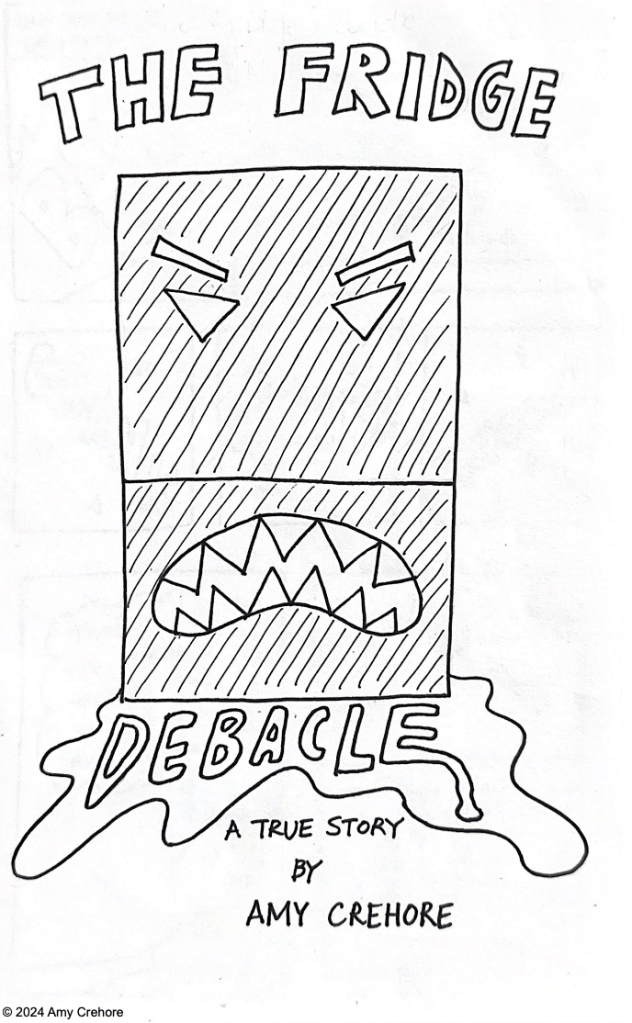
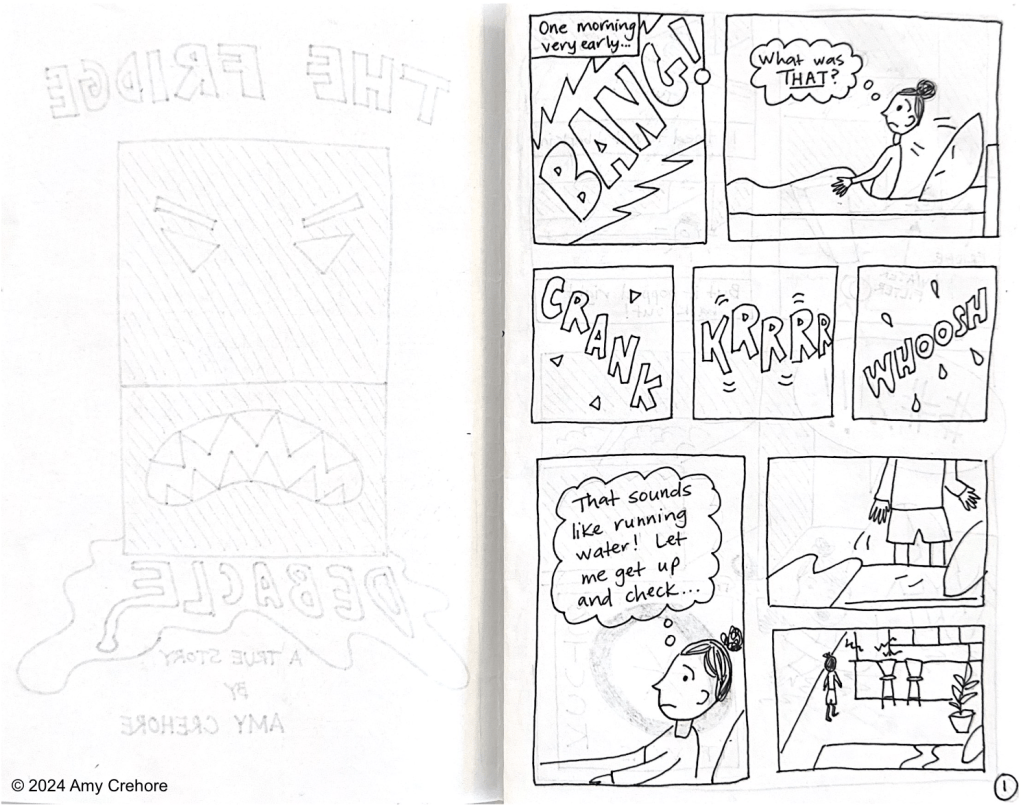
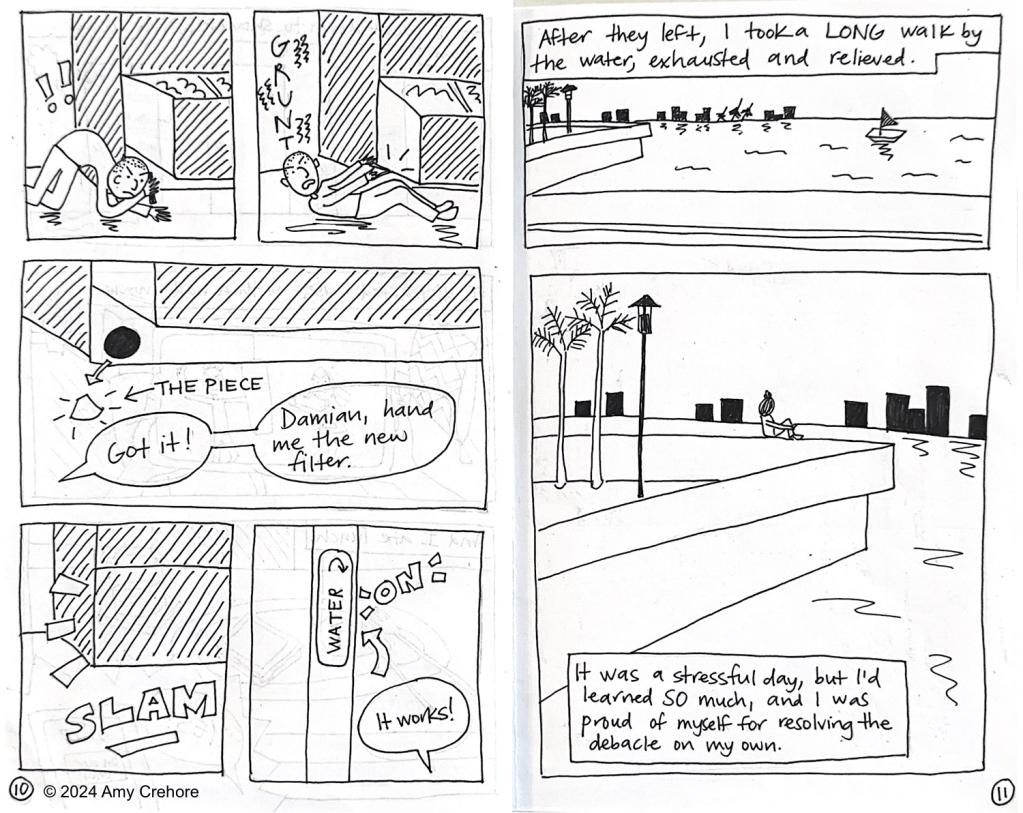
    This year, we had enough time to teach the full unit. I didn’t reinvent the wheel with the first bend, so I still used my Hareem-inspired graphic novel for that. For Bend II, in which the children write graphic memoirs, I knew I wanted to challenge myself to create my own, and I knew exactly the small moment I wanted to use for it: the fridge debacle.

    Throughout the unit, Kim has remarked over and over again how incredible it is to watch the writers’ engagement in this medium. As graphic novel lovers, they thrived (with only a few gripes here and there of “I’m no good at drawing!” — but once they realized they could get away with stick figures, it was full steam ahead). And for me, as someone who enjoys doodling herself, I was thrilled to be working in the new medium as well. I even enjoyed students’ feedback for revisions during mini-lessons, such as the lesson where I modeled how to build suspense by deciding on the number of tiers and panels within each tier. I revised an original thumbnail of 3 tiers, 2 panels per tier, to 3 tiers, one panel per tier, because as R suggested, it would be much more impactful: dun, dun, DUN! Or when E remarked that I could start the story right at the loud noise waking me up, and flashback to the preceding trouble later on.

    And the result has been so much more rewarding than creating a mentor text that I can use for future teaching: I used writing and cartooning to create art out of one of the more annoying and stressful moments of my adult life. It took lots of time, stolen at lunch, or while the children were reading or writing or taking a math test, or at home while I watched Netflix. The joy of sharing this piece with my students who have followed along and assisted me in the process has been so special, as has sharing it with my friends and family who experienced the debacle alongside me.

    I present to you, The Fridge Debacle:

  • Swifties

    “Ms. Amy!” N calls during indoor recess. I’m sitting at my desk, working on our literacy power standards document. She’s in the mini-atelier of our class with some of her classmates, listening to music and drawing.

    “We forgot to give you this!”

    She hands me a big sheet of paper:

    “I love it!!” I exclaim as I sing the lyrics aloud. “But what’s this blank space??”

    Before she can respond, I’m already singing: “Cause I’ve got a blank space, baby, and I’ll write your name!”

    She laughs and tells me she was going to say the same thing.

  • Empathy

    Eva’s empathy illustration: “Hold on, I’m coming”

    Today, my empathy got the best of me. I was distracted all day by thoughts of Kim and her father, my heart reaching out to them in Boynton Beach, sending strength and resilience. Wishing I could squeeze her hand and make her smile like she has made me on my lowest days.

    The children were loud and weren’t being good listeners. It’s May, I should expect this by now.

    But last week was a strange, magical blip. Every afternoon as Kim and I walked home, we’d say to each other, “it’s been such a good week,” almost tentatively, scared we’d jinx it. Today was a day I was sure we had jinxed it. Yesterday they were in EP classes all day, so it figured that at the end of the day they’d be a mess. But today, it was a battle from the morning.

    I remember Lina’s teachings about confirmation bias. If we expect them to behave a certain way, they will behave a certain way. Their behavior will confirm the bias that we have.

    So I am asking myself: Tomorrow, how can I be more empathetic to them?

    There are only 14 days left of classes. 3 of those are our celebratory “blast off week” after graduation, and one of those is actual graduation. So really, there are only 10 days left of classes. The students must be buzzing with excitement and sadness and worry. On Thursday, during community time, I’ll ask them to share all their feelings about middle school and this upcoming transition. Tomorrow, I’ll show up believing they can be those same fifth graders we’ve learned to love in spite of their crazy this year.

    I’ll try to emulate Kim, and always see the positive in every situation, no matter how dire it seems on the surface. I’ll laugh it off and focus on the good. I’ll lead with love and kindness.

    Kim always says how much I’ve taught her this year, but she forgets that the teaching goes both ways. I have learned so much from her about life and relationships and perspective. And most importantly, I’ve gained a lifelong friend, one who not only climbs into the pit to sit with you when you’re down, but throws a rope down to help pull you out.

    We can do hard things.

  • The Best Read Aloud

    The Best Read Aloud

    Tension building.

    Students leaning forward from their seats or the rug.

    Shocked, grinning faces.

    Squeals and screams.

    “Shh, stop, you guys! Let her keep reading!!”

    That was how today’s read aloud session went.

    It was almost exactly a month ago that we said “Take Two” and sat down with Ana to rethink interactive read aloud for our classroom. We took what we’d done before and tweaked it for our students’ needs, then tweaked it again to fit our planning. We revised our main anchor chart twice.

    The result has been the most engaging read aloud this year, all culminating in today’s session.

    We read the triple climax of Ellie’s story in Starfish by Lisa Fipps: ripping up her “Fat Girl Rules,” speaking up to her mom after exploding in the doctor’s office, and standing up to her bullies. The kids were clapping, cheering, and yelling out, “Slaaaay, Ellie!” and “She’s so sigma!” (a Gen Z slang word whose meaning is still fuzzy for me).

    We hardly had time for conversation or turn-and-talks, and we didn’t need them — the interaction was evident. Our students know Ellie so well by this point. They hate her enemies and they cheer for her newfound confidence and bravery. They see connections in their own lives and are learning to put some of that understanding into action.

    It’s Teacher Appreciation Day (and Week), and today I’m grateful to Kim for spearheading the comprehension planning across this book and being always willing to try new things with me, no matter what time of year; to Ana for making time in her way-too-busy schedule to have a brainstorming meeting with us; and to Gianna for her book club plans (because that’s how our day ended, and it was beautiful).

    Today was one of the best days, and I couldn’t have done it without my teacher team.