Writing With Abandon

Reflections and ramblings about life as an educator, writer, reader, knitter, and over-thinker. Trying to do the writing only I can do.

Category: Uncategorized

  • Ramblings on Memoir

    As a middle schooler, I wrote stories about fictional characters, manifesting events that I hoped would unfold in my life (I remember one specifically about a girl who goes to a lake in the summer with friends, her crush telling her he liked her, them sharing a kiss on a boat one afternoon). I wrote fiction because I didn’t know how to write about my life other than writing in my diary. I had file after file of stories on my eMac computer, most lacking endings. 

    In high school, a few of my teachers had us write stories in the style of an author, which was my favorite way to show my understanding of a novel (like writing a “grotesque” a la Winesburg, Ohio by Sherwood Anderson, or writing in the style of Virginia Woolf in Mrs. Dalloway, the sentences verging on run-ons, lyrical and open). One teacher had us write page 200-something of our life memoir. I wrote about taking the crosstown bus to see my sister and meet my niece/nephew for the first time. 

    My friends and I became obsessed with freewriting after our teacher, Annie Thoms, had us get in the habit at the beginning of her writing workshop each day: set the timer, 10 minutes, only one rule — Don’t. Stop. Writing. Gemma would message me prompts on iChat in the evenings, a spattering of seemingly disconnected words — rose, schoolbus, blood, feather, bag of chips — and I would give her one in return — water bottle, field, purse, knife, lamp. We’d set our timers and see what would come out.

    In college, I went to school for creative writing and literature, thinking I’d write the Next Great American Novel. What I found was that I was much more interested in writing creative nonfiction than anything else. In my fiction classes, I’d end up writing memoirs thinly disguised as stories, and I wouldn’t get away with it. 

    “The craft is good,” my fiction professor would tell me when it was my turn for feedback, “but it doesn’t read as fiction.”

    I was lucky to take a class with professor and writer Kirsten Lunstrum, who encouraged my genre-bending and personal narrative writing. The first personal essay I wrote for her seemed to climb its way out of me, my fingers racing across the keyboard as I hurried to catch it all. I later took an independent study with her where I practiced more memoir writing and dipped my toes into fiction in a safe, brave space. But she left before my senior year, and I never got the mentorship — nor had the confidence — I felt I needed to finish with a strong creative writing project. I set aside my 30-page personal essay about me, my sister, and my mom, and focused on my literature thesis. I dropped the final required creative writing seminar and graduated without the double major. 

    I carry a lot of shame around that decision. 

    What was wrong with me that I couldn’t write actual fiction? What was wrong with the other creative writing professors that they couldn’t see the value in memoir? 

    I didn’t feel “good enough,” whatever that meant. And I stopped writing, for a long time. I’d come back to it in spurts, as the files on my computer prove to me:

    • STARTING MAY 2013
    • Starting oct 2017
    • One file from 2019 in a folder titled simply: “ramblings”
    • Three files in a folder titled “2020 Writings”

    But mostly, I let it slip away until I started teaching writer’s workshop in August 2021.

    Two weekends ago, Ana and I met up to record a few podcast episodes and go on our first writing date for a while at Books and Books. We ate delicious sandwiches, I purchased some books and a new notebook, and then we set out to write. I opened up my laptop to the fictional story I had started a few days earlier (my “novel,” I was calling it — no name, no real direction, just a feeling). I typed a few sentences and then felt it creeping up: the imposter syndrome. The “not good enough.” The you-don’t-even-know-how-to-write-a-short-story-so-why-would-you-try-a-novel? The if-you-can’t-write-a-fictional-story-are-you-even-a-writer-at-all?

    “I’m just going to read,” I told Ana, my cheeks flushed. Her fingers were racing across the keyboard, clacking away as she typed at a story that had materialized in her mind, big magic blooming.

    I opened up Refuse to Be Done by Matt Bell, finding comfort in his encouraging words: “Start writing, and the draft will come.” 

    Later, I found discomfort in a podcast episode Ana sent me — a man telling his listeners that before you write it, your novel needs to have an elevator pitch, otherwise it’s probably not a very good one. He had some good advice, but most of it was lost in a sea of other advice that made me feel very, very small.

    “I don’t have an elevator pitch,” I told her. “I don’t know what my novel is about.” 

    I didn’t write for a week. 

    Then, a few days ago, I opened up the other book I’d purchased: Body Work: The Radical Power of Personal Narrative by Melissa Febos, a writer who had taught at my college the year before I arrived. My friend Bob always told me I would have loved her classes. 

    And her words lit something up in me. 

    “But my own story wouldn’t leave me alone,” she writes in the first chapter. “It called to me the way I have since come to recognize is the call of my best stories, the ones that most need to be told. So I wrote it” (Body Work 7).

    I could feel again the sensation of that first story I wrote for Kirsten’s class, how it nagged at me until I got it out, how it flew out of me effortlessly. I know writing does not always come that easily — trust me, I do. 

    But I also know what it feels like to have a story that won’t leave me alone. And for me, that’s never been fiction. 

  • A List Poem

    Things on my mind:

    how many fungus gnats will be on the yellow sticky traps today

    why the copy machine on the 4th floor struggles so hard to print on card stock

    my lack of a plan for dinner tonight and how I’d better figure something out before Emily comes over

    why Phoebe insists on barking every time someone is in the hallway

    why my upstairs neighbor insists on playing his DJ music so loudly that it vibrates our ceiling and makes me feel like I’m “in da clurb”

    the overnight trip on Thursday and Friday

    making sure I’m fully packed for the overnight trip on Thursday and Friday

    feeling untethered

    but holding onto faith

    the students of mine who want to try a month without their phones or tablets

    the fact that I don’t know if I could survive a month without my phone or tablet

    the fact that it’s not that I don’t know if I could, it’s that our society is designed in such a way that if I went a month without my phone, I’d probably run into some trouble

    the vlogs that my students recorded this afternoon

    “What is UP, y’all?”

    “Hey guys, welcome back to my channel.”

    as though they’d been doing it forever

    our podcast and how we managed to record another episode in less than 10 minutes

    (“I couldn’t do this with anyone else,” Ana said, and I agreed)

    what the F is going on in Yellowjackets and how I just want to rot into the couch and binge watch it

    how I can’t just rot into the couch and binge watch it yet because I need to finish this slice and figure out dinner before Emily gets here

    the fact that I don’t know how to end a list poem

    but the other fact that this ending will have to do

  • My Writing Partner

    My writing partner’s laugh bursts out of her like a fizzy soda. When she’s really cracking up, she’ll grab your thigh and give you a look through teary eyes as the laughter bubbles up.

    “I have the idea for our first episode!!!” she texts me at 12:45pm on Sunday. “Let’s talk about James Clear’s tips for starting and keeping a writing habit.”

    She shares a document with the tips already outlined.

    My writing partner is always prepared.

    I scroll down to the second page and see the list of episode ideas we wrote down on another Sunday: October 1st, 2023. I went over that night for dinner, wine, a reader’s workshop planning session (no judging), and to discuss our dreams of a podcast.

    It kind of started as a joke, but my writing partner bought microphones the first time the idea came up. See? I told you she’s always prepared.

    We never met again to record anything, except the Thursday before spring break. We gathered in my classroom to give a mini-lesson on generating slice ideas with our colleagues who were participating in the SOL challenge. Those who weren’t able to make it begged us to record, so my writing partner started a voice memo, recorded the 17-minute conversation, and sent it to the WhatsApp group afterwards.

    “I felt like I was listening to a podcast,” one of the teachers wrote.

    And so the spark was rekindled.

    “Are we starting tomorrow??” I text my writing partner back at 2:17pm.

    “Let’s do it!!!” she replies.

    At 8:47pm she asks what I have planned while my students are in PE.

    I tell her nothing, but that it is our only break that day, so I’m not sure where my head will be or what unexpected to-do’s will pop up.

    But by the time 2 o’clock rolls around on Monday, I have nothing to prep and no desire to sit in my classroom, where I’ve been all day.

    “I’m going to see if Ana’s in her office,” I tell Kim, and I head off in search of my writing partner.

    I find her with Male, discussing schedules for next year.

    “So? Are we doing it?”

    “Well, I might have a meeting with Sophie at 2 because we never confirmed, but let me go check with her,” she says, heading off towards the first grade classroom.

    Male and I share stories of our break, talk triathlons and mile-long ocean swims, the new physical therapy I’m beginning to help tackle the recurring aches in my neck and shoulders.

    My writing partner swings the door open: “She doesn’t need to meet, let’s do it!”

    Male laughs as we head into my writing partner’s office just next door.

    My writing partner opens her computer to the list she shared with me the day before: “I figure we’ll just sort of read each one, and discuss a bit.”

    “I’ll set a timer,” I say, pulling my phone out of my pocket. “Ten minutes?”

    I turn to my writing partner. Her cheeks are red.

    “Are you nervous?” I ask.

    “A little,” she admits, giggling as she swipes through her phone to get to the voice memos app.

    We both laugh.

    “No laughing!”

    My writing partner’s finger is poised over the record button. My thumb hovers over the start timer button.

    We breathe in, and breathe out.

    Click.

    “Okay, so—” my writing partner begins, before we both let out the inevitable laugh. “We’re gonna try not to laugh or giggle too much.”

    And then she just launches in.

    Because my writing partner knows how to lead a damn good mini-lesson.

    And then I join in, because my writing partner makes it so easy.

    And we laugh, but at the right times.

    The conversation flows. We go through the points. We discuss.

    And then the timer goes off, and our first official podcast episode is complete.

    With a squeal, we send it to our SOL group chat, and then laugh and hug each other.

    How lucky I am to have a writing partner like her.

    The photo Male snapped of us after recording our first podcast episode.

    Find us on Spotify or Apple Podcasts. Eek!

    “A Writing Date”
  • Adva: My Hebrew Name

    Two and a half years ago, I went to Israel on taglit — birthright — as a 31-year-old.

    In case you don’t know, birthright is a free trip that many young Jewish people take to Israel. Taglit means “discovery,” and the program’s purpose is to help Jewish young adults aged 18-26 connect with their heritage and culture. Given the age range, it’s also often viewed by some of us in the Jewish community as an opportunity to party, which is one of the reasons I didn’t go at that age. Another was that I didn’t feel comfortable with the idea that I was allowed a free trip to Israel while Palestinian people were being denied their birthright, nor did I feel safe traveling into such a “heated” area. I won’t go further into the very complex politics, but when my best friend moved to Israel in 2018, and later met the love of her life, I knew I needed to visit her. Birthright had recently added trips for ages 27-32, so would allow me to do so on a budget, as I could get over there for free, and extend my stay for the price of a return flight. The original plan was for me to go in summer 2020, but then, you know, covid.

    So it was that in July 2022, I found myself on a coach bus with 30 other Americans and 5 Israelis, driving through the desert south of Jerusalem.

    Our bus group joked that it was “geriatric birthright” — full of the 27- to 32-year-olds that had passed on going in our college years or mid-20s. Most of us were well into our “adulthood,” with jobs and partners, some of us with children. So there wasn’t really a chance that any of us would hook up with an Israeli soldier or make aliyah (immigrate to Israel). A good third of the group were religious, another third were not religious but had a strong cultural Jewish identity, and the rest of us were sort of just along for the ride.

    The day’s plan was to get to the Bedouin tents, where we’d eat dinner and sleep for just a few hours, then wake up while it was still dark and drive to Masada National Park to see the sunrise. After that, we’d head to the Dead Sea, and then it was on to Jerusalem, where we’d spend Shabbat.

    I was interested in getting bat mitzvah-ed while we were there, which was something many half-Jewish people like me did on birthright. My sister had done it when she went after college, so I was interested too, more as a novelty than anything.

    I made my way down the aisle to the front of the bus and tapped one of our trip leaders, Josh, on the shoulder.

    “What’s up?” He asked, turning from the window.

    “I’m interested in getting bat mitzvahed,” I said.

    Becoming bat mitzvah,” he corrected me. “But that’s great! Hold on a sec.” He stood up facing the back of the bus. “Is anyone else interested in becoming a bat or bar mitzvah while we’re in Jerusalem? If so, come see me now.”

    I watched the faces look at Josh, look at me, and look at each other. A few didn’t look at all. After a beat, two others, a girl named Maridon from Salt Lake City and a guy named Jordan from the DC area, walked down the aisle towards us and sat down in the surrounding seats. Maridon had recently converted to Judaism and was quite religious, so this wasn’t just novelty for her. Jordan was half-Jewish like me.

    “There’s no such thing as half-Jewish,” I remember Josh telling me, either during that conversation or during another.

    “Okay,” Josh said as soon as we were all settled. “So this is how it works: I’ll give you each a line from the Torah that you’ll need to recite in Hebrew during the ceremony. I’ll give you the Hebrew, the English translation, and the Hebrew transliteration so you can practice beforehand. Other than that, you’ll need a Hebrew name.”

    Maridon already had hers picked out.

    Jordan’s name already had Hebrew origins.

    Mine? Not so much.

    “Do you have any Hebrew names in your family?” Josh asked.

    “I don’t think so,” I told him, thinking about how my Ashkenazi Jewish family, originally from Russia and Romania, tended to use Yiddish words more than Hebrew. I’d only just learned a couple days before that a kippah was the same thing as a yarmulke.

    “Which of your parents is Jewish?”

    “My mom.”

    “What’s her name?”

    “Carol Jo.”

    He frowned. “Okay, what about her parents?”

    “Harold and Eleanor.”

    The frown grew deeper.

    “Do you have any aunts?”

    “Rae and Billie.”

    Annnnd deeper.

    “Well, you can choose the name of a person from Bible whose story resonates with you,” he suggested. As an agnostic, that wouldn’t work for me. “Or, you can find a Hebrew name that you like the meaning of.” That sounded more like it.

    I headed back to my seat near Daniella, Rachel, and Mai, one of the Israelis with us.

    “Guys, help me figure out a Hebrew name!” I pleaded. “I want it to have a meaning.”

    “What does your name mean?” Mai inquired.

    “Amy means beloved.”

    “That would be Ahava,” she told me.

    “Like the brand?” I asked, thinking of the company that makes lotions and scrubs with Dead Sea salts.

    “Yeah, I see your point,” Mai laughed. “I see you with a cool Hebrew name, something a bit more modern, you know?” She thought for a moment. “What about Gal, like Gal Gadot? It means ocean wave.”

    “I like the meaning, but I kind of want it to start with an A, like Amy.”

    “Hmm,” she pondered again. “Wait! What about Adva? It means little wave, like a ripple. And it’s really modern, not too common.”

    Adva. I turned the word around in my head, tasted it on my tongue. The meaning tugged on my heart, making me think of my career as a teacher, the hundreds of students I’ve had the joy of connecting with.

    “I love it.”

    ***

    Two days ago I sat meditating during therapy, the pulses buzzing in my hands and ears, trying to connect deep within, where the strength of my sensitivity lies.

    My mind cleared, and I saw myself as a pebble in the water, concentric circles rippling out from me to the students, friends, and family in my life, who each had their own circles too.

    I smiled to myself, remembering that I am Amy, but I am Adva, too.

    A small wave, a ripple, radiating ever outwards.

  • On Keeping a Writing Practice

    The 2025 Slice of Life teachers comes towards its end, and I’m thinking about how to maintain this writing practice. I did pretty well last year, slicing almost every Tuesday until the fall.

    Ana and I are texting about how we can get in the habit of writing more. We have been dreaming up our podcast for a couple years already. We might start with a Monday mini-lesson that explores slicing craft moves to encourage our colleagues to keep at it. Short. 10 minutes or less. Just like the mini-lessons we plan for our students.

    I tell her how excited I am for the time that will open up for me after the school year ends. Can I make it a habit to write every day? Creatively write? Not just journal or blog, but really write?

    I dream of writing a middle grade novel.

    Maybe if I write that dream here, text it to Ana, publish it to my blog, it will light a fire underneath me to take the steps to get there. Maybe.

    I dream of writing a middle grade novel that could lend itself to the joys of read aloud or book clubs. That kids see and hear themselves in.

    Whew. Big dreams.

    “Fiction intimidates me so much,” I text Ana. “Especially long form.”

    “Liz would say, ‘set a date with writing and stick to it,’” she replies. “Avoid seeing the length, just start somewhere.”

    She then suggests I get a new notebook solely for that idea that I “can’t get my hands off of.” (You don’t need to tell me twice to get a new notebook, my stationery-loving heart sings!)

    She then reminds me of the writing advice I took notes on from Kelly Yang.

    See, a few weeks ago, the social scientists group watched a video from Kelly Yang for schools about her newest book, Finally Heard, which some of them are reading in their book club (I originally thought of it for read aloud, but decided against it). In the video, Kelly Yang shares some of the brain science behind what makes our devices and these apps so fun and addictive, and she does so in an engaging and hilarious way. At the end, she spends 5 minutes sharing her tips for writing.

    “Do we want to keep watching?” I asked the group.

    A few mumbled no, but others nodded eagerly.

    “Wait, I want to see,” E said. She was accepted to an arts middle school for creative writing.

    I pressed play, pen at the ready to take notes. As I listened and jotted, I realized Kelly wasn’t just sharing tips for writing in general, she was sharing tips for writing a story. A long form story.

    One of my favorite pieces of her advice is how she always writes an outline, but likes to see it as a “trail map.” When you go hiking, you might take the trail suggested, or you might find another way—maybe an easier way, or a more direct way, or a more interesting way. But you at least have that map there to guide you, in case you get lost.

    “Did she say she starts with a character?” Ana asks.

    I text her the picture of my notes along with the word: “Emotion!”

    “Does it ring a bell for you?”

    It does.

    We end our conversation by setting a writing date for next Saturday, at a cute bookstore café.

    I have a new notebook to buy.

  • Nature Walk

    Nature Walk

    Yesterday, we went for a hike at Loblolly Woods Nature Park in Gainesville, FL, a gem in the middle of the small university city. There are no hikes like this in downtown Miami.

    The park has a wider path that is shared with bikers, but we only saw other hikers, alone or with their dogs. At one point, the path turned into a boardwalk.

    The sun dappled through the heavy tree canopy, making it the perfect temperature for our walk. The noise of the cars on the roads disappeared, birdsong and rustling leaves taking its place. We’d missed this.

    We held hands and walked, letting our conversation bounce around effortlessly from more serious topics to silly ones to those inspired by what we saw around us. I truly believe we’ll never run out of things to talk about.

    We followed side paths that branched off from the trail, encountering a pond where we watched two turtles sitting on a small log in the water.

    “Look, there’s another one that just came up for air!” you said.

    I stepped closer, but he didn’t re-emerge.

    Then I noticed the strangest-looking bark pattern I’d ever seen on a log:

    I walked down towards it.

    “Be careful there,” you warned.

    The turtles dropped into the water at the sound of my footsteps rustling on the leaves. I snapped a close-up:

    “What kind of tree is this?”

    The bark looked to me like a topographical map, rivulets running along it. I tried a Google image search this morning but came up with nothing conclusive. A cottonwood tree? A southern live oak?

    We continued walking, stepping into a huge empty basin that looked like it had once housed water, covered in brown and red leaves.

    “This is so cool,” you proclaimed.

    We turned back to the main trail, took another side path down by the creek, and found a bench to sit on as we watched the water burble and heard a tiny bird rustle in the brush behind us. You shared about your Catholic school upbringing and we talked about different styles of behavior management and discipline in schools until our stomachs grumbled.

    We searched for a lunch spot that would allow dogs and discovered a Pan-Asian restaurant sitting at the bottom of a lake. Perfect.

    The food was delicious, too.

    A perfect way to soak up all the nature before we went back to the city.

  • A Night in the Woods

    “Do you want to sleep with the shade up?” Patrick asked after we brushed our teeth and got under the covers.

    We’re staying at a Postcard Cabins getaway in a small cabin with a huge window. As we watched the first episode of Adolescence (I was ready to keep watching; Patrick needs longer to digest each episode of a crime thriller), we kept the shade down for privacy in case any other residents were wandering the woods.

    “I don’t know…” I wavered, a small giggle hiccuping in my chest, tears peaking from the corners of my eyes. “I want to wake up with the sunrise, but…”

    “But what?” He prodded.

    “But I’m afraid there’s going to be someone’s face waiting on the other side!”

    Patrick’s laugh made us both crack up, like two little kids hiding under the covers at a sleepover.

    “Are you really scared?”

    “Yes!!” I squealed, and we laughed more. “Did you put the door lock?”

    “Not yet! Go put it on!”

    “Will it work if there’s an intruder?”

    “It will do its best.”

    “Its best?!” I leapt back into bed, pulling up the covers. I frowned. “Well, luckily, since it’s so quiet here, we’ll hear anyone approaching.”

    “Yeah,” Patrick agreed. “Or will we?”

    Now he was just messing with me.

    “It’s scary to imagine one face at the window,” he said. “But you know what’s funny to imagine?”

    “What?”

    “Many faces at the window.”

    I laughed.

    “Okay, okay,” he hugged me. “You gonna be okay?”

    “Yes,” I laughed again nervously. “I think so.”

    And I was! No intruders, no creepy faces at the window.

    In the morning, when Patrick took Phoebe out, he showed me what a “face in the window” would really look like. We both cracked up again, our laughter silenced by the window’s soundproofing. The cabin is lofted enough off the ground that a head barely reaches!

  • 12 Months of Phoebe

    12 Months of Phoebe

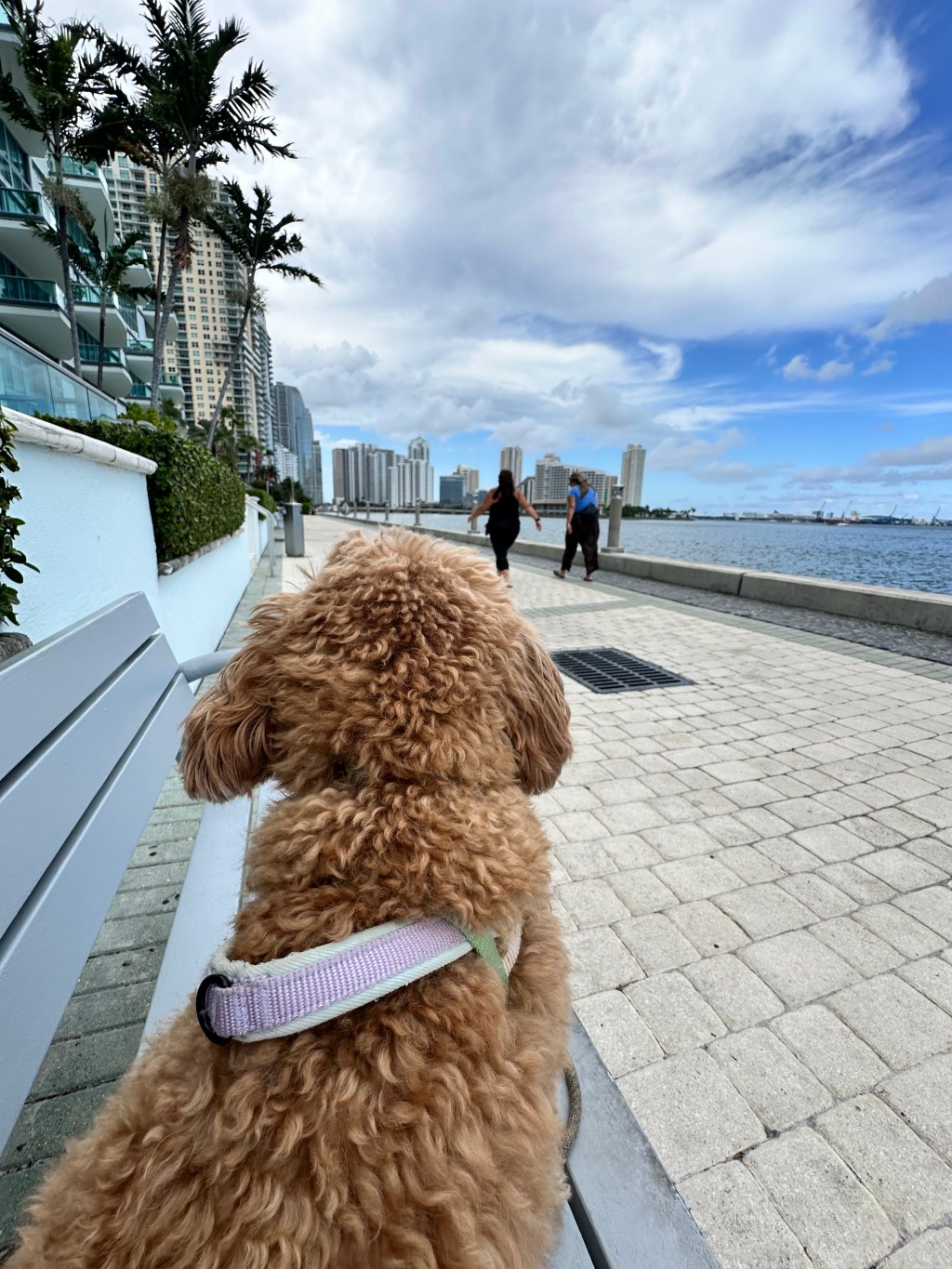
    We always joke that Phoebe got a “glow-up” thanks to me coming into her life: new bed, new toys, and especially, and most noticeably, new haircuts.

    Inspired by Elisabeth from The Dirigible Plum’s A Year in Pictures, featuring her very photogenic cat, Pickles, I wanted to do the same with Phoebe.

    Phoebe is a fluffy toy golden doodle who loves nothing more than to snuggle up on whoever’s closest, lick whatever part of their body she can get her tongue on, and roll over to enjoy the belly rubs.

    When I looked at my camera roll, I found 674 photos of Phoebe—and that’s been edited down! Phoebe’s only been in my life for a year and a half, but she feels like she’s been part of it for way longer. As my dad says, I “finally got the dog I always wanted.” (My childhood dog, Gracie, was the best, but to my dismay, she hated to snuggle.)

    So, I present to you: A Year in Pictures aka 12 Months of Phoebe (plus 2 extra photos on either end). I’ll let you be the one to decide if she’s had a glow-up.

  • 4-4-4

    Today I woke up not too inspired, so I tried the 4-4-4 slice format that I’ve seen at arjeha and Persistence and Pedagogy: 4 minutes to write about 4 things within 4 feet of you. Here’s what I ended up with:

    My silk Drowsy eye mask that I got after going to Cuba with Reeta. She’s always worn an eye mask, but this one was something special. Silk, plush, and no ear straps, aka. no pain. I treated myself to one as soon as I got home, and now wear it every night. It keeps my curls in tact. P jokes about how I wore it on our first sleepover. “Well, goodnight!”

    Hydrocortisone cream on the nightstand because the eczema on my knuckles always acts up when I travel, especially if the weather is different from Miami.

    My kindle with about 9 or 10 library loans on it. Do you know the trick for keeping library loans as long as you’d like on your kindle? If not, I’ll let you in on the secret now: as soon as you deliver the books to your kindle, put it on airplane mode. Then, even when they officially get returned to the library, they’ll remain on your kindle until you read them!

    The blackout shutters, wooden with slats, a typical feature of almost all brownstones in New York. They block out all the light, turning my bedroom here into the perfect cave, pitch black until I’m ready to wake up.

    And there goes the timer! One more minute to reread and clean up, and then I’ll turn on the light and add some photos.

  • Copy Cat

    “Can you help me Tía Amy?”

    My nephew brought his knees up on the bench next to me, propping my mom’s iPad on them as he worked on the Spelling Bee.

    “I’ve already gotten LACE and LICE,” he said proudly.

    I peered at the letter options for the day: C-A-I-L-B-E-Y.

    “Hmmm,” I said, the letters zooming around as they rearranged themselves in my mind. “Do you know how to spell CABLE?”

    He shook his head.

    “Try it. C-A-…”

    He tapped B, then hesitantly the L and the E, looking up at me. I nodded.

    “Yay!” He grinned.

    I pulled open my own NYT Games app, bringing up the Wordle, which is the one I opt to start with every morning. Wordle, then the Mini, then Strands, and finally Connections once Patrick is ready.

    I’m a random-first-word guesser, so I popped in: CABLE.

    Okay, okay, would have preferred some other letters, but not bad!

    “What’s that?” John Henry asked.

    “The Wordle,” I told him.

    “I wanna play Wordle!”

    He opened up the game.

    “Do you know how to play?”

    “Yeah…” he said, unsure.

    “So the yellow means that the letter is correct, but it’s in the wrong place. Green means right letter, right place. Gray means it’s not in the word at all. So see, our word has an E but it’s not at the end.”

    “Got it,” he said, as he typed CABLE in and pressed enter. Doh!

    “Wait!” I laughed. “Don’t guess the same word as me.”

    He looked at me blankly.

    “Now, what’s a 5-letter word with an E in it that doesn’t end with E or include any of the other letters?”

    He brought his hand to his chin. Thinking pose.

    “I want to type for you, Tía,” Emmie said.

    I pulled her up to sit beside me.

    I thought to myself. I always like to guess an S or a T early on. And maybe there’s another E somewhere. The Wordle likes to do that sometimes.

    “Let’s try STEER. Ready? S… T… E… E… R.” I spelled slowly for her as she found the letters on the keyboard.

    Darn it. I hate when you get through the second guess without any new letters. At least we know where the E is.

    Before I could think, John Henry typed STEER in and clicked enter.

    “Johnny!” I said. “You can guess something different than me and we can win faster. See how we each have 6 guesses? If we play together, we’ll actually have 12.”

    (Yes, I am that competitive against myself and Wordle. And yes, I see how playing team-Wordle and team-Connections may be perceived as cheating, but I prefer to see them as two minds are better than one. Plus, I have a 228-day streak that I do not want to give up!)

    “So now we need to think of a word with an E as the fourth letter, and none of these other letters we’ve guessed.”

    “What letters now, Tía?” Emmie asked, impatiently. “Can I hold your phone.

    “Hold on, I’m thinking. And no, I’m gonna keep holding my phone.”

    “Why?”

    My mom came over to help John Henry.

    Maybe… MINED? MOLED? There’s likely an -ED at the end.

    “Okay, Emmie, ready? M… O… W… E… D.”

    Now we’re talking. But if there’s no -ED at the end, nor -ER, what could it be? The S is out of the question. Could it be… a Y? _ODEY? DO_EY? Aha!

    “Emmie, type: D… O… P… E… Y. Yes!”

    “We got it! We got it!” Emmie cheered.

    “Got what?” John Henry looked over. My mom and him were still on guess three.

    “The word is DOPEY,” I said proudly. And yes, this time he could copy it.