Writing With Abandon

Reflections and ramblings about life as an educator, writer, reader, knitter, and over-thinker. Trying to do the writing only I can do.

Category: Uncategorized

  • Day 16: On Hugs

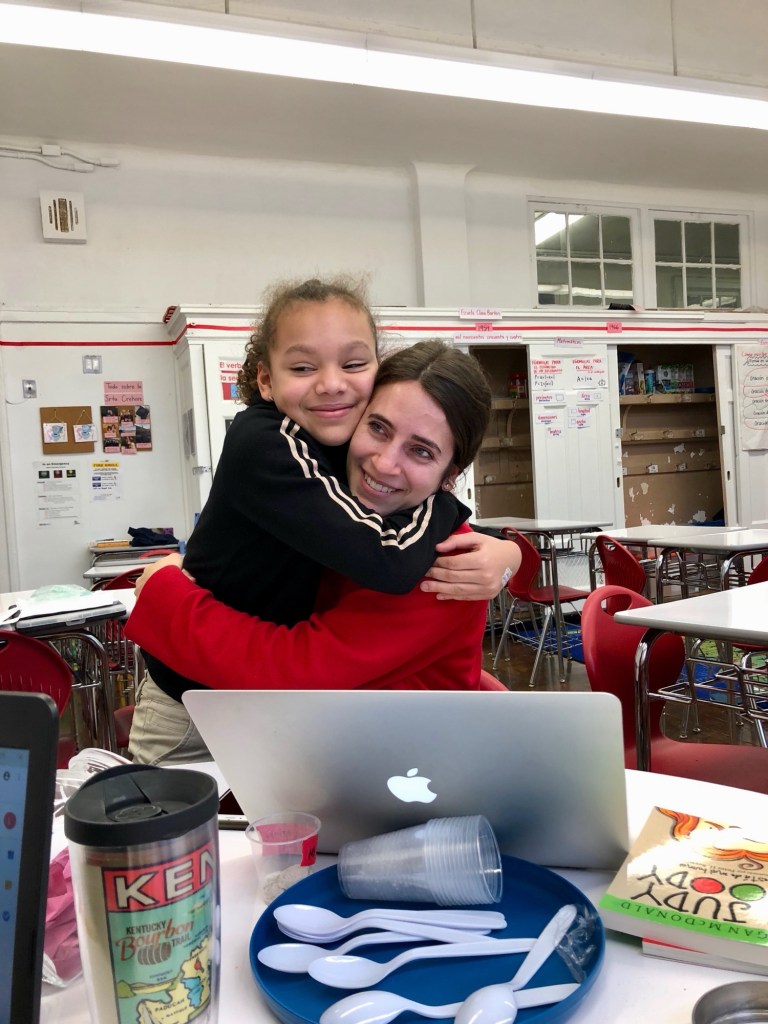
    Me and my student Aleena in a 20-second hug, November 2018.

    In 2003, there was a study that showed “hugging for 20 seconds noticeably reduces blood pressure, heart rate, and stress” (source). This is what Joliette told me one day our first year at Samara. We hugged each other and our students often that year. We were founding the first 4th grade, and I’d go on to found 5th grade with the same group. It was a busy and stressful year, and it was November, around our first parent-teacher conferences, when our energy levels were depleted and we weren’t sure we’d make it to Thanksgiving break.

    I’m thinking about hugs right now as I sit in a park in the shade, letting the breeze cool me off while I type this slice on my phone.

    On Thursday morning when we were getting ready to leave for the overnight, greeting parents and students in the lobby and waiting for the bus, I was suddenly hit with a wave of dizziness. It had happened briefly the night before, but just for a few seconds. This was lasting minutes.

    I figured it was a side effect of an antibiotic I had just started taking, that or my nerves acting up before the big trip. Either way, it freaked me out. If you were following along with me for last year’s challenge, I had a month of unexplained vertigo in March that was pretty frightening. I started to panic — had my vertigo come back? Was I experiencing one of the rare side effects of the antibiotics? Would I faint on the trip and need to be carted off to the emergency room, scarring my students for life?

    I gave Kim a hug and whispered in her ear what was happening, and she told me to take a break in the other lobby, go to the bathroom, and breathe.

    But it didn’t help.

    We loaded up the bus and I managed to keep a brave face until getting on, then I settled into my seat, letting Kim and our other two teacher chaperones take the lead. The kids were distracted with each other in the back. Good. I put on my headphones and pulled up a new mix, got my sunglasses out, and took a deep breath.

    In-two-three-four.

    Out-two-three-four-five-six.

    My fingers tingled and my brain felt too big for my skull. I would calm down enough and then picture another worst case scenario. I was hot and freezing. The bus’s AC was strong, but was it this strong? I stopped being able to tell the difference between the waves of anxiety and the dizziness.

    Kim texted me to see how I was doing and I told her I’d come to try to give her a hug soon, that that’s what I thought I needed. When I got up, she was passing snacks out in the back, and I saw N sitting solo.

    “How are you feeling?” I asked, sliding in next to her. She leaned up against me. She’d been absent on Wednesday, and earlier that morning, her mom had called and explained that she was saying she was sick because she was scared to sleep away from home. We’d encouraged her and told her we’d be there for her the whole time, that all of her friends would miss her terribly. She decided to come.

    “I’m okay,” she mumbled, snuggling up into me.

    We hugged for a long time. I could feel my anxiety melting away. I was still a bit dizzy — so there was definitely a side effect of the medication happening there — but I also felt a sense of “this is gonna be okay.”

    “You know,” I said to N, “I was really nervous about this trip too. I was dreading it actually! 16 fifth graders on an overnight?!”

    N laughed.

    “But I’m so glad we’re going, and this hug is making me feel a LOT better.”

    “Me too,” she said.

    Kim got back then and laughed.

    “Wait, you two look so cute! Let me take a picture.” She snapped it and then mouthed to me, “you do look a bit pale.”

    “I’m better though,” I said. “This hug is what I needed!”

    There’s much more to post about the trip — N actually did get sick. She spiked a fever but was a trooper with Children’s Advil and a big smile. I felt pretty awful all day on Thursday but still had a blast, and luckily have been feeling better (though tired!) since Friday morning — but that’s for a future slice. Today, I’m just grateful for hugs.

  • Day 15: A Bota Bag

    Soria, qué linda eres

    Con tus fiestas San Juaneras

    Con tu sinfín de haceres

    Y tus bonitas mujeres

    Que iluminan la verbena

    It was summer, and I was in my Spanish boyfriend at the time’s pueblo, Soria. I’d been living in Madrid for a year by then, and had visited Soria once before, but I’d never seen it like this.

    In Spain, when a town has their festivals, it’s like it becomes a lawless land. Everyone is partying, everywhere. Streetlights? Who needs them. Stores? Psssshh. Food? Better fill up because you’ll be drinking from the moment you wake. Wine? Oh, tons of it.

    I was reminded of Soria’s San Juan festival last week when L’s mom came in to give a presentation on Spanish inventions. One of the first images she projected on the screen was of a bota bag, or a wineskin.

    “Who knows what this is?” María asked.

    The kids started shouting out answers.

    “A bag!”

    “A pouch?”

    “What is that?”

    “It’s a bag, yes,” María said. “It holds a liquid. Do you know which one?”

    “Water!”

    “Juice!”

    “Wine,” I said. Upon seeing the image, my mind had immediately flashed to the streets of Soria, someone pouring cold red wine into my mouth from above, wiping it from my lips and chin with the back of my hand.

    “No fair, Ms. Amy!” María laughed. She knows I lived in Madrid for 2 years.

    “Woops!” I said, making the sign of zipping my mouth shut. “Ya me callo.

    As she clicked through the rest of the slides, my mind skipped around more moments from that weekend, like a pebble’s ripple across the water: watching townspeople chase a bull in the ring, then all of us climbing down into the arena, wearing party hats and leis; waiting on what felt like the longest line ever for bocadillos, my stomach growling; singing Soria, qué linda eres at the top of our lungs as we walked through the park at night; feeling nauseous from drinking too much, too quickly, a friendly stranger helping me throw up behind a dumpster, gifting me a bottle of water; the men in the street with the bull meat and the bota bags, giving anyone who wished a bite and a swig; wanting desperately to go back to Madrid.

    Even at 23 years old, when I liked to party, the Spanish festivals were too much for me. I remember, laugh, and get back to the presentation.

    **

    This post was inspired by Amanda Potts’ lovely post “Cheesy” about eating raclette for dinner, which takes us on a journey to her first time trying it while studying in France.

  • Day 14: Overnight

    Today we’re taking the 5th graders to the Kennedy Space Center for an overnight trip. About 4 hours north on a charter bus with a stop on the way to stretch our legs and have a snack, check in by 3:30, explore the space center all afternoon and evening, lights out by 10:30, wake up at 6:30, some more morning exploration, and then back in Miami tomorrow by 4pm.

    Maybe it’s the time of year, maybe it’s the behavior lately, maybe it’s the excitement that the kids haven’t been able to contain since they found out about it a month ago, maybe it’s the responsibility of taking sixteen 10- and 11-year-olds four hours from home for a learning experience, yes, but mainly a giant sleepover, but I’ve been pretty much waiting for this trip to be behind us. The dread has been palpable. You can see it on my face and in my body language.

    “I’m a super heavy sleeper,” Z shared at dismissal. “When I’ve slept at M’s house and her phone was beeping, I didn’t wake up at ALL.”

    “Me too,” J chimed in.

    “Ms. Amy, what are you going to do with your hair? Mine looks CRAZY in the mornings,” R had shared at recess earlier.

    “I don’t think I should know about their sleep habits!” I said, exasperated, to Kim and some other coworkers on the elevator back upstairs, to some nervous laughter.

    But then last night as I packed, and this morning as I’m typing this and taking bites of my yogurt and granola, I want to readjust my perspective.

    Let’s be real.

    What are these fifth graders going to remember from their last year in elementary school?

    Not my amazing writing or math lessons. Not the way we transitioned through the halls or our morning routine.

    No. They’re going to remember what happened with their friends at recess and lunch. They’re going to remember the show they put on for their parents this past Monday. And they’re certainly going to remember this overnight field trip.

    So I’m flipping the script. I’m going to try to enjoy myself on this trip and make sure the kids get the most out of it, too. I’m there with 4 other adults (Kim, Male, Christian, and one of our students’ moms). If anything goes haywire, we’ve got it. We have food, we have a first aid kit, we’ve all packed our sleeping bags and blow up sleeping mats.

    All that’s left is to have fun.

  • Day 13: Benington

    Yesterday, after I left early for a doctors appointment, J and E (who were sitting out during PE because of injuries) found a stray tennis ball, drew a face on it, and named it Benington.

    “They told the other kids that he was a new student,” Kim explained this morning. “And it was the perfect example of how rumors get started, because then all of them were asking if we were actually getting a new student.”

    Sometime between yesterday and today, Benington has gained: a bed, a pillow, a blanket, and even a tiny Benington-sized book about his life. There is a poster hanging now in our classroom with a photo of him and the names of all the girls and their relationship to him (because, of course, they adopted him).

    It’s moments like these when I see most clearly how fifth graders live in the hallway between adolescence and childhood. Last week, E was talking about her crush and J was showing off TikTok dances. This week, they’ve become the adoptive parents of a tennis ball!

  • Day 12: Pupusas

    My first two years of teaching, I worked at a public school in Washington Heights. Most days I packed a lunch, but when I was feeling lazy or had run out of groceries, I’d pick up pupusas from La Cabaña Salvadoreña just down the block. Two chicken and cheese pupusas for just $2 each, stacked one on top of the other in a styrofoam box with curtido (a spicy cabbage slaw) and some tomato salsa. Mmm.

    I’m thinking of those pupusas today as I’m home early from work after going to a doctor’s appointment. Trader Joe’s started selling frozen ones, and I heated one up for lunch. It’s not the same, of course, but it triggers my memory and reminds me of those days eating pupusas in the classroom with my first coworkers. It also reminds me of the 5-meal days when we’d have night classes: breakfast at 6, lunch at 10:23 (so random), snack (empanadas, smoothies, wraps) between 2:30 and 4:30, dinner (empanadas, smoothies, wraps?) on break at 6, and another snack after class before bed.

    Sometimes I wonder how I survived those two years in the NYC Teaching Fellows, teaching full time every day and taking classes 2-4 nights a week. But I know it was a combination of my friends and coworkers who were right there doing it with me, pure adrenaline, and tasty, cheap food like those pupusas.

  • Day 11: Ariel

    Almost every morning, without fail, I text with Ariel on WhatsApp as I get ready for my day. She lives 7 hours ahead in Tel Aviv, and has since fall 2019. We lived together for one singular, amazing year in an apartment in Washington Heights, which helped us add to the list of descriptors we give ourselves: best friends, sisters, roomies, wives.

    Ariel and I met as middle schoolers and became friends when I joined her travel soccer team, but our story starts way before that. Our mothers worked together at Avon for a few years before they had us, before Ariel’s very Irish Catholic mom met her very Israeli dad. Years later, they bumped into each other — pregnant! — on the bus. Ariel and I were born 5 days apart. But they wouldn’t see each other again until those soccer tryouts. When her mom and my mom recognized each other, the rest was history. We carpooled with them every Saturday and Sunday to practice and games, belting out Jon Bon Jovi and Celine Dion songs the whole way.

    We went to different high schools and colleges, and then Ariel went to RISD for her masters in architecture while I lived and worked in Madrid. When we both moved back to New York, we were living with our parents.

    On Halloween 2016, while we pregamed before going to my sister’s friend’s rooftop party, Ariel dressed as a cow and me dressed as a farmer, we realized that we could be the solution to our living-at-home-again woes: we’d move in together. We listed all the reasons why living with each other might not work, might ruin our friendship. Then we listed all the weird OCD things that we both agreed must happen in an apartment. When we were listing which chores we preferred and which we didn’t, we were already in it. We’d decided. We’d be roommates.

    Fast forward to this morning. I’m juggling the phone as I go between the bathroom and the kitchen, pull on my socks. She checks hers and replies in stolen moments at work. We text about nothing and everything: annoying things coworkers said, the perfect ringlet that formed in our hair, my doctor’s appointment on Tuesday, travel plans we both have, her ultrasound appointment today. Our conversations always happen in real-time during my mornings before work, and then it’s a bit of phone tag after 4 PM EST when she’s already asleep or heading there.

    But I know, no matter what, that if I send a text when she’s already sleeping, by the time I wake the next morning, the reply will be there, the conversation ready to be picked up where we left off.

  • Day 10: What happened to April 11th?

    “Fall back, spring forward.”

    That’s the line that helps you remember what to do with your clocks on Daylight Savings. Luckily most of our internet-connected devices do it automatically, you just have to remember to change the others (stove, microwave, car, alarm clock, analog watch, am I missing any?).

    The clocks changed this morning at 2 AM, jumping to 3, with all 60 minutes in between — gone. Which has me wondering this afternoon, as I can’t quite figure out what time it is, what happened to that hour?

    It reminded me of Ismo Leikola’s great bit about time differences around the world. How weird it is when we fly from one time zone to another, and how it really hit him when he went from America to New Zealand one time, flying out on April 10th and landing on the 12th.

    “Huh? Excuse me but, what happened to the 11th? I didn’t get to live that one. I don’t think I have lived that day yet, so…” he says, stumbling through his words in this hilarious delivery.

    *

    Today I was looking at pictures of my nephew when he was a baby. Big eyes, funny faces. Staring up at me in wonder. Short videos of me giving him big smooches on the cheeks and him giggling in that adorable way that babies do. I have so many pictures and videos of him from his first couple years of life, when I was living just a block away from my sister, and saw them almost every week.

    Now the photos and videos I see of him are the ones my sister posts online or sends our family group chat. Like the one she sent this week of him practicing his new “party trick” of burping, cracking himself up in the way that 6-year-olds do.

    How did he get from that small nugget who needed to be held, who was strengthening his neck muscles every time he leaned his head back to get a better look at you, to this long and muscular string bean of a kid who chews bubble gum and pulled out wiggly his front tooth and chases girls in the playground?

    Every time I visit home now, I just stare at him in wonder: How much he’s grown. How smart he is. How affectionate he is with his little sister.

    I don’t want to fall back or spring forward, lose a day, gain a day.

    I just want to listen to those third graders and be more present: be here, now. And make an effort to stay more connected, so that the “lost hours” aren’t so apparent.

  • Day 9: Connections

    We do the Connections every morning. 16 seemingly disparate words or phrases in a 4×4 grid, waiting for us to make the connection between them.

    We play Connections after we’ve already gotten the Wordle, and once we’ve solved the Mini Crossword. I play Spelling Bee most days too, though I’m not as obsessed as I was last year with getting Queen Bee (thanks, Steve G from Long Beach!), and I much prefer Connections.

    We only have 4 lives but if we play together we have 8. It’s not a competition. It’s a challenge, the goal being to find all four groups.

    There are always some red herrings. Some too obvious or too out there. The worst is when you lose a life and all the tiles shake, meaning you’re not even “one away.”

    If I solve everything well (the Wordle within 4, the Mini in under a minute, and Connections without losing all of my lives), it means it’s going to be a good day. If it’s a 6-guess day on the Wordle (“phew!”) or, god forbid, a loss of my streak, and I go to work without having Connections solved, I start the day uneasy.

    There’s something I love about having worked out my brain — successfully — before the day begins. As the tagline goes, “A good day starts with play.” And these word games keep our brains sharp, Kim reminds me.

    Today we did the Connections. First we solved the Wordle (I got it in 4), and then the Mini (1:39, it was slightly bigger today). I lost a life with my first guess. But then we saw it. The 4 categories, coming into focus, the pixels sharpening.

    “Ah-a!” That’s the feeling. When you finally see it.

    And so I know (or rather, hope confidently) today is gonna be a good day.

  • Día 8: La importancia de la gratitud

    Hoy a la hora de la despedida, vi a la mamá de una de mis estudiantes. Le llamé para decirle algo sobre el paseo la semana que viene (su hija tiene diabetes, y el paseo es durante la noche, así que ella viene con nosotros).

    —Estás en nuestro grupo, —le dije.

    —Ay gracias, —me respondió, un poquito asustado. —Creí que mi ibas a decir que algo había pasado.

    —No, no, esta semana todo bien con M. La vi jugando con todas las demás chicas, llevándose bien con ellas.

    —Qué bueno, así es como queremos que termine el año.

    Fue en ese momento que me comenzó a decir las palabras que yo no sabía que necesitaba tanto.

    —Estamos tan agradecidos de que M tiene a ti y a Kim este año. De verdad es la mejor manera de terminar su experiencia en KLA.

    —Gracias, S, —dije, el corazón creciendo dentro mi pecho. —Necesitaba escuchar eso después de la semana que hemos pasado.

    —Ay sí, de verdad. Para mi marido, te ama, eres la mejor maestra para M que ha tenido en sus años aquí. De verdad, muchas gracias.

    La abracé. Nos despedimos. Y me fui al otro lado del lobby con lágrimas contentas en los ojos.

    Hoy escribo sobre la importancia de la gratitud. Si eres agradecido por alguien, díselo. Puede cambiar su día.

    It’s been a while since writing in Spanish! But today is Multi-Lingual Friday, so I figured I’d give it a try.

  • Day 7: The Trouble with Eleven-Year-Old Girls

    I’m reading Fleishman is in Trouble by Taffy Brodesser-Akner, and last night when I came across the following lines, I actually laughed out loud:

    Hannah was invited to a sleepover that night. Sleepovers, as far as Toby could tell, consisted of the girls in her class getting together and forming alliances and lobbing microaggressions at each other in an all-night cold war, and they did this voluntarily.

    Fleishman is in Trouble, p. 78

    “This!!” I thought to myself, and made a note to tell Kim about it this morning.

    Hannah is Toby’s daughter, and she’s 11 years old, just like most of our fifth graders by this point in the year.

    Last week we found ourselves mediating conversations between girls, something we’ve been doing since the beginning of the year. Lots of “they said you were saying mean stuff about me” and “well, she said you were saying mean stuff about me” and Kim and I saying, “sounds like you’re all talking about each other to other people instead of to each other.” Later in the week, another student told me that her friend was a “great friend” because “even though she told __ that someone has a crush on him, she didn’t say it was me.”

    During one of our sessions with Lina, our guru from Stop Parenting Alone, Allison asked for advice on the “girl drama” in her class (the fourth grade class breakdown is 17 girls and 6 boys, the opposite of what I had last year).

    “First of all,” Lina explained, “we need to eliminate that phrase from your vocabulary. There is no ‘girl drama.’”

    Instead, we needed to think about how our students are developing their five social emotional competencies:

    • Self-management
    • Self-awareness
    • Social awareness
    • Relationship skills
    • Responsible decision-making

    It’s hard to be a grown-up in an eleven-year-old’s life and watch them struggling with friends or peers, and not want to just jump in and save them, protect them, shake them, make them see that, no, she’s not a great friend if she shares your secret crush WITH your crush! It’s hard because even if we did do those things, they ultimately have to figure it out themselves.

    So what’s our role?

    To guide them. To help them navigate the struggles of fear and disappointment and power. To give voice to a couple of their options, but let them make their own choices and learn from them.

    In the book, Toby proceeds to eavesdrop on Hannah’s sleepover. The “lion king” of the group asks his daughter a would you rather question, naming two boys: “Toby sat frozen at his hallway desk, inside this living nightmare, unable to discern what the stakes were, not knowing how to root for her” (Fleishman is in Trouble, 79). When Hannah chooses wrong, he tries to think of a reason to interrupt the girls, but knows that he can’t, that it will just make his daughter angry.

    This week has been better in terms of our girl-drama-that-we-don’t-call-girl-drama. During indoor recess today, two girls sat drawing together while the other five practiced acrobatic pyramids together (this was actually quite impressive). There were no conflicts, just joy and laughter. I know that’s not how the rest of the year will be, but I’m hopeful. Some of them are learning to navigate the social waters, whether they’re using our help or not, and they’re doing a pretty good job.