“Oh! You would be so proud of me,” I started saying to Ana at dismissal. She herded a child out the front door, wishing them well, and then turned back to me. I took a breath. “I—”
“Stop.” She grabbed my shoulder, cutting me off. “Why do you keep saying I ‘would’ be so proud of you? I am proud of you!”
I struggle sometimes to turn inward and tell myself, Look at you! You rocked it. I’m proud of you. But I’m trying to get better at it, so here we go: I made leaps and bounds in my conferring skills this past unit.
My big goal during this unit on journalism was to know what my students were writing so I could best support them through conferring and small groups. I had dabbled in conferring during the first two units, but felt ill-equipped to actually support my students apart from giving a compliment and moving on, which often felt like I was going, “You’re doing great! Keep it up, byeeee!”
Ana told me that in order to truly plan for conferring and small groups, I needed to know what the heck my students were able to do and what they were still working towards. And I could only do this if I actually read their writing.
So, the day after Thanksgiving break, I requested all students turn in their writer’s notebooks so I could see what was up. Skimming through the stack of notebooks was eye-opening, to say the least. I noticed which students weren’t generating ideas, which students had already written multiple news reports, and which students were still stuck writing what appeared to be narratives (which can happen during a genre switch like this). I did it again a week later, once students had started drafting.
In order to keep track of where students were at, I used a conferring notes document created by Amy Ellerman and outlined in depth in her blog post on Two Writing Teachers. I revised the teaching points at the top to work for my unit, and downsized it so it would fit on one page. Here’s what I ended up with:

This document is GOLD. Ellerman’s pattern-seeking strategy helped me so much, not just to figure out which teaching points I could revisit with which students in a small group, but also with my one-on-one conferring sessions.
With a quick visual of data, aligned to the major teaching points of my unit, I could come to a conference ready to go with both a compliment and a teaching point. This was a game-changer for me, and for my students as well. I believe many of them wrote better articles because I knew where they were at, knew where they still needed to go, and was prepared with supports for them when we met.
However, I did struggle with a couple of students (as we always do!). One of them is Enrique, who basically listened to my suggestions for revisions without implementing any. We had one small group session the day after I took stock of students’ notebooks that ultimately got hijacked by us butting heads (him: “Why do I have to _____” and me: “Because I said so!” Ohhh, shame).
Ana even had a short one-on-one conference with him where she suggested he keep his reader in mind as he drafted and revised, which he replied to with a, “Hm, yeah I’ll think about it.” She looked at me and shrugged.
But then something glorious happened. I had a small group conference with Enrique and his writing partner, Marcelo, who also happens to be his best friend.
As I could see from my conferring notes, neither of them had a lead that included the 5 W’s and H. Enrique was writing about new Disney Plus shows and had really just listed a bunch of items and saved his most important information for last, which was almost the opposite of the structure the students were supposed to be aiming for. Marcelo had written a catchy lead, but it was lacking some details that the reader really needed in order to understand what his article was about.
I started the small group conference with a compliment. I said: “You both generated a great newsworthy idea and are using an officious tone, just like a journalist! I think you are ready to look at the structure of your news reports to see if they follow the inverted pyramid. Let’s start at the top with the lead.”
They both flipped to the mini-anchor charts pasted in their notebooks and reminded themselves of what should go in a strong lead.
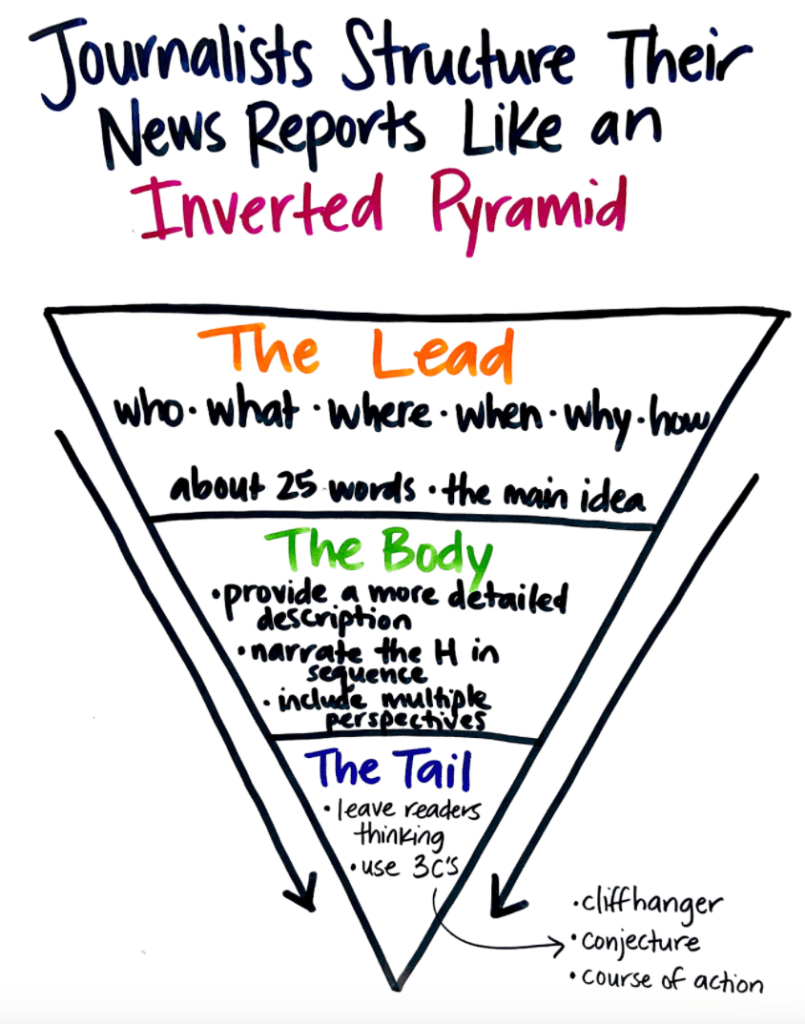
I had them take a highlighter to their drafts and highlight where they saw the 5 W’s and H. I did the same to my mentor article. Both boys realized quickly that their leads were falling short.
So we went back to our strategy from a mini-lesson a couple weeks prior: jot down each of the 5W’s and H and fill them out, then make a sentence or two with all that information. (Note: This strategy is inspired by Judith Hochman’s strategies to help students write complex sentences.) They started filling it out, and that’s when the lightbulb moment happened.
“How do I choose the ‘what’ in my article? There are so many shows!” Enrique asked.
“Maybe it’s the one you’re recommending at the end,” I ventured.
“So, Loki?” Enrique confirmed. He started jotting it down.
“I don’t think the most newsworthy one is Loki,” Marcelo interjected. “I think it’s Hawkeye, since that just came out.”
Enrique paused, thought about it, and then nodded. He erased what he’d written down and wrote: “Hawkeye.”
He filled out the rest of his page with ease.
The two of them then moved on to the body, figuring out they could interview each other to provide alternate perspectives in their articles, and finally onto the tail, both deciding to conclude with a follow-up course of action.
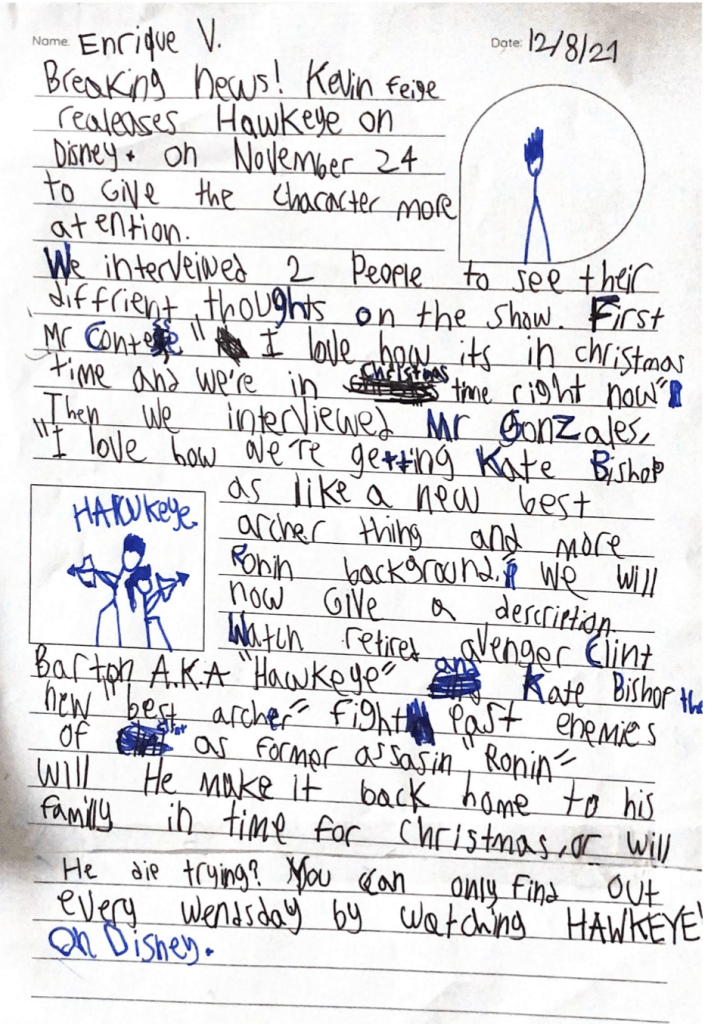
When Enrique showed me his revised article at the end of the independent writing period, it looked nothing like his first few drafts. It was a complete overhaul—a “major surgery” as we often say in our workshop. I gave him a huge hug.
Later that week, when he’d finished his published piece, I sent Ana a scan of his writing, from generating ideas to final product.
“I am SO PROUD OF HIMMMM!” I texted Ana.
I smiled at her reply: “I am SOOO PROUD OF YOUUUUUUUU!”
I guess I am proud of me, too.



 Writing With Abandon
Leave a comment